
The regenerative therapies market represents one of the most transformative frontiers in modern healthcare, shifting treatment paradigms from symptom management to tissue repair, functional restoration, and potential cures. Regenerative therapies encompass cell therapy, gene therapy, tissue engineering, and biomaterial-based solutions that aim to repair, replace, or regenerate damaged cells, tissues, and organs. As healthcare systems globally grapple with the rising burden of chronic and degenerative diseases, regenerative medicine has emerged as a critical solution capable of addressing unmet clinical needs across oncology, orthopedics, neurology, cardiovascular diseases, and autoimmune disorders. The market’s evolution is underpinned by decades of foundational research in stem cell biology and molecular genetics, now converging with scalable manufacturing technologies and clearer regulatory pathways.
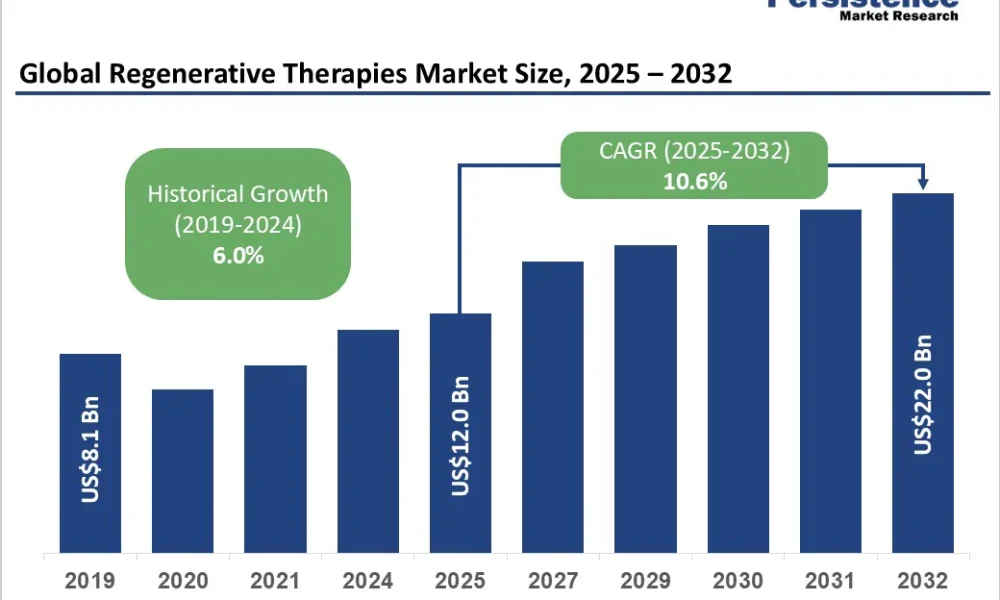
From a market size perspective, the global regenerative therapies market is expected to be valued at approximately US$12.0 billion in 2025 and is projected to reach US$22.0 billion by 2032, expanding at a robust compound annual growth rate (CAGR) of 10.6% during the forecast period. This acceleration reflects a marked improvement over the historical CAGR of 6.0% recorded between 2019 and 2024, highlighting a transition from experimental and early-stage adoption toward commercial maturity. Key growth drivers include the escalating prevalence of chronic diseases, strong venture capital and public-sector funding, technological breakthroughs in gene editing and stem cell processing, and supportive regulatory frameworks such as the U.S. FDA’s Regenerative Medicine Advanced Therapy (RMAT) designation. Cell therapy currently dominates the market with roughly 45% share due to its widespread clinical adoption, while gene therapy stands out as the fastest-growing segment. Geographically, North America leads owing to its advanced healthcare infrastructure and innovation ecosystem, whereas Asia Pacific is emerging as the fastest-growing region due to expanding healthcare investments and regulatory reforms.
Download Your Free Sample & Explore Key Insights: https://www.persistencemarketresearch.com/samples/10598
Key Highlights from the Regenerative Therapies Market Report
• The global regenerative therapies market is projected to grow from US$12.0 billion in 2025 to US$22.0 billion by 2032 at a CAGR of 10.6%.
• Cell therapy accounts for approximately 45% of the total market share, making it the leading therapy type worldwide.
• Gene therapy is the fastest-growing segment, with a projected CAGR exceeding 30% through 2032.
• North America dominates the market with around 45% regional share, driven by regulatory support and high R&D spending.
• Asia Pacific is expected to register the fastest regional growth at nearly 21% CAGR due to expanding healthcare infrastructure.
• Hospitals remain the largest end-user segment, contributing over 55% of total market revenue, while specialty clinics are growing rapidly.
Market Segmentation Analysis
The regenerative therapies market is segmented primarily by therapy type, application, and end-user, each reflecting different maturity levels and growth dynamics within the industry. By therapy type, the market includes cell therapy, gene therapy, and tissue engineering products. Cell therapy remains the cornerstone of the market due to its extensive clinical validation and application breadth, particularly in oncology, musculoskeletal disorders, and cardiovascular diseases. Stem cell-based therapies dominate this segment, supported by a large number of Phase II and Phase III clinical trials and increasing regulatory approvals. Autologous and allogeneic cell therapies are both gaining traction, with allogeneic approaches offering scalability advantages that appeal to commercial stakeholders.
Gene therapy represents a rapidly evolving segment characterized by high innovation intensity and investment inflows. Advances in CRISPR-Cas gene editing, viral vector optimization, and in vivo delivery mechanisms are expanding the scope of gene therapy beyond rare genetic disorders to include oncology, metabolic diseases, and cardiovascular conditions. This segment’s growth is further reinforced by expedited approval pathways and growing payer acceptance for high-value, potentially curative treatments. Tissue engineering, while comparatively smaller in market share, continues to play a vital role in applications such as wound care, orthopedics, and reconstructive surgery, benefiting from innovations in biomaterials and 3D bioprinting technologies.
From an application standpoint, musculoskeletal disorders account for the largest share of the regenerative therapies market. Aging populations and the increasing prevalence of osteoarthritis, spinal injuries, and degenerative bone diseases are fueling demand for cartilage regeneration, bone repair, and soft tissue reconstruction therapies. Oncology is the fastest-growing application area, driven by the success of CAR-T cell therapies and other immuno-oncology approaches that leverage regenerative principles to reprogram the immune system. Additional applications include cardiovascular diseases, neurology, dermatology, and autoimmune disorders, each contributing to market diversification.
End-user segmentation reveals hospitals as the dominant revenue contributors due to their ability to handle complex regenerative procedures, advanced infrastructure, and multidisciplinary clinical teams. Hospitals are central to administering high-acuity treatments such as CAR-T therapies and stem cell transplants. However, specialty clinics are emerging as a high-growth end-user category, particularly for orthopedic, aesthetic, and minimally invasive regenerative procedures. Their growth reflects shifting patient preferences toward outpatient care and the increasing feasibility of delivering regenerative treatments outside traditional hospital settings.
Regional Insights and Market Dynamics
Regional performance in the regenerative therapies market varies significantly, shaped by differences in regulatory frameworks, healthcare spending, research infrastructure, and disease prevalence. North America stands as the largest regional market, accounting for approximately 45% of global revenue. The United States anchors this dominance through strong federal funding, advanced clinical research capabilities, and regulatory initiatives designed to accelerate innovation. Annual investments exceeding US$8 billion in regenerative medicine research have fostered a dynamic ecosystem of academic institutions, biotech startups, and pharmaceutical giants. High chronic disease prevalence and strong reimbursement mechanisms further sustain demand across multiple therapeutic areas.
Europe represents the second-largest regional market, contributing around 25% of global revenue. Countries such as Germany, the United Kingdom, France, and Spain play pivotal roles, supported by robust public healthcare systems and strong academic-industry collaborations. Regulatory harmonization under the European Medicines Agency has improved cross-border market access, although approval timelines tend to be longer than in the United States. Europe’s market growth is steady, driven by orthopedic and cardiovascular applications, as well as sustained public funding for translational research and clinical trials.
Asia Pacific is the fastest-growing regional market, driven by rapid healthcare infrastructure development, favorable manufacturing economics, and expanding patient populations. China leads the region with aggressive government funding, regulatory reforms, and private-sector participation, positioning itself as a global hub for regenerative medicine by 2030. Japan’s long-standing leadership in regenerative research, supported by progressive regulatory policies, further strengthens the region. Emerging markets such as India and Southeast Asian countries are aligning regulatory standards with international norms, facilitating foreign investment and cross-border collaborations. Rising middle-class populations and increasing awareness of advanced therapies are accelerating adoption across the region.
Get Custom Insights Designed for Your Business: https://www.persistencemarketresearch.com/request-customization/10598
Market Drivers
The primary driver of the regenerative therapies market is the rising global prevalence of chronic and degenerative diseases, including cardiovascular disorders, diabetes, cancer, and neurodegenerative conditions. These diseases impose significant long-term healthcare burdens and often lack definitive curative treatments, creating strong demand for regenerative solutions that address underlying pathology rather than symptoms. According to global health data, chronic diseases account for tens of millions of deaths annually, underscoring the urgent need for innovative therapeutic approaches.
Technological advancements also play a central role in market expansion. Breakthroughs in stem cell science, gene editing technologies such as CRISPR, tissue engineering, and biomaterial development have significantly improved the safety, efficacy, and scalability of regenerative products. Advances in manufacturing automation and quality control have reduced production costs and improved consistency, enabling broader commercialization. Additionally, supportive regulatory frameworks and expedited approval pathways have shortened development timelines, encouraging investment and accelerating market entry for novel therapies.
Market Restraints
Despite strong growth prospects, the regenerative therapies market faces notable restraints, primarily related to high treatment and manufacturing costs. Personalized and complex production processes, particularly for autologous cell therapies, contribute to elevated pricing that limits accessibility in cost-sensitive markets. Reimbursement uncertainty further compounds this challenge, as payers grapple with evaluating the long-term value of high-cost, one-time treatments.
Regulatory and ethical challenges also constrain market growth. Variability in regulatory requirements across regions complicates global commercialization strategies and can delay approvals. Ethical concerns surrounding stem cell sourcing and genetic modification necessitate rigorous oversight, increasing compliance costs and extending development timelines. These factors collectively pose barriers to rapid market penetration, particularly in emerging economies.
Market Opportunities
Significant opportunities exist in emerging markets, where expanding healthcare infrastructure and large patient populations present untapped demand. Countries across Asia Pacific are investing heavily in biotechnology and clinical research, offering cost advantages for manufacturing and trials. These regions are poised to contribute substantial incremental revenue to the global market over the next decade.
Additional opportunities arise from the convergence of regenerative medicine with digital technologies such as artificial intelligence, machine learning, and 3D bioprinting. AI-driven drug discovery and predictive analytics can shorten R&D timelines and improve clinical trial success rates, while bioprinting enables customized tissue constructs. Furthermore, addressing underserved niche indications such as rare diseases, spinal cord injuries, and autoimmune disorders offers early-mover advantages and long-term growth potential for innovative companies.
Checkout Now & Download Complete Market Report: https://www.persistencemarketresearch.com/checkout/10598
Company Insights
The regenerative therapies market is moderately consolidated, with leading players focusing on innovation, strategic partnerships, and geographic expansion to strengthen their competitive positions. Key companies operating in the market include:
• Novartis AG
• Pfizer Inc.
• BlueRock Therapeutics
• Athersys, Inc.
• Mesoblast
• Sangamo Therapeutics
• TiGenix
• Celyad Oncology
• Fate Therapeutics
• Orchard Therapeutics
• Regen Lab
• Cook Biotech
Recent developments in the market highlight the pace of innovation and collaboration. In 2025, academic researchers demonstrated the potential of induced pluripotent stem cell-derived neural transplants to restore motor function after stroke, underscoring the therapeutic promise of regenerative neurology. In the same year, international collaborations advanced novel regenerative treatments for multiple sclerosis, moving closer to clinical trials and potential commercialization. Strategic partnerships between hospitals and regenerative medicine providers, particularly in emerging markets, further illustrate expanding clinical adoption and diversification of care delivery models.
Market Segmentation
By Therapy Type
- Cell Therapy
- Gene Therapy
- Tissue Engineering
- Biomaterials
By Application
- Musculoskeletal Disorders
- Oncology
- Cardiovascular Diseases
- Neurology
- Ophthalmology
- Others
By End-user
- Hospitals
- Specialty Clinics
- Academic & Research Institutes
- Commercial & Industrial Sectors
- Government Institutions
By Region
- North America
- Europe
- East Asia
- South Asia & Oceania
- Latin America
- Middle East & Africa
Conclusion
The regenerative therapies market is entering a pivotal phase of growth, driven by rising chronic disease prevalence, rapid technological innovation, and increasingly supportive regulatory environments. With strong momentum across cell and gene therapy segments, expanding clinical applications, and accelerating adoption in emerging regions, the market is poised for sustained expansion through 2032. While challenges related to cost, regulation, and ethical considerations remain, ongoing advances in manufacturing efficiency, policy harmonization, and interdisciplinary collaboration are steadily addressing these barriers. As regenerative medicine continues to redefine therapeutic possibilities, it stands to play a transformative role in the future of global healthcare, offering durable solutions for some of the most complex and pressing medical challenges of our time.




