
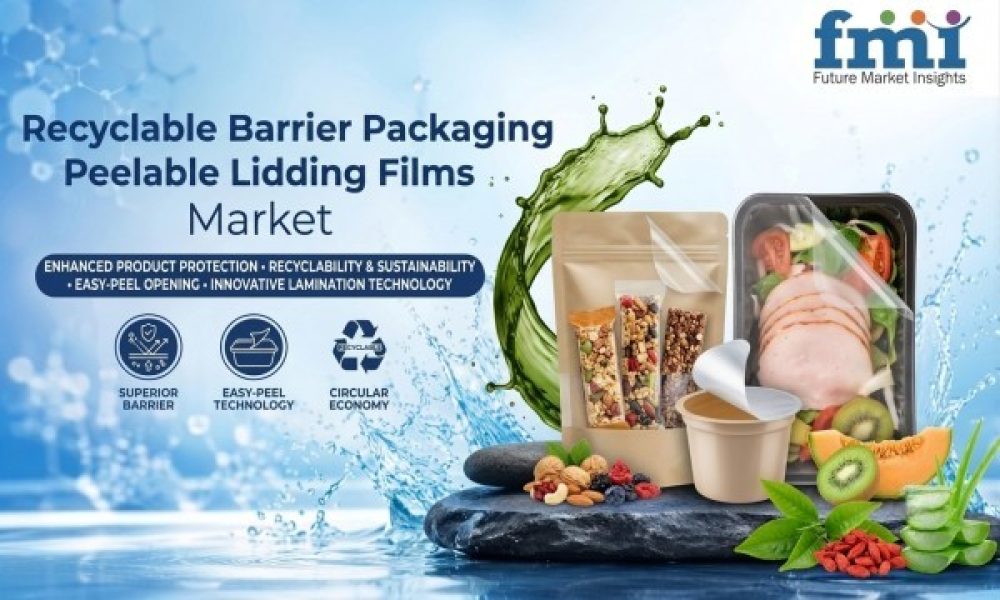
The global recyclable barrier packaging peelable lidding films market is projected to reach USD 120.0 million by 2036, up from USD 50.0 million in 2026, expanding at a 9.1% CAGR during the forecast period, according to Future Market Insights.
The market is gaining attention as packaging manufacturers and food processors work to meet recycling requirements without compromising barrier protection, peel consistency, or production-line reliability. The shift is placing greater emphasis on complete pack validation rather than evaluating recyclable film structures in isolation.
Packaging engineers increasingly need evidence that a lidding film can perform consistently with the selected tray material, flange geometry, sealing temperature, and pressure. This is particularly relevant as Regulation (EU) 2025/40, published in January 2025, applies from August 12, 2026.
Get detailed market forecasts, competitive benchmarking, and pricing trends:
https://www.futuremarketinsights.com/reports/sample/rep-gb-34438
Material Selection Moves Toward Mono-Material PE
Mono-material PE is projected to account for 34.0% of the market in 2026, making it the leading material category in the report. Its position is linked to familiar polyethylene processing routes and simpler material identification across recyclable lidding structures.
Commercial qualification remains a practical consideration. Plant teams need to assess peel force, sealing conditions, line speed, and product contamination under expected production conditions before committing to high-volume supply.
Coveris’ June 2025 MonoFlexBE disclosure, cited in the report, illustrates the industry’s focus on combining recyclable mono-material construction with high-barrier performance.
Pouches and Grease-Resistant Films Hold Important Positions
Pouches are estimated to account for 44.0% share in 2026, supported by flexible dimensions and efficient material use across different fill volumes. Their adoption also benefits from compatibility with existing form-fill-seal equipment.
Grease-resistant films are forecast to capture 38.0% share within the barrier or feature category. Oily products, marinades, and contaminated tray flanges can affect sealing during food production, making consistent sealing performance a practical requirement.
Food remains the largest end-use category, with an estimated 63.0% share in 2026. Chilled foods, protein products, and ready meals require both shelf-life protection and controlled opening behavior, keeping film performance closely tied to the complete packaging system.
Recyclability Assessment Creates New Qualification Requirements
Recyclability assessment rules are influencing material selection and packaging approval. Film developers must consider the effects of barrier layers, inks, labels, and sealants rather than assessing only the primary polymer.
The report identifies incompatible functional layers as a key restraint because they can affect recyclate quality even when the primary film uses a single polymer family.
At the same time, joint development between tray and lidding-film suppliers presents an opportunity. Coordinated trials can identify flange, sealing, and peel constraints earlier, reducing the risk of specification changes during later commercial qualification.
Nandini Roy Choudhury, Principal Consultant at Future Market Insights, said:
“Commercial success depends on a verified tray-film pair instead of an isolated recyclable lidding claim. Packaging teams that combine seal trials with recovery assessment can avoid late specification reversals.”
Regional Growth Shows a Narrow but Meaningful Range
The country-level outlook shows growth across all five profiled markets. The United States records the highest forecast CAGR at 9.4%, followed by the United Kingdom at 9.1%, Germany at 9.0%, France at 8.6%, and Japan at 8.4%.
Regulatory and technical requirements differ across these markets. In the United States, state-level recovery differences can influence recyclability claims. The United Kingdom’s annual methodology for packaging assessment creates another reporting consideration.
Germany’s national minimum standard provides a defined documentation route for packaging design, while France places emphasis on evidence supporting environmental claims. Japan’s packaging sector continues to place importance on material traceability and consistent film quality.
Competitive Landscape
The competitive environment includes integrated packaging groups and specialists with film manufacturing and application-testing capabilities.
Key companies profiled include Amcor, Coveris, SÜDPACK, Winpak, TekniPlex, Constantia Flexibles, Klöckner Pentaplast, and ProAmpac.
Recent developments cited in the report include Amcor’s April 2026 collaboration involving molded-fiber trays with barrier liner and top web, Coveris’ September 2025 introduction of MonoFlexBP, and Winpak’s September 2025 introduction of Medform DT.
Get the Complete Story—Read More About Our Latest Report!
https://www.futuremarketinsights.com/reports/recyclable-barrier-packaging-peelable-lidding-films-market
Report Scope
The report covers the recyclable barrier packaging peelable lidding films market by material, format, barrier or feature, end use, and region. Materials include paper, molded fiber, recycled PET, mono-material PE, and bio-based polymer.
Formats include pouches, trays, labels, mailers, and inserts. Barrier or feature categories cover grease resistant, high barrier, tamper evident, traceable, and freshness indicating films.
The research covers North America, Latin America, Europe, East Asia, South Asia and Pacific, and the Middle East and Africa, with country analysis including India, the United States, United Kingdom, Germany, France, and Japan.
FMI Custom Research: Strategic Intelligence for Confident Decision-Making
In today’s rapidly evolving business environment, leadership teams need more than market data—they need clear, actionable intelligence tailored to their strategic objectives. FMI’s Custom Research solutions are designed around the specific business questions organizations need answered, enabling executives to evaluate growth opportunities, validate investments, assess competitive dynamics, and reduce uncertainty before making critical decisions. By combining deep industry expertise, primary research, and proprietary market intelligence, FMI delivers insights that help organizations move from assumptions to evidence-based strategies with greater speed and confidence.
Business Impact
FMI helps organizations transform market complexity into strategic clarity, enabling leadership teams to identify growth opportunities faster, optimize resource allocation, strengthen competitive positioning, and make high-stakes business decisions with confidence.
To explore how FMI Custom Research can support your strategic priorities, please connect with our team at – [email protected]
About Future Market Insights (FMI)
Future Market Insights, Inc. (FMI) is an ESOMAR-certified, ISO 9001:2015 market research and consulting organization, trusted by Fortune 500 clients and global enterprises. With operations in the U.S., UK, India, and Dubai, FMI provides data-backed insights and strategic intelligence across 30+ industries and 1200 markets worldwide.



