
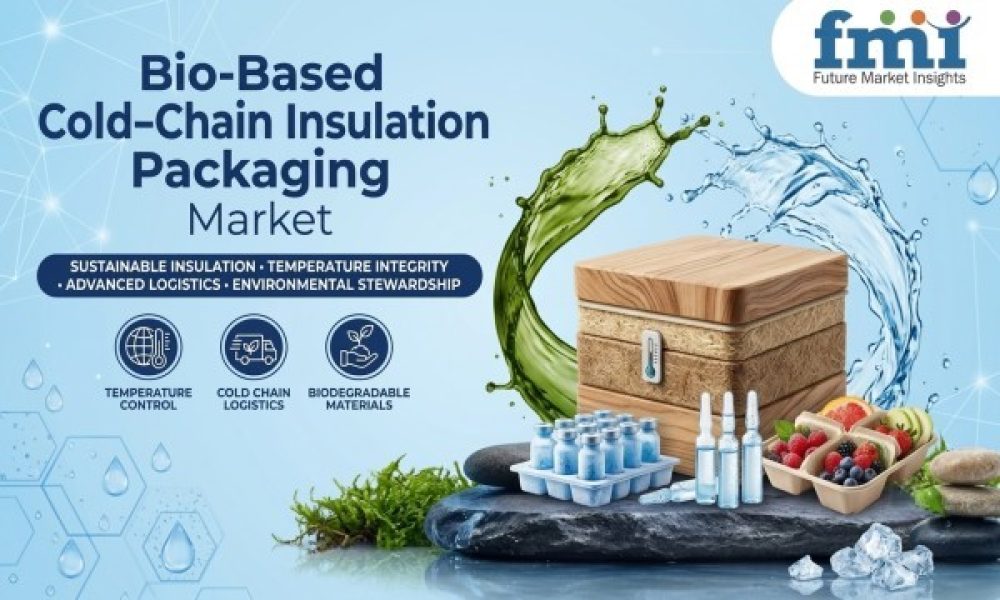
The global Bio-Based Cold-Chain Insulation Packaging Market is projected to reach USD 1,580.0 million by 2036, up from USD 773.8 million in 2026, expanding at a 7.4% CAGR, according to Future Market Insights.
Demand is being shaped by food and pharmaceutical shippers seeking temperature-controlled packaging that protects sensitive payloads while reducing dependence on rigid foam at the destination. Renewable systems increasingly combine paper, molded fiber, plant-based polymers, wool, and related materials with familiar corrugated cases and established pack-out processes.
Qualification Is Becoming Central to Bio-Based Packaging Adoption
The commercial case for bio-based insulation increasingly depends on measured thermal performance rather than renewable content alone. Packaging teams must establish whether a liner can maintain required temperatures across seasonal conditions, route lengths, handling events, coolant placement, and destination conditions.
Visy reported in April 2026 that Visycell produced 41% fewer greenhouse gas emissions than an EPS equivalent across two cold-chain applications. The comparison provides a measured replacement reference, although route qualification and local disposal conditions remain important considerations.
North American programs often begin with parcel qualification and recovery claims that vary across municipal systems. European packaging programs face additional design requirements as Regulation (EU) 2025/40 establishes staged recyclability requirements and tighter controls on substances of concern, with the regulation generally applying from August 2026.
Get detailed market forecasts, competitive benchmarking, and pricing trends:
https://www.futuremarketinsights.com/reports/sample/rep-gb-34389
Paper Leads the Material Mix
Paper is projected to account for 38.0% of material demand in 2026. Its position reflects established corrugated converting capabilities and compatibility with familiar cutting, folding, and case-integration processes.
Visy launched Visycell in April 2025 as a fiber thermal liner made from cardboard waste offcuts for temperature-sensitive food and beverage shipments. Its flat-packed format supports warehouse storage and existing case assembly. Humidity exposure, however, means barrier and seal performance must be assessed across the complete package.
Pouches are projected to represent 23.0% of the format category in 2026. Their flexible construction suits smaller chilled consignments and direct delivery, while lower coolant capacity and compression exposure can limit their use on longer routes.
Cold Chain Remains the Largest End-Use Category
Cold chain is forecast to account for 42.0% of end-use demand in 2026. Insulation is purchased as part of a complete temperature-control system, where coolant geometry, pack-out instructions, route conditions, and seasonal profiles all influence performance.
Veritiv introduced TempSafe PalletShield in December 2025 with more than five days of validated protection across refrigerated and frozen conditions. Such developments demonstrate the growing focus on complete passive temperature-control systems rather than insulation materials considered in isolation.
Food delivery programs can support relatively straightforward qualification on predictable short routes. Pharmaceutical distribution requires documented seasonal profiles and repeatable pack-out instructions across approved facilities and shipping lanes.
Regulatory and Qualification Requirements Shape Market Opportunities
PFAS-related food-contact requirements are supporting interest in alternative grease-resistant structures. The FDA stated in January 2025 that authorizations for 35 PFAS-related food-contact notifications were no longer effective, covering grease-proofing uses in paper and paperboard food packaging applications.
At the same time, qualification expense remains a restraint. TemperPack launched its Qualified Shipper Program in September 2025 with prevalidated systems and ISTA reports for pharmaceutical users, illustrating the evidence required for specialized medicine shipments.
Material-specific waste requirements also create opportunities for simpler package structures. PackUK confirmed in June 2025 that modulated fees begin in 2026 through red, amber, and green recyclability assessments. Packaging providers therefore have an incentive to evaluate thermal performance alongside final material classification.
Regional Growth Creates Different Commercial Pathways
India is projected to record a 10.0% CAGR through 2036, while the United States is forecast to expand at 9.3%. Japan follows at 8.5%, with the United Kingdom at 7.8%, France at 7.0%, and Germany at 6.3%.
India’s cold-storage network, pharmaceutical distribution, and temperature-controlled food logistics support demand for renewable insulation. The Press Information Bureau reported 8,815 cold-storage facilities with 40.21 million tonnes of capacity in June 2025.
In the United States, pharmaceutical parcel delivery is supporting recurring demand for qualified insulation systems. Cold Chain Technologies reported in May 2025 that UVA Health Pharmacy Services used Rx Naturals for home deliveries serving more than 25,000 patients annually.
European markets face stronger emphasis on recovery documentation and material separation. France reported 4.893 million tonnes of household packaging and graphic paper sorted for recycling during 2024, according to ADEME. Germany’s dual systems recycled about 5.5 million tonnes of packaging waste during 2024, according to the German Environment Agency.
Analyst Perspective
“Bio-based cold-chain insulation succeeds when a packaging team treats material choice as part of a qualified shipping system. The liner must control temperature across real routes, fit existing pack-out work and separate cleanly at the destination. Companies that connect laboratory evidence with regional production and clear recovery instructions are better placed to turn limited trials into repeat orders.”
Nandini Roy Choudhury, Principal Analyst, Future Market Insights
Competitive Landscape
The market includes TemperPack, DS Smith, an International Paper company, Veritiv, Visy, Storopack, Woolcool, Cold Chain Technologies, and Ranpak.
Competitive strategies span fiber insulation, wool, plant-starch materials, pharmaceutical qualification, engineering support, and distribution services. Recent developments include DS Smith’s TailorTemp launch, Storopack’s RENATURE Thermo deployment, and Woolcool’s LifeGUARDIAN system.
Report Scope
The Bio-Based Cold-Chain Insulation Packaging Market covers material, format, barrier or feature, end use, and regional demand. Materials include paper, molded fiber, recycled PET, mono-material PE, and bio-based polymer.
The study covers North America, Latin America, Western Europe, Eastern Europe, East Asia, South Asia and Pacific, and the Middle East and Africa. Key countries include the United States, Germany, the United Kingdom, France, Japan, and India, along with 30+ additional countries.
The forecast period is 2026 to 2036. FMI uses a hybrid bottom-up and top-down approach supported by primary interviews and official desk research.
Gain Comprehensive Knowledge—Read the Entire Report Now!
https://www.futuremarketinsights.com/reports/bio-based-cold-chain-insulation-packaging-market
FMI Custom Research: Strategic Intelligence for Confident Decision-Making
In today’s rapidly evolving business environment, leadership teams need more than market data—they need clear, actionable intelligence tailored to their strategic objectives. FMI’s Custom Research solutions are designed around the specific business questions organizations need answered, enabling executives to evaluate growth opportunities, validate investments, assess competitive dynamics, and reduce uncertainty before making critical decisions. By combining deep industry expertise, primary research, and proprietary market intelligence, FMI delivers insights that help organizations move from assumptions to evidence-based strategies with greater speed and confidence.
Business Impact
FMI helps organizations transform market complexity into strategic clarity, enabling leadership teams to identify growth opportunities faster, optimize resource allocation, strengthen competitive positioning, and make high-stakes business decisions with confidence.
To explore how FMI Custom Research can support your strategic priorities, please connect with our team at – [email protected]
About Future Market Insights (FMI)
Future Market Insights, Inc. (FMI) is an ESOMAR-certified, ISO 9001:2015 market research and consulting organization, trusted by Fortune 500 clients and global enterprises. With operations in the U.S., UK, India, and Dubai, FMI provides data-backed insights and strategic intelligence across 30+ industries and 1200 markets worldwide.



