
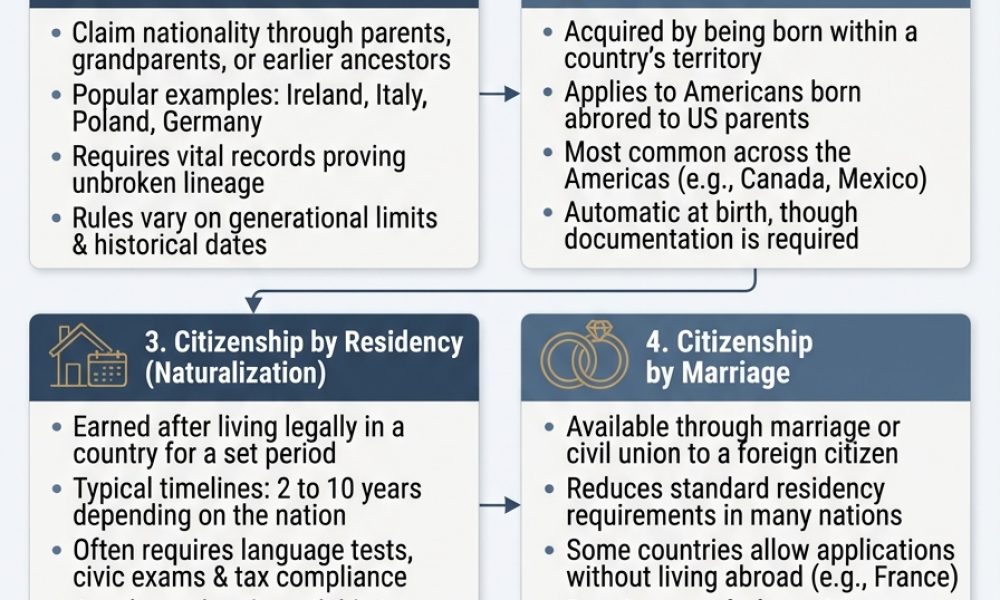
Millions of Americans may have potential claims to another nationality through family history, foreign birth, marriage, or lawful residence. However, eligibility depends on each country’s citizenship laws and the evidence required to establish nationality across generations.
WASHINGTON, November 13, 2026: Americans investigating a second citizenship in 2026 face a wider range of possible legal pathways than the familiar investment promotions suggest, but the decisive questions involve birthplace, ancestral nationality, family relationships, residence histories and documentary evidence rather than the price of a passport.
A person born in the United States may already possess another citizenship through a parent. At the same time, someone whose grandparents emigrated generations ago might qualify for recognition through a foreign birth register, and a third applicant may need to establish years of lawful residence abroad. These routes produce different legal outcomes: some applicants merely document nationality acquired at birth, others acquire citizenship only after registration, and naturalization candidates generally must meet residence, language, character, or integration conditions before authorities consider granting citizenship.
The potential population is substantial given America’s immigrant history. However, no reliable nationwide tally establishes how many residents actually qualify under the various foreign statutes, particularly after governments tightened some ancestry rules and expanded others during 2025 and 2026. For families weighing a European Union passport, a practical relocation option, or a stronger connection to relatives overseas, the starting point is a country-specific legal assessment rather than assuming a surname, ancestry estimate, or family story establishes citizenship.
Birthplace and Parental Nationality Create Different Starting Points
Birth on foreign soil may confer citizenship automatically in some countries, while others generally depend on the nationality or immigration status of the parents, so an American born overseas should first examine the law in force on the precise date and location of birth. A child born abroad to American parents can also acquire United States citizenship under applicable transmission rules, making dual nationality possible from birth even when the child has never held the foreign country’s passport or visited its consulate.
In contrast, an American born domestically to a parent who retained another nationality may have inherited that nationality through descent. However, some governments require registration within specified periods, proof that the parent could transmit citizenship, or other steps before recognition becomes effective. The U.S. State Department’s guidance on dual nationality explains that individuals may hold another nationality without realizing it. It warns that citizens with multiple passports may have legal obligations in each country, including limits on consular assistance.
Consequently, families should distinguish an existing legal status from an application seeking a new grant of citizenship, because the difference affects evidence requirements, effective dates, children’s eligibility, and even which government document must be obtained before travel.
Ancestry Claims Begin With an Unbroken Documentary Chain
Citizenship by descent often attracts Americans whose parents, grandparents, or earlier ancestors came from Europe. Still, genealogical discoveries represent only preliminary leads until vital records establish every legally relevant link between the applicant and a qualifying foreign national. Applicants typically need certified birth and marriage records, evidence of name changes, adoption or parentage where relevant, and proof of an ancestor’s citizenship status, with translations, apostilles, or consular legalization required under the receiving authority’s procedures.
Naturalization records can be especially consequential because an ancestor who voluntarily became an American citizen before a child’s birth may have lost the original nationality under historical law, potentially interrupting transmission even where the family’s cultural identity remained unchanged. Dates matter as much as documents, since legislation governing married women’s nationality, unmarried parents, adoption and children born overseas changed repeatedly during the twentieth century, and a rule applicable today might not describe citizenship status when an earlier generation was born.
For that reason, treat online eligibility quizzes and commercial family-tree databases as research aids, not government determinations, nd have legal opinions identify the controlling statute, relevant dates, and a defensible path to recognition.
Ireland Offers a Defined Route for Qualifying Grandchildren
Ireland remains a significant example for Americans tracing family roots because a person with a grandparent born on the island of Ireland may be eligible to become an Irish citizen through the Foreign Births Register, subject to the official requirements. Someone born outside Ireland to a parent who was themselves born on the island may already be an Irish citizen under the applicable law, demonstrating why the correct application can differ substantially even between members of the same extended family.
For later generations, timing becomes critical because a parent who acquires Irish citizenship through foreign birth registration generally must complete that registration before the next child’s birth for citizenship to pass along that line. Irish citizenship also brings European Union citizenship and corresponding movement rights under applicable law, but obtaining the nationality still requires a complete submission. It should not be confused with an automatic entitlement to an immediate passport appointment.
Families applying for children should investigate the registration sequence early, since delaying a parent’s application until after a child’s birth can affect that child’s future eligibility in ways a later genealogical discovery may not be able to fix.
Italy’s 2025 Restrictions Reshaped Ancestry Applications
Italy illustrates why Americans should not rely on advice written several years ago, because legislation adopted in 2025 imposed substantial new conditions on recognition of citizenship by descent for people born abroad who also possess another nationality. Under the framework described by Italy’s Foreign Ministry, many new applicants must establish that a parent or grandparent held exclusively Italian citizenship, or that a qualifying parent lived in Italy continuously for at least two years after acquiring citizenship and before the applicant’s birth.
The legislation also contains important protections for certain applications or judicial proceedings initiated by the March 27, 2025, cutoff, making submission dates, appointment notices and the exact procedural history essential parts of an individual case review. In April 2026, the Associated Press reported on American families challenging the new restrictions, underscoring the personal stakes for descendants whose family records and long-standing plans did not automatically translate into eligibility under the amended law.
A separate Italian Supreme Court ruling in July 2026 clarified an older question involving children born with dual nationality and a parent’s subsequent naturalization, but that historical interpretation should not be mistaken for a blanket repeal of the 2025 requirements. For Americans with Italian ancestry, the responsible approach is to check current consular criteria and any relevant court developments before paying for extensive archival searches, translations, or representation built on outdated assumptions.
Canada Changed Its Citizenship-by-Descent Rules in December 2025
Canada moved in a different direction when reforms effective December 15, 2025, changed its former first-generation restriction on citizenship by descent, potentially affecting Americans born outside Canada with parents or earlier generations connected to Canadian citizenship. Under Canadian government guidance, many people born abroad before the effective date to a parent who was a Canadian citizen when they were born may now be recognized as citizens, including some previously excluded by the old generational limit.
For births abroad on or after December 15, 2025, a Canadian parent who was also born abroad generally must demonstrate at least 1,095 days of physical presence in Canada before the child’s birth to transmit citizenship under the updated framework. These rules also interact with provisions for adopted children and people affected by earlier nationality legislation, making it important to examine both the family history and the applicant’s exact birth or adoption circumstances.
Even when citizenship already exists by law, travelers generally need documentary proof and the appropriate Canadian passport before relying on Canadian status, which is why a citizenship certificate and a passport application should be treated as separate administrative stages.
British Citizenship Usually Has a Narrower Descent Limit
British nationality law offers another example of how ancestry can matter without creating an unlimited family entitlement, because citizenship is normally passed automatically only one generation to children born abroad, with additional registration routes available in specified circumstances. An American whose parent was born in the United Kingdom may therefore have a stronger claim than someone relying exclusively on a British grandparent. However, the applicant’s date of birth, parental status and historical legislation can materially alter the outcome.
British government guidance also recognizes that certain people affected by older rules involving unmarried parents or unequal treatment may qualify through registration, making a categorical refusal based solely on an ancestor’s gender or marital history potentially premature. Acquiring British citizenship does not itself confer European Union citizenship after Brexit, and British or Irish dual nationals should assess the United Kingdom’s entry-document rules separately from the travel privileges associated with other European passports.
Marriage Can Assist Eligibility Without Guaranteeing Citizenship
Marriage to a foreign citizen may create a special route to naturalization, shorter residence conditions or a separate registration procedure in some jurisdictions, but a wedding certificate alone generally should not be presented as proof that a second nationality has been acquired. Authorities may examine whether a marriage is genuine and continuing, how long the couple has lived together, whether the applicant meets language or integration requirements, and whether any criminal, immigration or security concerns affect admissibility.
Children of multinational couples may face a different set of rights because nationality could pass directly through a parent at birth, even when the noncitizen spouse must pursue a lengthy residence-based route and submit a separate application. Couples planning international moves should evaluate both partners’ immigration status and the children’s documentation together, rather than assume that one spouse’s citizenship automatically provides identical residence, employment, and travel permissions to every family member.
Legal Residence Remains a Pathway When Ancestry Is Unavailable
Americans without a qualifying parent or grandparent can sometimes pursue naturalization through lawful residence, beginning with an appropriate immigration category and continuing through periods of actual presence, tax compliance, language study and maintenance of lawful status. Portugal’s government nationality guidance, updated in October 2026, describes eligibility routes including birth, Portuguese parentage, marriage and at least five years of legal residence. However,h applicants must still assess the detailed rules and any later legislative changes.
Other countries use different clocks and conditions, and the qualifying period may start only when lawful residence is established rather than when a person purchases property, enters as a tourist or receives a provisional immigration document. Residency programs marketed to investors or retirees should therefore be evaluated according to the rights actually granted, because permission to live in a country is not the same as citizenship and does not necessarily produce a passport after a predictable number of years.
Actual presence rules can also disrupt assumptions about flexible international lifestyles, especially when lengthy absences, expired residence permits or incomplete local registrations prevent an applicant from meeting the continuity requirements imposed by the relevant nationality authority.
Records, Processing Delays and Family Planning Determine Results
Even apparently straightforward applications can stall when a grandparent’s birth certificate contains a different spelling, a marriage record is missing, or government files contradict family recollections about the year an ancestor became a United States citizen. A disciplined application starts with a chronological family chart showing every birth, marriage, change of nationality, and migration event, followed by requests for certified records from state registries, national archives, churches, or authorized municipal offices where appropriate.
Applicants should then compare those records against the current consular checklist, identify discrepancies before filing, and establish whether the relevant authority requires original documents, certified copies, official translations, apostilles, fingerprints, or an in-person interview. When parents and children might each qualify, the order of applications can be decisive, since one person’s registration or citizenship recognition may be a prerequisite for another person’s claim, and approaching a deadline without understanding that sequence can create avoidable problems.
Applicants should also budget for uncertain processing periods rather than assume a published target is a guarantee, because document verification, appointment availability, requests for additional evidence,e and litigation can extend even a legally supportable case.
Dual Citizenship Creates Responsibilities Alongside Travel Options
A second passport can expand lawful residence and employment possibilities in the issuing country and, where applicable, across a regional bloc. Still, its value depends on the precise nationality acquired and the legal rights that accompany it. American citizens generally remain subject to United States tax obligations even while living abroad or holding another passport, and they should review any additional financial reporting duties with qualified advisers rather than assuming dual nationality automatically erases them.
United States citizens must use American passports to enter and depart the United States. At the same time, another country may expect its nationals to use that country’s passport at its borders, a practical detail that matters when coordinating international family travel. Other possible obligations include military service, civil registration, restrictions on certain public roles and limitations on United States consular Protection while inside the country of the second nationality, reinforcing the need to examine obligations before seeking recognition.
A foreign passport also does not eliminate outstanding legal obligations, prevent Extradition, bypass sanctions, or guarantee admission to third countries, and applicants should reject any promotional claim portraying nationality as immunity from ordinary legal processes.
How Americans Can Decide Which Citizenship Route Is Realistic
The most effective first step is to inventory confirmed facts, including each parent’s citizenship at the applicant’s birth, grandparents’ birthplaces, ancestral naturalization dates, any foreign birth registrations,s and periods of lawful residence that might support naturalization. That information can be organized into three separate categories: citizenship potentially held already, nationality obtainable through a formal descent or family registration, and naturalization requiring future residence or other qualifying conduct under a foreign country’s rules.
A qualified professional should then identify the relevant government agency, the current law, documentary obstacles, processing uncertainty, ty and the probable consequences for spouses and children, while distinguishing legal eligibility from a prediction of favorable administrative treatment. For applicants comparing lawful international mobility strategies, Amicus International Consulting’s second-passport services describe an individualized assessment process. However, any eventual citizenship or passport depends on the issuing government’s legal procedures and independent approval.
Families should resist paying substantial fees for promised results before verifying the applicable route and issuing authority, especially where advertisements blur the distinction between residency, discretionary citizenship grants, automatic nationality by descent, and the issuance of travel documents. In 2026, the clearest lesson is that a second citizenship may be closer than an American applicant expects, but establishing that possibility requires careful evidence, current legal analysi,, and realistic planning ratherthan assumingn that ancestry or investment alone guarantees another passport.




