
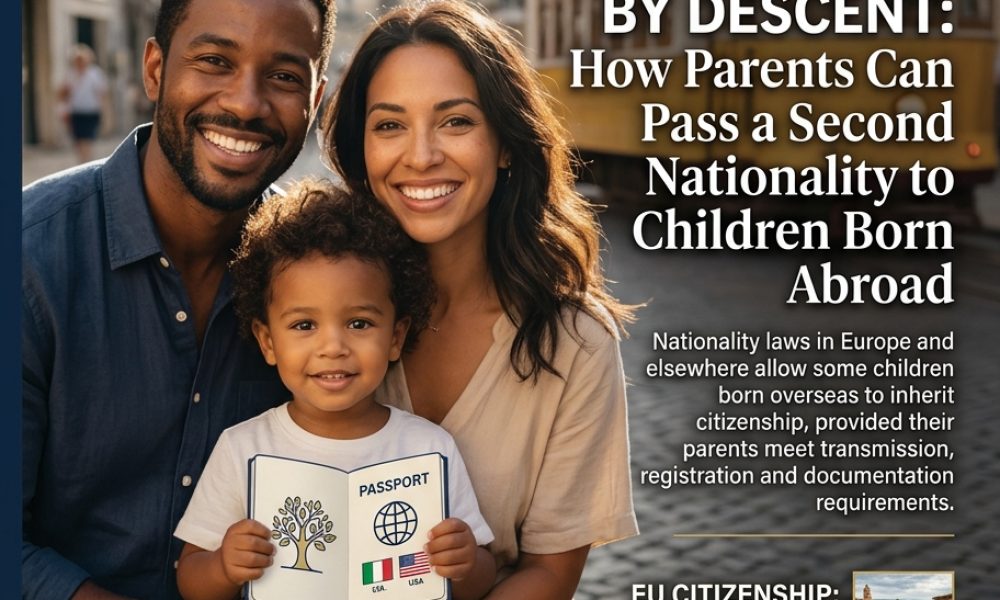
Nationality laws in Europe and elsewhere allow some children born overseas to inherit citizenship, provided their parents meet transmission, registration and documentation requirements.
WASHINGTON, November 13, 2026: Parents raising children outside their country of citizenship may be able to pass along a second nationality from birth, but the outcome depends on laws governing family relationships, parental residence histories, and registration deadlines that differ significantly across jurisdictions. An American child with an Irish, Canadian, Italian, or German parent may qualify for another nationality without ever living in that country. However, the route can involve automatic inheritance, a formal declaration, or a separate registration procedure that creates citizenship only when completed. For families considering future education, residence or international mobility, the central task is not simply obtaining another passport, but establishing when citizenship exists, what evidence proves it and whether the child can eventually transmit that nationality to the next generation.
A Parent’s Passport Does Not Always Settle a Child’s Status
Citizenship by descent, frequently described through the legal principle of jus sanguinis, generally connects nationality to a qualifying parent rather than the territory of birth. Still, governments define qualifying parental citizenship and the effect of overseas births in markedly different ways. One legal system may recognize a foreign-born child as a citizen immediately. At the same time, another requires parents to declare the child’s birth before a deadline, and a third may permit later citizenship registration without treating nationality as having existed since birth.
The timing distinction matters because an application that merely documents existing citizenship can have different consequences for subsequent generations than an application through which a child first acquires nationality through registration or official acceptance. A family therefore needs to confirm the parent’s citizenship on the exact date of birth, the transmission law then in force and any subsequent amendments, rather than relying on the parent’s current passport or an ancestry-based advertisement.
American Parents Must Establish Physical Presence and Parentage
United States citizenship may pass to a child born abroad when the transmitting parent satisfies the Immigration and Nationality Act’s applicable requirements, which depend partly on the child’s birth date, the citizenship of each parent and the circumstances of parentage. For a child born in wedlock on or after November 14, 1986, to one United States citizen and one noncitizen parent, the citizen parent generally must have accumulated five years of physical presence in the United States before birth, including two years after age 14.
Different provisions may apply when both parents are American citizens, when the child was born outside marriage, or when older statutory periods govern, so a simple assertion that one parent’s passport guarantees transmission can be materially misleading. The State Department’s guidance on children born abroad explains the relevant citizenship and parental connection tests in detail, allowing families to evaluate their specific circumstances against the government’s rules rather than relying on generalized online summaries. Parents preparing a claim should gather school, employment, medical, tax, or other records showing actual United States presence, along with evidence of the child’s birth and the legally relevant parental relationship, before scheduling an appointment with an embassy or consulate.
Birth Registration and Citizenship Proof Are Not Identical
For eligible children who acquired American citizenship at birth, a Consular Report of Birth Abroad documents that citizenship. At the same time, a United States passport provides the travel document required for American citizens to enter and leave the country. The report is not a local birth certificate or a general custody determination, and parents may still need the foreign country’s civil registration documents to establish the child’s birth, parentage and legal identity for other official purposes.
Similar distinctions arise internationally because some authorities first enter an overseas birth in their civil records, others issue a nationality certificate. Others require a successful citizenship declaration before you can request a passport. Getting the right document in the right order can prevent years of later disputes over names, birth dates, or legal status, especially when a child reaches adulthood in another country or applies for a passport independently.
Canada’s December 2025 Reform Reopened Some Family Lines
Canada changed its citizenship-by-descent framework on December 15, 2025, removing the former first-generation limit for many people born abroad before that date and potentially recognizing citizenship in families previously blocked by the older rule. Immigration, Refugees and Citizenship Canada explains that many affected people born before the change became citizens automatically under the revised legislation. However, obtaining a citizenship certificate remains important when they need official proof or travel documents.
For children born abroad on or after December 15, 2025, to a Canadian parent who was also born abroad, the law generally requires that parent to have accumulated at least 1,095 days of physical presence in Canada before the child’s birth. Because the new rule combines generational status with a measurable residence history, an expectant parent should gather travel, schooling, and other credible presence evidence well before a child’s birth rather than assume Canadian grandparents alone establish transmission. Adoption cases have related but distinct provisions, and a family should distinguish an adopted child’s eligibility for a direct grant from citizenship that may arise automatically through birth under the amended Canadian legislation.
Ireland Makes the Registration Date Particularly Important
Ireland generally recognizes a person born abroad as Irish from birth when a parent was an Irish citizen born on the island of Ireland. At the same time,e another route permits qualifying descendants of Irish-born grandparents to become citizens through the Foreign Births Register. According to Ireland’s Department of Foreign Affairs, entry on that register makes an eligible registrant an Irish citizen, so the registration date can determine whether citizenship passes to children born later.
For example, a parent who qualified through an Irish grandparent but completed foreign birth registration only after having a child abroad normally cannot rely on that later registration to establish the child’s entitlement through the parent’s foreign-born line. Irish officials specifically caution expectant applicants about this timing problem, illustrating why a family planning another pregnancy or adoption may need to address a pending registration before the relevant birth rather than regard paperwork as optional. An Irish passport may ultimately carry European Union citizenship privileges. Still, those rights depend on lawful recognition of Irish nationality and should not be promised to a child whose qualifying parental registration was never completed in time.
Italy’s New Rules Demand a Fresh Family Assessment
Italy’s citizenship-by-descent system underwent substantial restrictions in 2025, and parents who previously expected automatic recognition for every foreign-born child must now account for additional statutory tests involving the child’s other citizenships and the family’s connection to Italy. Under the amended law, a child born abroad with another nationality may qualify for automatic Italian citizenship in specified cases involving an exclusively Italian parent or grandparent, a qualifying parent’s prior residence in Italy, or protected earlier applications.
For some children who do not qualify automatically, Italian consular guidance describes a separate acquisition procedure involving a formal declaration by eligible parents or guardians, with deadlines that can depend on birth dates and transitional provisions. That distinction matters because citizenship obtained through the newer declaration process may begin after the declaration rather than at birth, producing legal consequences for the child’s own future ability to transmit Italian nationality.
In 2026, Associated Press reporting on an Italian high court decision highlighted a separate historical dispute over whether children lost inherited Italian nationality when a parent later naturalized abroad, without eliminating the independent restrictions adopted in 2025. Parents should therefore seek an assessment that separates older family transmission questions from current statutory exceptions, since a favorable historical court interpretation does not automatically make every overseas-born child eligible under the newly amended law.
Germany Has a One-Year Rule for Some Overseas Families
Germany generally allows citizenship to pass through a German parent. Still, an important generational cutoff can apply when the German parent was also born abroad after December 31, 1999, and ordinarily resides outside Germany when the child is born. When the child acquires another nationality at birth, such a family may need to request entry of the birth in Germany’s civil register within one year to preserve acquisition of German nationality, subject to the statutory exceptions.
Germany’s Federal Foreign Office explains that a timely application can allow nationality to be recognized with effect from birth, which makes the first birthday a meaningful deadline for affected parents living in the United States or elsewhere. The rule does not mean every German citizen abroad faces the same filing requirement. Still, it shows how birthplace across successive generations can matter even in a legal system strongly tied to citizenship through parentage.
British Citizenship Usually Passes Automatically One Generation Abroad
United Kingdom guidance generally permits a British citizen otherwise than by descent to transmit citizenship automatically to a qualifying child born abroad. In contrast, a British citizen who already holds nationality by descent ordinarily cannot do the same for another overseas-born generation. Registration routes exist for some children of British citizens by descent, including pathways linked to a qualifying parent’s earlier residence in the United Kingdom or a period of family residence there, but the conditions must be established individually.
The parent’s manner of acquiring British citizenship, the child’s birth date and historical rules affecting unmarried parents can all change the result, making it unreliable to judge eligibility solely by whether a British passport appears in the family archive. Since Brexit, British citizenship is also not equivalent to European Union citizenship, so families comparing British and Irish options should distinguish nationality recognition from the different mobility rights that may eventually flow from each passport.
Portugal Provides Another Route Through a Citizen Parent
Portuguese nationality procedures permit many people born outside Portugal to a Portuguese mother or father to seek recognition of Portuguese nationality from birth, provided they complete the legally required declaration and civil registration process. Portugal’s justice authorities describe a procedure for an overseas-born child of a Portuguese parent to declare the wish to acquire Portuguese nationality, with supporting Identification and parentage documents establishing the connection to a qualifying citizen. Families should nonetheless determine whether the Portuguese parent already held citizenship at the child’s birth and whether records require transcription or correction, because registering a child and establishing a parent’s earlier nationality can involve separate administrative tasks.
Adoption, Assisted Reproduction and Family Recognition Can Change Eligibility
A conventional birth certificate does not always settle nationality transmission because adoption, assisted reproduction, surrogacy arrangements and later acknowledgments of parentage may raise questions about who qualifies as a parent under the relevant country’s citizenship legislation. Some governments extend transmission rights to qualifying adopted children. In contrast, others place them in a different application category or require recognition of a foreign adoption before a nationality or passport request can proceed.
Families using assisted reproductive technology should check rules governing genetic, gestational and legally recognized parentage rather than assume that a foreign court order or a birth certificate naming two adults will be interpreted identically everywhere. For unmarried parents, older birth dates can also trigger historical legal distinctions, including requirements for acknowledgment or legitimation that differ from the rules governing children born within marriage, especially in claims covering several generations.
Document Consistency Can Determine Whether a Claim Succeeds
A credible descent application ordinarily begins with the child’s full birth record, the transmitting parent’s citizenship evidence and documents connecting the parent to the relevant earlier generation, with exact requirements determined by the receiving authority. Marriage certificates, name-change orders, adoption decrees, naturalization records, and proof of parental residence may be needed when authorities must reconcile different surnames, establish a legal relationship, or determine whether citizenship transmission was interrupted.
Foreign governments can require official translations, apostilles or other forms of authentication, and they may reject applications supported only by family-tree screenshots, ancestry estimates or uncertified digital copies that do not meet formal evidentiary standards. Parents can reduce avoidable delays by checking all names, dates and places before submission, requesting corrections from the issuing civil registry when needed and keeping a clearly organized record of the documents already filed.
Deadlines Deserve Attention Before a Child Reaches Adulthood
The biggest administrative mistake is assuming you can always postpone foreign citizenship recognition until a child wants to study or work abroad, because registration deadlines and age restrictions may permanently narrow an otherwise promising route. Ireland’s requirement that a registering parent acquire citizenship before the next generation’s birth and Germany’s one-year filing rule in specified circumstances illustrate two ways time can affect a family’s rights.
Other systems may require parental declarations during a child’s minority, impose filing windows after adoption, or apply more demanding residence and character tests when an applicant waits until adulthood, making early country-specific advice valuable. Families should record which applications preserve an existing entitlement, which create citizenship only prospectively,y and which remain discretionary, because each category has different consequences for future travel plans and the nationality of descendants.
Dual Citizenship Offers Rights but Also Creates Responsibilities
A child who holds both American and foreign nationality may gain residence, educational, or employment opportunities in the second country. Still, the practical value varies by the issuing state’s laws and any regional rights attached to citizenship. United States citizens must generally use a valid American passport to enter and leave the United States, even when they also hold another nationality, and the other country may impose its own passport-use expectations at its borders.
Parents should also consider possible military obligations, local civil registration requirements, applicable taxation, and limitations on United States consular assistance. At the same time, a dual citizen is physically present in the country of the second nationality. If parental custody or international travel arrangements are contested, two passports do not override court orders or consent requirements, and families should review both countries’ rules before organizing overseas travel with a minor.
A Practical Plan Starts Before the Birth Certificate Arrives
The first step for expectant parents is to identify every nationality either parent currently holds, how each was acquired, and whether the child is expected to acquire another citizenship through birth in the proposed country of delivery. Next, parents should compare current official transmission rules and deadlines, gather proof of residence and parentage, confirm consular jurisdiction, and determine whether an application must be submitted before birth, within the first year, or during childhood.
When families weigh lawful international mobility options, Amicus International Consulting’s second-passport services provide a starting point for examining documentation and nationality pathways. At the same time, the government alone grants, recognizes, and issues citizenship documents. No adviser should promise a passport merely because a parent or grandparent once held foreign citizenship, since the decisive legal questions concern transmission at the relevant date, successful completion of any required procedures, and acceptance of authentic supporting evidence.
A Child’s Future Nationality Depends on Timely Decisions Today
Citizenship by descent can preserve family connections across borders and give children born abroad meaningful future choices. Still, those benefits depend on accurately interpreting laws that differ sharply across the United States, Canada, Ireland, Italy, Germany, Britain and Portugal. The most consequential questions often concern details that seem administrative, including when a parent’s nationality became effective, whether enough residence was accumulated before birth and whether a registration was completed within a legally meaningful period. For parents thinking about a second nationality in 2026, prompt verification of citizenship rules and careful preservation of family records are more reliable than promotional promises, and they can protect a child’s legitimate rights long before another passport becomes necessary.




