
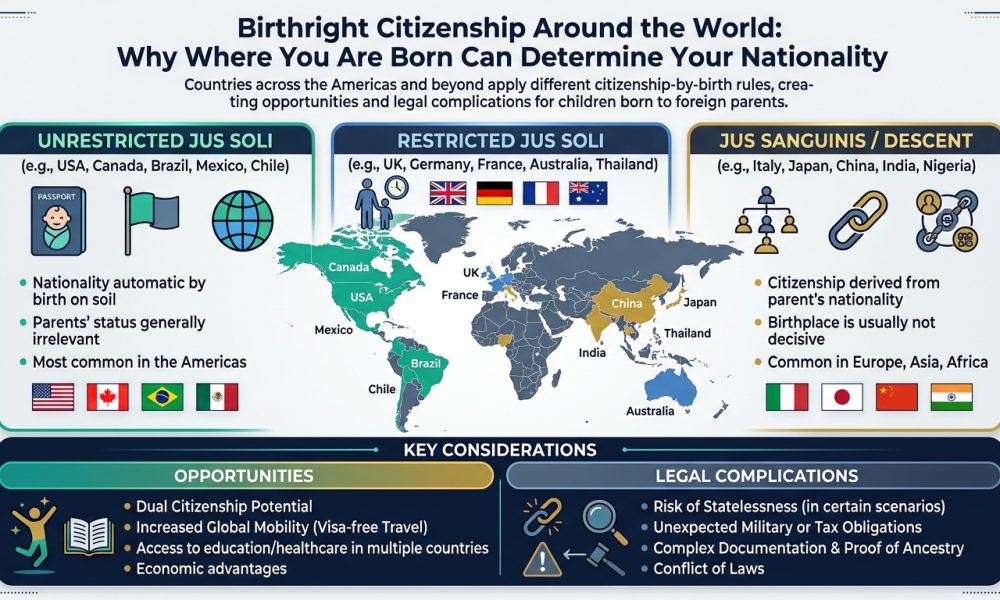
Countries across the Americas and beyond apply different citizenship-by-birth rules, creating important opportunities and legal complications for children born to foreign parents, particularly when family nationality, immigration status and future residence plans intersect.
WASHINGTON, November 13, 2026: The country where a child is born can determine citizenship from the first moments of life, but governments apply sharply different standards that can leave neighboring families with entirely different legal rights and responsibilities.
For parents considering an overseas delivery, for adults investigating their childhood birthplace, and for families managing more than one nationality, the central distinction is whether local law recognizes birth on the territory, descent from citizens, or some combination of both.
Recent litigation in the United States and changing nationality rules elsewhere have renewed attention to birthright citizenship. However, a foreign hospital certificate or a child’s new passport should never be confused with immigration permission for the parents.
Two Legal Traditions Explain Much of the Global Divide
The principle commonly called jus soli, meaning right of the soil, links nationality to birthplace. In contrast, jus sanguinis, meaning right of blood, derives citizenship from parents, although many countries blend these approaches through conditions involving residence and legal status.
A comparatively broad birthplace rule can grant citizenship at birth to a child of foreign visitors. In contrast, a narrower rule may require a citizen parent, an established resident parent, or an extended period of childhood residence before nationality follows.
Research published by Pew Research Center in March 2026, drawing on comparative nationality-law data, identified 33 countries with generally applicable automatic birthright citizenship, while numerous additional jurisdictions recognized more restricted forms of territorial citizenship.
The United States Retains Broad Birthright Citizenship After a Major Ruling
In the United States, the Citizenship Clause of the 14th Amendment generally recognizes people born on American soil and subject to American jurisdiction as citizens, with narrow exceptions historically involving foreign diplomats and hostile occupying forces.
President Donald Trump’s January 2025 executive order attempted to exclude certain children of parents who were in the country unlawfully or temporarily, prompting litigation over the Constitution, federal nationality law and the limits of presidential authority.
On June 30, 2026, the Supreme Court rejected the order by a 6-3 vote, and Associated Press coverage reported that five justices found its restrictions incompatible with the 14th Amendment.
A sixth justice agreed that the order could not stand because of existing federal legislation, illustrating why the difference between constitutional Protection and statutory Protection remains relevant to discussions about any future changes to American citizenship policy.
The ruling did not create automatic lawful immigration status for a newborn citizen’s foreign parents, who remain subject to applicable visa, admission, and immigration enforcement rules regardless of the nationality their child receives at birth.
Canada Generally Recognizes Children Born on Canadian Territory
Canada also applies broad territorial citizenship to most children born within its borders, including children whose parents hold foreign citizenship. However, important exceptions can arise where a parent possesses diplomatic privileges connected with service to another government.
Canadian authorities ordinarily treat a provincial or territorial birth certificate as foundational proof of a child’s Canadian birth. However, families must still meet the government’s documentary rules when obtaining a passport or resolving questions about nationality.
The distinction between citizenship acquired in Canada and citizenship transmitted to children born abroad became especially important after Canadian reforms took effect on December 15, 2025, changing some descent rules without eliminating the separate legal significance of Canadian birthplace.
For a child born overseas to a Canadian parent also born abroad after that effective date, the parent’s physical presence history may become critical, demonstrating that nationality through descent and nationality through birthplace operate under different tests.
Mexico’s Constitution Gives Birthplace an Especially Clear Role
Mexico’s Constitution recognizes individuals born within the republic as Mexican nationals by birth regardless of their parents’ nationality, establishing a broad territorial principle that differs from the more conditional frameworks followed in several European countries.
A child delivered in Mexico to foreign parents may therefore acquire Mexican nationality at birth. Still, the family must properly register the event and secure valid civil records before seeking Mexican travel documents.
Mexican nationality does not automatically confer residence rights on every foreign parent, nor does it erase the family’s obligation to follow immigration procedures, maintain accurate civil information or comply with requirements for the child’s international travel.
Brazil and Argentina Show the Breadth of South American Rules
Brazil’s Constitution generally regards a child born within Brazilian territory as Brazilian by birth even when both parents are foreigners, subject to an exception involving parents serving their own country in an official capacity.
Argentina’s nationality legislation likewise recognizes people born within the republic regardless of parental nationality, with exceptions for children of certain foreign diplomatic representatives, demonstrating another longstanding territorial model across South America that continues to shape nationality registration today.
These rules help explain why countries in the Americas frequently appear in international comparisons of birthright citizenship. Still, similarities in wording do not mean their registration procedures, passport requirements, or parental residence policies are interchangeable.
Not Every Country in the Americas Grants Unconditional Citizenship
The Dominican Republic provides a contrasting example because its Constitution excludes certain children of foreign diplomats, people considered in transit, and foreigners residing unlawfully, creating nationality questions that cannot be resolved merely by showing birth on Dominican territory.
Dominican migration authorities emphasized in 2025 that a certificate recording a child’s birth to nonresident foreign parents does not necessarily establish Dominican nationality, underscoring the distinction between documenting a birth and establishing citizenship.
Chile also applies qualifications involving the circumstances of foreign parents present temporarily. At the same time, Colombia’s rules examine factors such as parental nationality or domicile, meaning a hospital delivery alone may not settle an applicant’s legal position.
These differences matter for families comparing destinations across Latin America, where a promotional claim that every country follows the same automatic birthright rule could expose children to future identity and documentation disputes.
The United Kingdom Changed Its Approach More Than Four Decades Ago
The United Kingdom largely ended automatic citizenship based only on birthplace for children born from January 1, 1983, introducing rules that ordinarily require at least one parent to be British or legally settled when the child is born.
Someone born in Britain after that date to two parents holding temporary permission may therefore lack British citizenship at birth. However, later registration routes can become available through a parent’s changed status or prolonged childhood residence.
For certain children born in the United Kingdom who complete their first ten years of life there, nationality registration provisions may apply even if neither parent held settled status at the original date of birth.
Ireland Requires Parents’ Status to Be Examined Carefully
Ireland ended unrestricted birthright citizenship for children born on the island from January 1, 2005, replacing the previous broad rule with a system that accounts for parental citizenship, residence rights, and qualifying residence periods.
Under current Irish guidance, a child born after that date can qualify through an Irish or British citizen parent, certain unrestricted residence rights, or a parent’s qualifying legal residence during three of the preceding four years.
A child who did not qualify automatically at birth may still have a later naturalization pathway after meeting the relevant residence conditions. Still, families should not mistake that possibility for proof that nationality existed from the day of delivery.
Parents should also remember that Irish nationality can bring European Union citizenship rights, making a correct birth-status determination consequential for future education, work and residence choices well beyond the original family migration decision.
Germany Connects Birthright Citizenship to Established Residence
Germany offers a conditional birthplace route for children of foreign parents, with legislation effective in June 2024 reducing the relevant period of a parent’s lawful habitual residence from eight years to five years alongside permanent residence conditions.
A newborn in Germany may consequently acquire German citizenship when the required parental criteria are met. In contrast, another baby born in the same hospital to newly arrived visitors ordinarily would not acquire citizenship through birthplace alone.
Germany’s 2024 nationality reforms also broadened acceptance of multiple citizenships, so qualifying children no longer face the earlier general requirement to choose between German and another inherited nationality under the former options system.
France Can Recognize Birthplace Through Later Childhood Residence
France uses another variation in which a child born locally to foreign parents can acquire French nationality at age eighteen when the person lives in France and has accumulated the required five years of habitual residence since age eleven.
Earlier declaration procedures can also be available for qualifying teenagers. At the same time, a child born in France to a parent who was also born there may acquire French nationality at birth under a separate rule.
The French approach shows why birthright citizenship can describe an eventual entitlement linked to birthplace rather than automatic nationality at birth, particularly when childhood residence provides the required additional connection.
Families should avoid assuming a child can leave France shortly after birth and return as an adult with an automatic claim, since authorities must assess the relevant residence conditions and evidence before establishing nationality.
Australia and New Zealand Put Parental Status at the Center
Australia generally grants citizenship at birth to children born there when at least one parent is an Australian citizen or permanent resident, with a separate route for certain Australian-born children ordinarily resident there throughout their first ten years.
The ten-year provision matters because it can allow a qualifying child to acquire citizenship later,, even withoutbeingtizen at birth. Still, it does not turn a short visit for childbirth into permanent family immigration rights.
New Zealand similarly changed its rules for births occurring from January 1, 2006, generally requiring at least one parent to hold New Zealand citizenship or an immigration status permitting indefinite residence, subject to the country’s detailed statutory provisions.
For older adults investigating birth in either country, the date on the original birth record can therefore be decisive, because laws that applied before the reforms may grant citizenship unavailable under the conditions imposed on children born later.
Children Can Inherit Another Nationality Regardless of Birthplace
The place where a baby is delivered tells only part of the story, because a parent may transmit a second nationality under laws recognizing descent, producing a child with two citizenships even before any passport application has been submitted.
The U.S. State Department’s guidance on dual nationality explains that nationality may arise through birth in one country and parentage in another, while warning that each jurisdiction determines citizenship under its own laws and policies.
An American child born in Canada, Mexico or Brazil may therefore potentially hold both United States citizenship through a qualifying American parent and citizenship from the birthplace. However, American transmission requirements must be examined on a case-by-case basis.
Conversely, a child born in a country without automatic territorial citizenship may rely on parental nationality alone, and inadequate birth registration or missing evidence of a parent’s status can make later passport applications considerably more difficult.
Birth Certificates, Citizenship Certificates and Passports Are Different Documents
A birth certificate ordinarily records an event and identifies the child and parents. In contrast, a nationality certificate or passport addresses citizenship status under a separate legal framework, meaning the documents cannot always substitute for one another.
In a broad territorial citizenship country, an authentic local birth certificate can provide powerful evidence supporting nationality. However, governments may still require Identification records, registration numbers, or additional verification before issuing travel documents.
Where citizenship depends on immigration status, a clerk’s birth record may be insufficient without contemporaneous proof that a parent was settled, permanently resident, or otherwise eligible under the law in force that day.
A Newborn’s Citizenship Does Not Automatically Legalize the Parents
Families sometimes conflate a child’s right to citizenship with an immediate right for the parents to settle permanently. Still, these are separate legal questions governed by immigration categories, residence permissions, and sometimes minimum sponsorship ages.
Even when a newborn becomes a citizen automatically, visiting parents may still need to depart when their authorized stay ends, and they should not assume that a baby’s passport provides immunity from immigration enforcement.
Parents also need to consider hospital expenses, access to insurance, medical risks from international travel during pregnancy, consent documents, and possible airline restrictions, none of which disappears merely because a country recognizes birthplace citizenship.
When future family relocation is the objective, the responsible approach is to examine lawful residence pathways for adults independently from the child’s nationality, together with the financial and practical consequences of raising a multinational family.
Preventing Statelessness Remains a Separate Global Concern
Rules that safeguard children who would otherwise be stateless serve a different purpose from programs marketed as second-passport opportunities, since these protections are intended to prevent people from growing up without recognition as nationals of any country.
Some legal systems provide citizenship or a process to obtain it for children born locally who cannot inherit a parent’s nationality. In contrast, others impose residence, registration, or evidence conditions that can complicate recognition.
A child may face serious difficulties when parents cannot obtain nationality documents, when laws discriminate in transmission through mothers or fathers, or when governments dispute whether a family has a legally recognized connection to another state.
Careful civil registration and access to competent legal assistance can be essential in such circumstances, because correcting an omission early may prevent years of uncertainty involving education, medical services, employment and lawful international travel.
Planning for Birth Abroad Requires More Than Comparing Passport Strength
Prospective parents should first identify the law operating in the proposed country on the expected birth date, including diplomatic exceptions, residency qualifications, any recent amendments, and special procedures for registering a child of foreign parents.
They should then compare that law with the nationality transmission rules of each parent’s home country, establish the documents required to prove parentage, and confirm where and how any foreign birth must be reported.
Advisers examining lawful second-nationality possibilities, including Amicus International Consulting’s second-passport services, can help frame questions about eligibility and documentation. Still, no private provider can substitute its assessment for official recognition by the competent government.
The Enduring Lesson Is That Birthplace Matters, but Law Decides
Birthright citizenship in 2026 remains an important feature of nationality law across much of the Americas. Still, Europe and the Pacific show that being born in a country does not create identical rights everywhere.
For some children, nationality begins automatically at birth; for others, it depends on a parent’s settled status, years of residence, or a later formal declaration, making accurate legal classification more important than marketing claims about passport access.
As families become increasingly international and governments continue revisiting nationality policy, the safest foundation remains current official law, properly registered births and reliable evidence establishing which citizenships a child actually holds and what those citizenships mean.




