
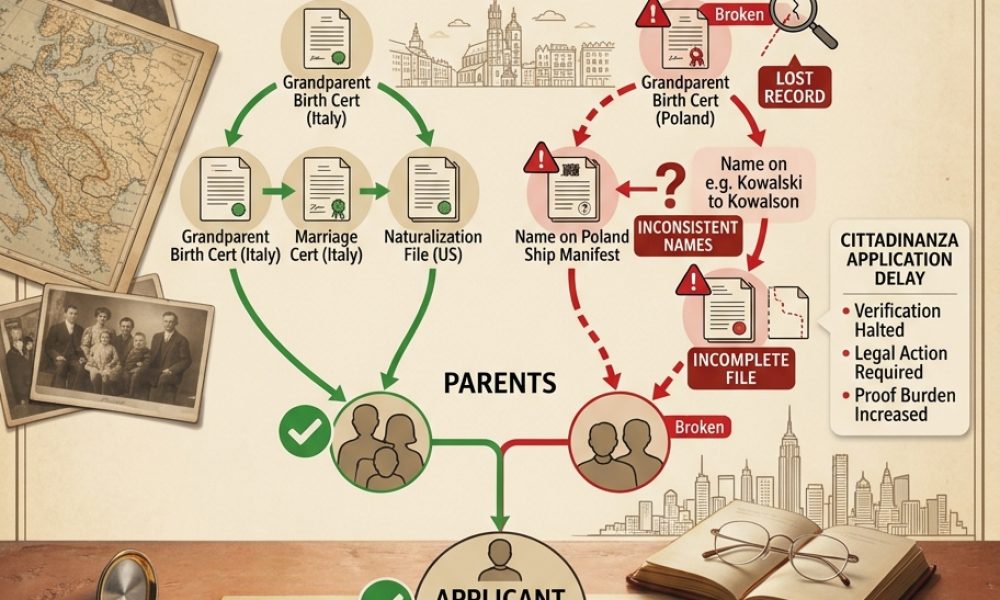
Applicants seeking ancestral citizenship may face lost birth certificates, inconsistent names, and incomplete immigration files that complicate verification of family lineage.
WASHINGTON, November 13, 2026: Americans seeking citizenship through European parents, grandparents, or more distant ancestors are discovering that the hardest obstacle may be neither family history nor language, but obtaining records created decades before modern Identification systems existed.
A plausible claim can remain unresolved when a birth was registered under an unfamiliar surname, a courthouse no longer holds an immigrant’s naturalization papers, or a historical border change scattered original documents among different countries. The evidentiary challenge can last for months because applicants often depend on offices in several jurisdictions, each with different retention schedules, request forms, privacy protections, and standards for producing certified records suitable for foreign legal proceedings.
As interest in second citizenship persists in 2026, applicants must distinguish a genuine gap in proof from a legal obstacle no document can fix, because the issuing government ultimately determines both eligibility and acceptable evidence.
Citizenship Claims Require More Than a Family Story
Citizenship by descent generally depends on a legally recognized connection between successive generations, meaning applicants must establish who their ancestors were, whether those relatives held the relevant nationality, and whether citizenship could pass onward at each birth.
A photograph of a Polish grandfather, an Italian surname, or an Irish family tradition can point investigators toward useful archives. Still, these clues rarely replace the certified civil documents that nationality authorities expect to review. Genealogists and nationality lawyers also approach these discoveries differently, because identifying a likely relative is an investigative achievement while proving citizenship requires a legally sufficient explanation of relationships, dates and nationality status that an official reviewer can independently evaluate.
The distinction matters because an incomplete file may delay confirmation of citizenship that already exists. At the same time, a well-documented family can still be ineligible under historical loss rules, registration deadlines, or more recent statutory restrictions.
Birth Certificates Are Often the First Missing Link
A long-form birth certificate normally identifies a child’s parents, allowing officials to connect the applicant to an earlier qualifying generation. Still, short-form certificates and index entries may omit precisely the names needed for legal verification.
Families should first establish which government office registered the birth, whether the record was later transferred to a state archive, and whether a newly issued certified copy is available despite the loss of the original family certificate. Ask specifically for a full certified entry showing parental details rather than ordering the most convenient abbreviated certificate, because a document suitable for school enrollment may omit the information an overseas citizenship authority requires.
If no record exists or it has been destroyed, the next step is to request an official written explanation from the responsible registry and check whether the destination country permits a substitute, rather than inventing or informally recreating evidence.
Ireland Recognizes a Narrow Historical Exception for Early Births
Irish Foreign Birth Registration ordinarily requires original civil birth records for the applicant, the qualifying parent and the Irish-born grandparent, together with supporting marriage, identity and name-change documents relevant to the family’s recorded history.
Because civil registration of births began in Ireland in 1864, the Irish Department of Foreign Affairs states that an applicant whose grandparent was born before that year may supply a baptismal certificate instead of a civil birth certificate. The accommodation shows how an issuing government can recognize the limits of historical recordkeeping without waiving proof entirely, because the substitute still must identify the relevant ancestor and meet the prescribed Foreign Birth Registration evidence requirements.
That accommodation should not be generalized to every missing Irish document, since an applicant with a grandparent born after civil registration began still needs to follow current official instructions and satisfactorily establish each generation’s relationship.
Italian Municipalities and Consulates Can Demand Corrections
Italian citizenship applications often require an extract from the ancestral municipality’s birth register, not an ordinary photocopy, along with foreign birth and marriage certificates that identify every descendant in the proposed transmission line.
The Italian consulate in Toronto advises applicants who cannot find a vital record to obtain a written statement from the registry confirming that the document does not exist, while also requiring correction of material discrepancies. Retain a written response documenting an unsuccessful official search with the original request and any registry reference numbers, as it helps distinguish a genuine absence of records from an applicant who stopped searching after one unsuccessful online inquiry.
Italy’s 2025 citizenship reforms introduced further eligibility restrictions for many foreign-born descendants, making it especially important to test the current legal route before investing heavily in archives that may establish ancestry but not eligibility.
Polish Ancestry Research Can Cross Former National Borders Confirming
Polish citizenship requires evidence that a qualifying ancestor held Polish nationality and passed it through successive generations, a task complicated when family documents originated in territories whose borders shifted during the twentieth century.
An ancestor’s village may now be in Ukraine, Belarus, or Lithuania, while surviving records might be housed in a Polish archive, a local civil registry, a religious institution, or another successor jurisdiction.
Polish consular guidance acknowledges that wartime destruction left some historical certificates unavailable. However, applicants must still establish their legal claim through acceptable documentation rather than assume that a missing birth register automatically proves Polish citizenship. Records created by religious communities or local administrations may sometimes help reconstruct an ancestral biography. However, authorities still must decide whether those materials prove nationality under the law that applied when the ancestor or descendant was born.
American Naturalization Files Can Settle Critical Dates
An emigrant’s American naturalization date can be decisive where foreign citizenship laws treated acquisition of another nationality as a possible loss event, particularly when the timing determines whether nationality passed to a child beforehand.
The United States National Archives’ naturalization research guidance explains that records predating September 1906 may remain in state or local courts, while later federal files are distributed across regional archives rather than a single comprehensive index.
A declaration of intention was typically an early procedural step rather than the final naturalization decision, so do not mistake the first papers you find for proof that an ancestor had already become American on the declaration date. Researchers should compare the declaration with any later petition, oath date, and certificate evidence, because the difference of a few years may determine whether an ancestor remained a foreign citizen when the next child in the family was born.
A Failed Archive Search Is Not Proof of Non-Naturalization
The National Archives can report that a search located no naturalization record in its holdings, but that response does not establish that the person never naturalized through another court or historical procedure in a different jurisdiction.
United States Citizenship and Immigration Services maintains separate historic immigration collections, including many certificate files and alien files. It can issue an appropriate certification of nonexistence where its statutory authority and records support that determination.
Applicants should identify which form of negative evidence the receiving foreign government requires, because a commercial database showing no search results and an official agency certification perform very different evidentiary functions during formal nationality proceedings.
Name Changes Can Create False Breaks Between Generations
A woman may appear under a birth surname in an Irish registry, a married name on an American census, and a different spelling on a later naturalization file, even though each document describes the same individual.
Other discrepancies can arise through translation, altered alphabets, phonetic spelling, adoption, clerical error or deliberate ,name changes, and each explanation should be supported by credible contemporary records rather than asserted without independent evidence.
Marriage certificates, divorce decrees, court-issued name-change orders, and corrected civil records may connect these identities. At the same time,e some consulates insist that applicants formally amend significant errors before submitting the full citizenship package for official assessment. When a registrar refuses to amend an old document, applicants should request the refusal and ask the foreign nationality authority what alternative proof it permits, rather than submitting unauthorized alterations that could undermine the credibility of every record in the file.
DNA Research May Help Identify Relatives but Does Not Replace Law
Genetic testing can reveal previously unknown biological relatives and help families locate relevant records. Yet, ancestry percentages do not independently establish citizenship, legal parentage or an entitlement to a passport from a foreign government.
In a Guardian report about DNA evidence and citizenship claims, one man traced an Irish father through genetic research. He later obtained a formal correction to his birth record before securing an Irish passport.
That sequence illustrates the value of converting genealogical leads into legally recognized documentary proof, particularly when adoption, unknown parentage or an inaccurate birth certificate initially prevents authorities from identifying the qualifying family relationship. A DNA result can help you find a previously unknown relative willing to assist with archival research. Still, formal parentage corrections must occur under applicable law and cannot be bypassed simply because relatives believe the biological connection is obvious.
Church Books and Historical Registers Offer Alternative Leads
When civil records are unavailable, church baptismal, marriage and burial registers can provide dates, locations and parental names that guide requests to government archives or help reconstruct a family timeline across successive generations.
Their evidentiary value depends on the applicable country’s instructions, however, since a parish entry accepted for one narrow historical category may not satisfy a different government’s detailed requirement for official documentary proof of citizenship.
Researchers should obtain complete, legible extracts with archival references and custodial details wherever possible, preserving enough context for an official reviewer to distinguish a genuine and verifiable historical record from an unsupported family transcription.
Destroyed Files Demand a Documented Search Strategy
Wars, fires, floods and administrative reorganizations have permanently affected some European archives, leaving descendants unable to produce the required standard certificate even when their ancestral relationship appears highly credible from several other surviving sources.
A disciplined search should identify the last known custodian, ask whether duplicate registers survive, request an official statement of nonavailability, and investigate whether another institution holds equivalent primary evidence from the relevant period.
If the receiving government authorizes a court finding, reconstructed civil record, or other alternative procedure, applicants should follow that recognized route instead of assuming that a sworn family affidavit automatically replaces records it cannot independently verify. The cost and availability of judicial reconstruction vary considerably, so a family should obtain precise guidance on whether that remedy is recognized before committing to litigation, especially where citizenship laws present another independent obstacle unrelated to documentation.
Apostilles and Translations Do Not Fix Incorrect Information
An apostille authenticates the origin of an eligible public document for use under the applicable international convention. Still, it does not guarantee that the recorded birthplace, spelling, or family relationship is factually correct.
Likewise, a certified translation renders document content into the required language without changing the underlying legal record, meaning a mistranscribed surname should normally be corrected through the issuing authority’s lawful process before final submission.
Requirements vary by consulate and document type, so applicants should confirm which records need original seals, current certified copies, apostilles, or sworn translations instead of paying to authenticate documents that cannot resolve the eligibility question.
Historical Citizenship Rules Can Make Complete Files Insufficient
Even perfect birth certificates may not establish an uninterrupted nationality line if a parent lost citizenship before a child’s birth, a registration deadline expired, or older legislation restricted transmission through a particular parent.
Polish cases can involve successive changes to nationality-loss provisions. At the same time, Irish registration depends on the qualifying familial relationship, and Italy’s newer restrictions may exclude applicants whose ancestors would have supported claims under previous rules.
A proper preliminary review should therefore separate the factual task of proving family connections from the legal task of establishing citizenship at each relevant date, preventing families from mistaking more research for a guaranteed remedy.
Applications for Children Add Another Layer of Urgency
An adult pursuing recognition through an ancestor may also need to determine whether their own child qualifies, since some systems grant nationality automatically. In contrast, others require registration completed before the next generation is born.
Irish Foreign Birth Registration is particularly significant when an overseas-born parent must register before a child’s birth to use the relevant route, making delayed document searches and unresolved application files consequential for future family eligibility.
Families planning births, adoption or overseas relocation should map these deadlines before requesting records, because an archive delay can become more than an administrative inconvenience when the governing law assigns legal consequences to timing.
Private Research Requires Careful Handling of Personal Records
Birth certificates, adoption files, naturalization petitions and passports contain sensitive personal and family information, sometimes involving living relatives who have not agreed to have their identities or histories circulated among multiple commercial researchers or websites.
Applicants should use authorized repositrrepositories of researchers’ credentialsid distributing unredacted Identification documents unnecessarily, whing apwhile respectingble legal restrictions on accessing sealed records or confidenconfidential informationing other individuals and their families.
A reliable adviser can organize evidence and explain a government’s requirements. Still, no private consultant can lawfully alter official civil registers, invent a parentage connection, or guarantee an issuing authority will accept deficient proof.
A Family Timeline Can Reduce Unnecessary Expense
The practical starting point is a chronological chart recording each ancestor’s full names, birth and marriage dates, places of residence, naturalization events, and available documents, with uncertainties identified rather than silently filled in with assumptions. A simple evidence inventory can distinguish records already in hand from items requested, missing, or legally unnecessary, making it easier to coordinate siblings or cousins who share ancestors while avoiding duplicate orders and inconsistent submissions to different authorities.
Applicants can then request the most consequential missing records first, beginning with proof of a qualifying ancestor’s citizenship and the documents linking the next generation, before ordering every possible certificate in the wider family tree.
Those comparing lawful international mobility options may consult Amicus International Consulting’s second-passport services for guidance on organizing objectives and documentation, while understanding that citizenship recognition and passport issuance remain exclusively within the relevant government’s legal authority.
Missing Documents Can Delay a Claim Without Defining Its Outcome
The absence of a grandparent’s birth certificate or an immigrant’s final naturalization order should prompt a methodical investigation rather than an automatic conclusion that citizenship is impossible, particularly where authorized substitutes or duplicate archives exist. The reverse conclusion is equally premature, because a church register, family genealogy, or favorable online search result may strengthen the research hypothesis without satisfying the precise admissibility and transmission rules that the foreign citizenship authority must apply.
Equally, families should recognize that a comprehensive collection of historical records cannot overcome a disqualifying statutory rule.T hatt evidence quality, filing deadlines, and government interpretation ultimately govern the outcome of a citizenship application.
For Americans exploring ancestral citizenship in 2026, the strongest strategy combines current legal analysis, carefully authenticated family records and transparent explanations of documentary gaps, protecting both the integrity of the application and the family’s long-term mobility plans.




