
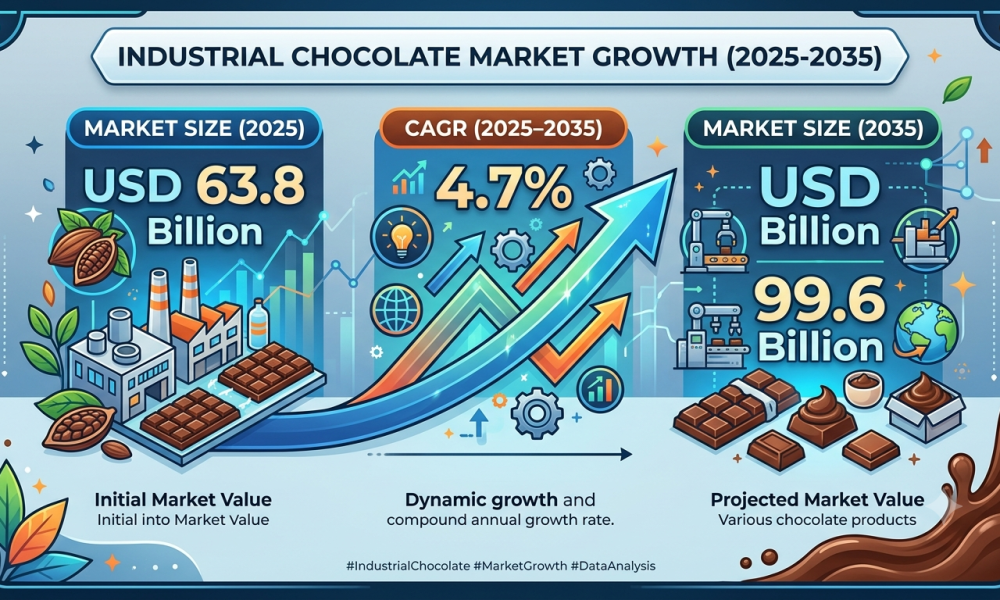
The global industrial chocolate market is projected to grow from USD 63.8 billion in 2025 to USD 99.6 billion by 2035, registering a 4.7% CAGR during the forecast period. Demand is supported by growing chocolate use across bakery and confectionery manufacturing, rising interest in premium and specialty formulations, and increasing adoption of plant-based, low-sugar, and functional chocolate products. Food manufacturers are also placing greater emphasis on cocoa traceability, ethical sourcing, and formulation flexibility.
Premium chocolate ingredients are creating additional opportunities for industrial chocolate suppliers, particularly as bakery, dairy, confectionery, and dessert manufacturers seek consistent flavor, texture, and product performance. Sustainability is also becoming an important purchasing consideration, with manufacturers increasingly focusing on ethically sourced cocoa, clean-label products, and traceable supply chains. At the same time, advances in processing, automation, AI-led recipe customization, and specialized formulations are supporting product development across end-use industries.
Get detailed market forecasts, competitive benchmarking, and pricing trends: https://www.futuremarketinsights.com/reports/sample/rep-gb-16643
Global Segment Leaders
- Product Type – Cocoa Butter: 42.3% in 2025. Cocoa butter leads the product segment because of its extensive use in chocolate, bakery products, confectionery, and other food applications. Its contribution to smooth texture and mouthfeel supports continued demand among manufacturers.
- Application – Bakery: 56.6% in 2025. Bakery applications account for the largest share as industrial chocolate is widely used in cakes, pastries, cookies, brownies, and other baked products for flavor, texture, and visual appeal.
- Product Type – Cocoa Liquor: 35.0% in 2025. Cocoa liquor remains an important industrial chocolate ingredient, serving as a base for dark, milk, and white chocolate formulations and benefiting from demand for premium and specialty chocolate products.
- Application – Ice Cream and Frozen Desserts: 18.0% in 2025. Chocolate is widely used in coatings, swirls, inclusions, and other frozen dessert applications. Premium, plant-based, and functional frozen desserts are also creating opportunities for industrial chocolate suppliers.
Country-Level Performance
China is projected to record the fastest growth among the profiled countries, with a 6.1% CAGR from 2025 to 2035. Growth is supported by urbanization, an expanding middle class, rising disposable incomes, and increasing demand for imported and premium chocolate products. Online retail is also improving consumer access to a wider range of chocolate products.
South Korea is expected to grow at a 5.5% CAGR, supported by rising demand for premium chocolates, expanding dessert consumption, and increasing presence of international chocolate brands in the domestic retail market.
The United States is forecast to expand at a 5.2% CAGR, supported by established confectionery and chocolate manufacturing capabilities, along with rising demand for premium, organic, plant-based, and sugar-free chocolate products.
Germany is projected to record a 4.9% CAGR. The country’s established chocolate industry, strong production base, export activity, and growing demand for sugar-free and functional chocolate products are supporting market development.
The United Kingdom is expected to expand at a 4.8% CAGR, supported by demand for ethically and sustainably produced chocolate, increasing interest in dark and high-cocoa-content products, and continued e-commerce penetration.
Australia is forecast to grow at a 4.7% CAGR, with demand supported by organic and sugar-free chocolate products, premiumization, sustainably sourced cocoa, and the expansion of supermarket and specialty retail channels.
Italy is projected to record a 4.6% CAGR, supported by demand for fine and bean-to-bar chocolates, premium flavor profiles, tourism, and high-quality cocoa ingredients.
France is expected to grow at a 4.5% CAGR, with its established gourmet chocolate culture, demand for premium and fair-trade products, and growing interest in organic chocolates supporting the market.
New Zealand is forecast to expand at a 4.4% CAGR, driven by demand for premium and ethically sourced chocolates, new flavor combinations, and growing interest in dairy-free and plant-based products.
Japan is projected to grow at a 4.3% CAGR, supported by demand for premium-quality chocolate, distinctive flavors, gift-giving occasions, and functional chocolate products.
Regional Context
China and South Korea represent the faster-growing country markets among those profiled, with CAGRs of 6.1% and 5.5%, respectively. China’s growth is linked to urbanization, rising disposable incomes, premium chocolate consumption, and online retail access, while South Korea benefits from premium chocolate demand, evolving dessert preferences, and the growing presence of international brands.
The United States, Germany, the United Kingdom, Australia, Italy, France, New Zealand, and Japan represent more established markets, with CAGRs ranging from 5.2% to 4.3%. Their markets are supported by premiumization, established food-processing industries, specialty chocolate demand, sustainable sourcing, and innovation in plant-based, organic, sugar-free, and functional formulations.
The full report covers North America, Latin America, Western Europe, Eastern Europe, South Asia & Pacific, East Asia, Central Asia, Balkan and Baltic Countries, Russia and Belarus, and the Middle East & Africa, with detailed country-level analysis.
Competitive Landscape
The competitive landscape includes Barry Callebaut, Cargill, Nestlé, Blommer Chocolate Company, Mars Inc., Puratos Group, Mondelez International, The Hershey Company, Fuji Oil Holdings Inc., and Olam Food Ingredients. The market features multinational chocolate manufacturers, cocoa processors, ingredient suppliers, and specialized players competing through vertically integrated supply chains, R&D investment, sustainability initiatives, product innovation, and long-term relationships with bakery, dairy, and confectionery manufacturers.
Suppliers are increasingly differentiating through traceable cocoa sourcing, flexible formulation capabilities, premium and specialty products, and solutions addressing plant-based, functional, and reduced-sugar demand. Processing technologies, including precision fermentation for cocoa alternatives and AI-led recipe customization, are also expected to influence competitive strategies.
FMI Principal Consultant for Food and Beverage Nandini Roy Choudhury notes that industrial chocolate demand is expected to favor suppliers capable of providing stable cocoa inputs and flexible formulation services, particularly as bakery and dessert manufacturers seek traceable sourcing programs and reliable production capacity for high-volume contracts.
Access full Report in PDF Format@ https://www.futuremarketinsights.com/reports/brochure/rep-gb-16643
Market Challenges and Opportunities
Cocoa price volatility remains a significant challenge for industrial chocolate manufacturers. Supply disruptions, geopolitical factors, climate-related risks, and dependence on cocoa cultivation can contribute to raw-material price fluctuations and pressure manufacturer margins.
At the same time, changing consumer preferences are creating opportunities for suppliers offering sugar-free, plant-based, functional, organic, and sustainably sourced chocolate ingredients. Growing demand for premium bakery products, specialty chocolates, frozen desserts, and clean-label formulations is supporting new applications for industrial chocolate.
About Future Market Insights (FMI)
Future Market Insights, Inc. (FMI) is an ESOMAR-certified, ISO 9001:2015 market research and consulting organization, trusted by Fortune 500 clients and global enterprises. With operations in the U.S., UK, India, and Dubai, FMI provides data-backed insights and strategic intelligence across 30+ industries and 1200 markets worldwide.



