
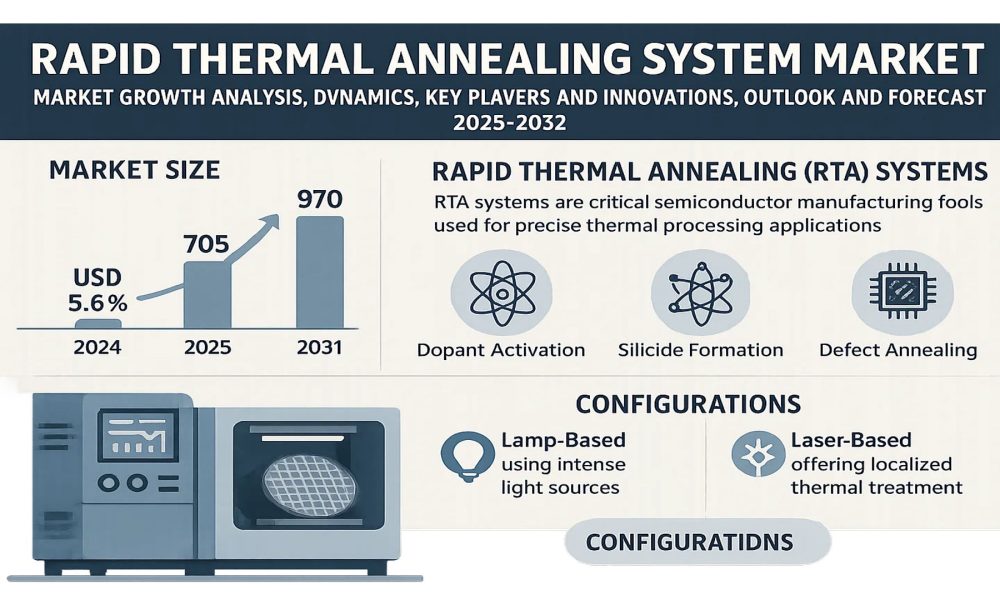
The Global Rapid Thermal Annealing System Market was valued at USD 667 million in 2024. The market is projected to grow from USD 705 million in 2025 to USD 970 million by 2031, exhibiting a CAGR of 5.6% during the forecast period.
Rapid thermal annealing (RTA) systems are critical semiconductor manufacturing tools used for precise thermal processing applications. These systems enable ultra-fast heating and cooling of semiconductor wafers, facilitating processes like dopant activation, silicide formation, and defect annealing. RTA technology comes in two primary configurations: lamp-based systems using intense light sources and laser-based systems offering localized thermal treatment.
The market growth is driven by increasing demand for advanced semiconductor devices and ongoing miniaturization trends in electronics. The expansion of 5G networks, IoT applications, and AI hardware has particularly accelerated adoption. However, high equipment costs and technical complexities present challenges for smaller manufacturers. Key industry players like Applied Materials and Kokusai Electric continue to innovate, with recent developments focusing on improved temperature uniformity and energy efficiency in next-generation RTA systems.
Download Your Free Copy of the Sample Report- https://www.intelmarketresearch.com/download-free-sample/10035/rapid-thermal-annealing-system-market
MARKET DYNAMICS
MARKET DRIVERS
Semiconductor Miniaturization Trends Accelerating RTA Adoption
The relentless push toward semiconductor miniaturization is driving significant demand for rapid thermal annealing systems. As chip manufacturers target nodes below 5nm, RTA’s precision in dopant activation and defect repair becomes indispensable. The global semiconductor industry’s capacity expansion projects, particularly in Asia, are creating sustained demand for thermal processing equipment. Leading foundries are currently allocating over 40-50% of their capex toward advanced node development where RTA plays a crucial role in achieving required electrical characteristics and yield rates.
Automotive Electronics Boom Fueling Equipment Investments
Electric vehicle production and advanced driver assistance systems (ADAS) are triggering unprecedented demand for power semiconductors and sensors. This automotive semiconductor segment is projected to grow at nearly 12% CAGR through 2030, creating substantial demand for RTA systems capable of processing silicon carbide and gallium nitride wafers. The stringent reliability requirements in automotive applications make precise thermal processing non-negotiable, pushing manufacturers to upgrade their annealing capabilities. Major players are now developing specialized RTA configurations tailored for wide bandgap semiconductor processing.
➤ Recent studies indicate that thermal budget control during annealing contributes to over 30% performance variation in power MOSFETs, making RTA system selection critical for automotive-grade production.
Government Investments in Domestic Semiconductor Manufacturing
National semiconductor self-sufficiency initiatives like the CHIPS Act in the U.S. and similar programs in Europe are driving billions in fab construction projects. Each new 300mm wafer facility typically requires 50-100 thermal processing tools, with RTA systems representing a significant portion. These capacity expansions, coupled with technology transfer requirements in emerging semiconductor nations, are creating durable demand across the RTA equipment market.
MARKET OPPORTUNITIES
Emerging Materials Science Applications Creating New Markets
Beyond traditional semiconductor manufacturing, RTA technology is finding novel applications in advanced materials development. The growing fields of flexible electronics and quantum dot displays require precise thermal processing at temperatures below 400°C – a sweet spot for modern RTA systems. Research institutions specializing in 2D materials like graphene are increasingly adopting customized RTA solutions, creating a niche but high-value market segment with 25%+ annual growth potential.
AI-Driven Process Optimization Opening Service Revenue Streams
The integration of machine learning with RTA systems enables real-time process adjustments and predictive maintenance capabilities. Equipment manufacturers are developing subscription-based analytics platforms that can improve anneal uniformity by 15-20% through adaptive control algorithms. This shift toward smart, connected thermal processing tools creates recurring revenue opportunities beyond traditional equipment sales while reducing barriers to adoption through performance guarantees.
Aftermarket and Upgrade Cycles Sustaining Mature Markets
With semiconductor fabs typically refreshing their tool sets every 5-7 years, the RTA market benefits from a steady stream of upgrade opportunities. Older systems often require expensive part replacements or control system modernizations to maintain process consistency. Equipment vendors are establishing dedicated service divisions offering retrofit packages that can extend tool lifespans while incorporating the latest thermal control technologies at 30-50% of the cost of new systems.
Segment Analysis:
By Type
- Lamp-based
- Laser-based
Lamp-based systems dominate due to their high efficiency, uniformity in heating, and lower operational costs compared to laser-based solutions.
By Application
- Semiconductor Manufacturing
- Advanced Packaging
- Solar Cell Production
- R&D Laboratories
Semiconductor Manufacturing holds the largest share, driven by increasing demand for high-performance chips and advanced thermal processing requirements.
By End User
- Foundries
- IDMs (Integrated Device Manufacturers)
- Research Institutions
Foundries lead the market, supported by large-scale semiconductor production and process optimization needs.
By Heating Method
- Conduction
- Convection
- Radiation
Radiation-based heating is most widely used due to its rapid processing, uniform temperature distribution, and suitability for semiconductor applications.
List of Key Rapid Thermal Annealing System Companies Profiled
- Applied Materials, Inc. (U.S.)
- Kokusai Electric Corporation (Japan)
- Mattson Technology, Inc. (U.S.)
- ADVANCE RIKO, Inc. (Japan)
- Koyo Thermo Systems Co., Ltd. (Japan)
- AnnealSys SAS (France)
- ECM GmbH (Germany)
- CVD Equipment Corporation (U.S.)
- SemiTEq JSC (Russia)
RAPID THERMAL ANNEALING SYSTEM MARKET TRENDS
Semiconductor Industry Expansion Driving Market Growth
The Rapid Thermal Annealing (RTA) System Market is experiencing robust growth, driven primarily by the semiconductor industry’s demand for advanced thermal processing solutions. As semiconductor nodes shrink below 7nm, manufacturers increasingly rely on RTA systems for dopant activation, oxide growth, and silicide formation critical steps in chip fabrication. These systems enable precise, rapid heating (up to 1200°C in seconds) with minimal thermal budget, improving device performance while reducing production costs. The global adoption of 5G, IoT devices, and AI accelerators continues to push semiconductor manufacturers toward adopting next-generation RTA equipment to meet evolving technological requirements.
Other Trends
Transition to Larger Wafer Sizes
The shift from 200mm to 300mm wafer production, particularly among leading foundries, is accelerating investments in high-throughput RTA systems. Recent industry data highlights that over 65% of new semiconductor fabrication facilities under construction are designed for 300mm wafer processing. This transition necessitates RTA systems capable of handling larger substrates while maintaining uniformity across the entire wafer surface. Equipment manufacturers are responding with multi-zone heating technologies and improved temperature control algorithms to minimize thermal gradients factors directly impacting yield rates in advanced logic and memory device production.
Integration of AI and Advanced Process Control
The integration of machine learning algorithms into RTA systems is revolutionizing thermal process optimization in semiconductor manufacturing. Advanced systems now utilize real-time temperature profiling and predictive maintenance capabilities, reducing defect rates by up to 30% compared to conventional systems. Key players are developing AI-driven closed-loop control systems that automatically adjust heating parameters based on in-situ metrology data, ensuring consistent results across production batches. This technological evolution aligns with the industry’s broader trend toward smart manufacturing and Industry 4.0 adoption, where data-driven process control significantly enhances operational efficiency.
Demand from Emerging Applications
Beyond traditional semiconductor manufacturing, RTA systems are gaining traction in emerging applications like advanced packaging and photovoltaic device production. In heterogeneous integration architectures such as 3D ICs, RTA processes enable reliable bonding interfaces while preventing thermal damage to stacked dies. The solar energy sector also benefits from rapid thermal processing for PERC (Passivated Emitter Rear Cell) solar cell manufacturing, where precise temperature control enhances conversion efficiency. Industry projections suggest these non-semiconductor applications could account for over 15% of the RTA system market revenue by 2031, creating new growth avenues for equipment suppliers.
Recent Developments in the Rapid Thermal Annealing (RTA) System Market:
- Advancement in Semiconductor Manufacturing:
In 2024, several semiconductor manufacturers adopted next-generation RTA systems with improved temperature uniformity and faster ramp rates. These systems are crucial for advanced process nodes below 5nm, where precise dopant activation and defect repair are required. - Integration with AI & Automation:
Leading players like Applied Materials and Kokusai Electric are integrating AI-driven process control into RTA systems. This development enhances predictive maintenance, improves yield, and ensures consistent wafer quality in high-volume fabs. - Expansion in Compound Semiconductors:
Recent R&D investments are directed toward RTA solutions optimized for wide-bandgap semiconductors such as SiC and GaN. These materials are increasingly used in EV power electronics, 5G infrastructure, and renewable energy applications, boosting demand for advanced annealing technologies. - Sustainability and Energy Efficiency:
Manufacturers are focusing on energy-efficient RTA systems with reduced power consumption and better cooling technologies. This aligns with semiconductor fabs’ goals to lower carbon emissions and operational costs. - Strategic Partnerships and Capacity Expansion:
In 2025, key equipment suppliers announced collaborations with foundries in Asia (Taiwan, South Korea, and China) to support growing demand for advanced nodes. Several fabs also expanded their RTA tool installations as part of large-scale capacity build-outs for AI chips and memory semiconductors.
Download Your Free Copy of the Sample Report- https://www.intelmarketresearch.com/download-free-sample/10035/rapid-thermal-annealing-system-market
About Intel Market Research
Intel Market Research delivers actionable insights in technology and infrastructure markets. Our data-driven analysis leverages:
- Real-time infrastructure monitoring
- Techno-economic feasibility studies
Competitive intelligence across 100+ countries
Trusted by Fortune 500 firms, we empower strategic decisions with precision.
International: +1(332) 2424 294 | Asia: +91 9169164321
Website: https://www.intelmarketresearch.com
Follow us on LinkedIn: https://www.linkedin.com/company/intel-market-research




