
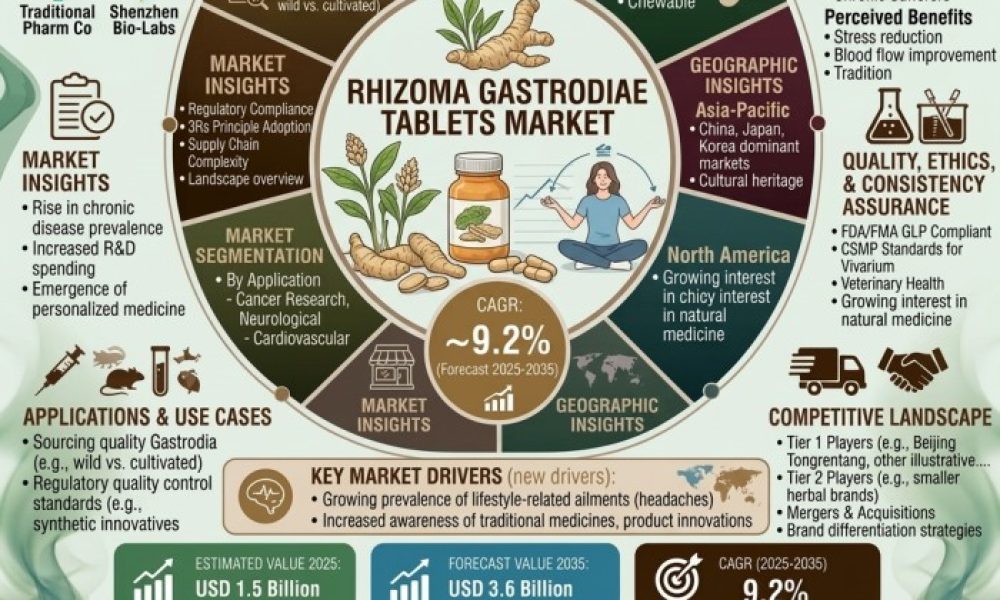
Standardization, traditional-medicine integration and expanding digital pharmacy access are reshaping demand for Gastrodia-based tablets, according to Fact.MR.
NEWARK, Del., October 8, 2026. The global Rhizoma Gastrodiae Tablets Market is projected to rise from USD 14.5 billion in 2026 to USD 37.6 billion by 2036, expanding at a 10.0% CAGR, according to Fact.MR. The market is expected to create an incremental opportunity of USD 23.1 billion over the forecast period.
Get detailed market forecasts, competitive benchmarking, and pricing trends:
The strongest growth is concentrated in markets where traditional medicine is integrated into healthcare delivery. China remains the production and consumption center, while India benefits from a large base of traditional and alternative medicine practitioners. In Germany, regulatory requirements for herbal medicinal products raise evidence and quality expectations, but an established phytopharmaceutical tradition supports niche demand for standardized formulations. Demand is also shaped by growing preference for herbal and complementary medicine, alongside a shift toward preventive healthcare.
Where growth is fastest
- China: 13.5% CAGR through 2036. Extensive traditional Chinese medicine integration, provincial manufacturing capacity and hospital pharmacy supply support demand.
- India: 12.5% CAGR. Traditional-medicine practitioners, complementary-medicine adoption and online pharmacy access support expansion.
- Germany: 11.5% CAGR. EU herbal-medicinal-product requirements favor standardized, documented products, while phytopharmaceutical demand supports pharmacy channels.
- Brazil: 10.5% CAGR.
- USA: 9.5% CAGR, with complementary-medicine and self-care demand supporting online and retail channels.
- United Kingdom: 8.5% CAGR.
- Japan: 7.5% CAGR, supported by Kampo integration and preference for documented, standardized formulations.
What leads the market
- Standard Rhizoma Gastrodiae Tablets: 46.8% of product share in 2026, supported by established demand, procurement scale and broad distribution.
- Neurological Disorders: 71.3% of application share in 2026, making it the dominant application segment.
The hurdle
The main constraint is uneven standardization. Fact.MR identifies regulatory hurdles for herbal medicines, limited standardized clinical evidence and difficulty maintaining consistent product quality across manufacturers as barriers to acceptance outside traditional-medicine markets. Heavy concentration of demand and supply in China also limits addressable demand in markets where traditional medicine has lower adoption.
Recent developments
Two developments highlighted by Fact.MR occurred through 2025. Expansion of e-commerce and online pharmacy platforms broadened access to rhizoma gastrodiae tablets beyond hospital channels, supporting self-care and preventive use. Continued research into Gastrodia elata efficacy and safety also supported potential wider acceptance by healthcare professionals.
Key companies profiled include Zhaotong Huacheng Pharmaceutical, Guangdong Luofushan National Pharmaceutical, Tongrentang Chinese Medicine, Guizhou Bailing, Guangxi Chanfang Pharmaceutical, Lanzhou Foci Pharmaceutical, Shaanxi Tianyang Pharmaceutical, Taiji Group Sichuan Mianyang Pharmaceutical and Yunnan Baiyao Group.
Analyst quote
“This is a traditional Chinese medicine market whose trajectory hinges on standardization and integration with mainstream care. China dominates both production and consumption, with TCM embedded in healthcare delivery, so the growth question outside China is whether quality control and evidence can earn broader acceptance. Standard tablets lead, but standardized extraction and sustained-release formats are where credibility builds.
China and India anchor growth through deep practitioner bases and rising neurological-disorder prevalence. The manufacturers best positioned combine reliable Gastrodia supply with extraction consistency and documentation, since fragmented quality remains the main barrier to cross-market trust and clinical adoption.”
— Shambhu Nath Jha, Principal Consultant at Fact.MR
What this means for manufacturers, distributors and healthcare procurement teams
- Prioritize standardization. Consistent extraction, quality-control systems and documentation are increasingly relevant to acceptance beyond core traditional-medicine markets.
- Build channel coverage selectively. China and India offer the fastest country growth, while online pharmacy expansion can extend access beyond hospital channels.
- Treat evidence and regulatory readiness as market-entry requirements. Western markets face stronger herbal-medicine requirements and lower traditional-medicine adoption, making product documentation and quality evidence important commercial considerations.
Explore More Related Studies Published by Fact.MR Research
Non-Invasive Diagnostic Tests Market
Disposable Spirometry Filters Market
About Fact.MR
Fact.MR is a market research and consulting firm providing syndicated research, customized research, investment research, and market intelligence across a broad range of industries. Its research coverage includes food and beverage, healthcare, pharmaceuticals, biotechnology, consumer products, chemicals and materials, technology, industrial goods, and packaging.
Fact.MR provides market intelligence designed to help organizations understand market dynamics, emerging opportunities, competitive developments, and changing industry requirements.
Media Contact
Fact.MR
Email: [email protected]
Phone: +1 (628) 251-1583
Website: www.factmr.com



