
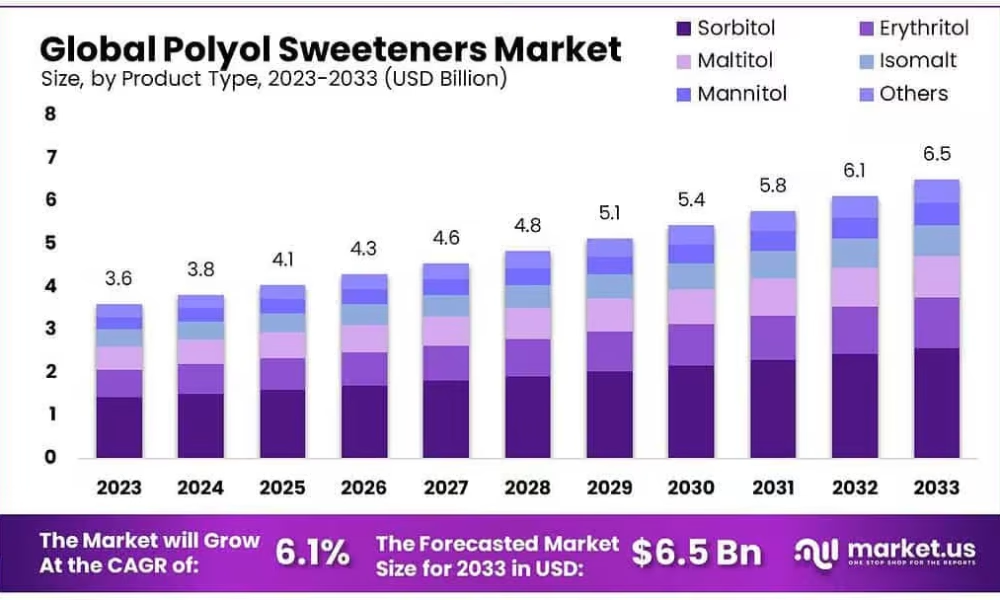
According to market.us, the Polyol Sweeteners Market is projected to reach approximately USD 6.5 billion by 2033, rising from USD 3.6 billion in 2023, with a compound annual growth rate (CAGR) of 6.1% over the period from 2023 to 2033.
Polyol sweeteners, commonly referred to as sugar alcohols, are increasingly recognized as a better-for-you substitute for traditional sugars across food, beverage, pharmaceutical, and personal care applications. Key variants such as xylitol, sorbitol, erythritol, and maltitol are derived from natural sources like fruits and vegetables, though they are typically produced industrially to meet rising demand. These compounds deliver sweetness with significantly fewer calories and minimal impact on blood sugar levels, which makes them ideal for low-glycemic and sugar-restricted products.
Their adoption is being driven by growing public concern over sugar-related health issues, including obesity and diabetes, as well as a broader shift toward wellness-focused consumption. Beyond sugar-free snacks and bakery items, polyol sweeteners are frequently used in oral care products due to their ability to prevent tooth decay.
Regulatory efforts to reduce added sugar in consumer products, particularly in North America and Europe, are accelerating this shift. Meanwhile, the Asia Pacific region is witnessing rapid growth supported by increasing awareness of health benefits and the expansion of processed and functional food categories.
Key Takeaways
- Market Growth Projection: The Polyol Sweeteners Market is projected to reach around USD 6.5 billion by 2033, growing from USD 3.6 billion in 2023, at a steady CAGR of 6.1% during 2023-2033.
- Market Leaders: Sorbitol dominates with a 39.7% share in the market due to its widespread use in various food and beverage products, driven by lower caloric intake and dental health benefits.
- Application Diversity: These sweeteners find applications beyond food and beverages, extending to personal care, pharmaceuticals, and industrial uses like paints, coatings, and textiles.
- Form Preferences: Powder/Crystal form holds over 72.3% of the share due to ease of use, versatility across industries, longer shelf life, and suitability for various manufacturing processes.
- Function Significance: Flavoring and sweetening Agents lead with 52.6% market share, playing a crucial role in enhancing taste profiles without the drawbacks of regular sugar.
- Regional Dynamics: North America currently holds the highest revenue share at over 44.6%, but the fastest growth rate is expected in the Asia Pacific due to increased purchasing power and rising demand for sugar-free products.
Access a Complimentary Sample of This Premium Report: https://market.us/report/polyol-sweeteners-market/request-sample/
Factors Affecting the Growth of the Polyol Sweeteners Market
Rising Health Awareness and Lifestyle Shifts: Consumers are increasingly prioritizing healthier eating habits due to growing concerns over obesity, diabetes, and cardiovascular diseases. This shift is fueling the demand for low-calorie and low-glycemic alternatives like polyol sweeteners, especially in products marketed as sugar-free or diabetic-friendly.
Expanding Applications Across Industries: Polyol sweeteners are being widely adopted not only in the food and beverage industry but also in pharmaceuticals and personal care products. Their use in functional foods, oral care products, and sugar-free medications continues to expand, contributing significantly to market growth.
Supportive Regulatory Environment: Government regulations and health guidelines encouraging reduced sugar intake have pushed manufacturers to reformulate products using alternatives like polyols. Approvals for use in food and safety recognition by international food safety authorities also play a major role in boosting industry adoption.
Growth of Functional and Clean-Label Foods: As consumers increasingly look for clean-label, plant-derived, and functional ingredients, polyol sweeteners are finding greater traction. Their natural sourcing and multi-functional benefits align well with the demands of health-conscious consumers seeking transparency in food labels.
Technological Advancements in Sweetener Production: Innovations in fermentation, extraction, and processing technologies have made the production of polyol sweeteners more efficient and cost-effective. These advancements have improved product availability and allowed manufacturers to enhance the taste, stability, and versatility of polyol-based formulations.
Key Market Segmentation
By Product Analysis
Sorbitol holds a dominant position in the polyol sweeteners market with a 39.7% share, making it the leading product segment. Its wide acceptance is driven by its low-calorie content and benefits for dental health, which make it a preferred choice in numerous food and beverage applications. Sorbitol is a key ingredient in products like surimi—a refined, uncooked fish paste—and is also used to enhance flavor balance in carbonated drinks and fruit juices. Its growing use in dietary supplements and processed foods is expected to further boost demand.
Beyond the food sector, sorbitol serves as a thickener and moisturizer in skincare products such as milky lotions, face masks, and creams. Additionally, its applications are expanding into other industries, including paints and coatings, textiles, surfactants, and tobacco, which is anticipated to create new growth avenues.
In parallel, mannitol—a related sweetener—continues to gain traction in pharmaceutical applications due to its role in reducing intracranial pressure and treating oliguric kidney failure. Administered intravenously, mannitol is filtered by the kidneys, reinforcing its importance in critical care and clinical treatments.
By Form Analysis
In 2023, the Powder/Crystal form led the polyol sweeteners market, accounting for over 72.3% of the total share. Its dominance is largely attributed to its versatility, ease of handling, and compatibility across various industries such as food and beverage, pharmaceuticals, and personal care. The powder or crystalline form offers practical advantages like longer shelf life, stability during transport, and ease of incorporation into different formulations, making it a preferred choice among manufacturers.
The demand for powdered and crystalline sugar alcohols is expected to maintain an upward trend. Their role as bulking and coating agents in food production adds to their functional appeal. Common applications include mint tablets, polydextrose, and a range of sugar-free frozen seafood products such as shrimp ball fillets, roasted fish fillets, frozen raw fish, and dried squid threads, particularly popular in countries like South Korea and China. Xylitol crystals and powdered sorbitol are especially in demand within these segments.
Meanwhile, syrup or liquid forms of polyol sweeteners are also gaining momentum due to their high water solubility. This characteristic makes them ideal for pharmaceutical, nutraceutical, and certain industrial applications. As awareness of low-calorie dietary benefits continues to spread, the popularity of liquid sugar alcohols is also expected to grow steadily.
By Function Analysis
In 2023, Flavoring & Sweetening Agents dominated the polyol sweeteners market, capturing approximately 52.6% of the total share. This dominance is driven by their widespread use in food, beverages, and pharmaceuticals, where they replicate the sweetness of sugar without the associated calories. These sweeteners are essential in sugar-free products such as candies, desserts, beverages, and even certain medicinal formulations.
Polyol sweeteners are often blended with high-intensity sweeteners like saccharin, acesulfame potassium, and neotame to produce sugar-free confectionery. Their moderate sweetness, combined with sugar-like texture and bulk, enhances the appeal of processed food items. This makes them a preferred ingredient in various formulations across the food and beverage industry.
Crystalline polyols such as erythritol and xylitol are known for their cooling sensation, especially in mouthfeel applications. This property contributes to their increasing use in menthol-flavored products, further expanding their utility. In addition to taste, polyols help improve texture and volume in baked goods and confectionery, with popular choices including sorbitol, maltitol, mannitol, and xylitol.
Moreover, polyols are finding growing application in the cosmetics industry as humectants due to their moisture-retaining properties. This diversification of applications continues to support the expansion of the polyol sweeteners market globally.
By Application Analysis
In 2023, the Food & Beverages sector held the largest share of the polyol sweeteners market, accounting for over 40.6% of the total. This dominance highlights the widespread use of these sweeteners in products such as candies, beverages, desserts, and dairy items, where they provide sweetness with reduced sugar content.
Polyol sweeteners like erythritol, isomalt, and lactitol have received Generally Recognized as Safe (GRAS) status from the U.S. Food and Drug Administration (FDA), affirming their suitability as food additives. While mannitol awaits full approval, xylitol has been permitted for use as a specialized dietary component. These regulatory endorsements support their broader use in food applications.
Sugar alcohols are also commonly used as coating agents for confectionery items, including chewing gum and hard candies, due to their non-hygroscopic properties. Mannitol and sorbitol, both with lower caloric content, are among the most frequently used polyols in such applications.
The personal care and cosmetics segment, although smaller, is anticipated to witness steady growth in the coming years as polyols gain popularity as moisturizing agents and humectants in various skincare and hygiene products.
Key Market Segments
By Product
- Sorbitol
- Xylitol
- Mannitol
- Maltitol
- Isomalt
- Other Products
By Form
- Powder
- Liquid
By Function
- Flavoring & Sweetening Agents
- Excipients
- Bulking Agents
- Humectants
- Other Functions
By Application
- Food & Beverages
- Personal Care & Cosmetics
- Pharmaceuticals
- Other Applications
Regional Analysis
In 2023, North America led the polyol sweeteners market with a revenue share exceeding 44.6%. The region is expected to witness continued growth, driven by increasing consumer demand for natural ingredients and expanding applications in personal care, particularly in markets like France and Germany.
In Europe, regulatory support such as the Horizon 2020 Strategy—approved by the European Parliament in April 2019—aims to promote the development of naturally derived products. This policy initiative is expected to boost the demand for polyol sweeteners in the region’s food and beverage sector over the forecast period.
Polyol sweeteners are also gaining traction in non-food applications, including their role as detergents, dispersants, wetting agents, and emulsifiers. The rising preference for bio-based products in Europe is fostering greater adoption of biobased surfactants like sorbitol and rhamnolipids. Environmental regulations aimed at reducing greenhouse gas emissions are further supporting market growth in this segment.
Asia Pacific is projected to experience the fastest growth from 2023 to 2032, fueled by rising disposable incomes, increasing consumption of sugar-free and reduced-sugar nutritional supplements, and expanding use of polyols in pharmaceutical applications. This regional momentum reflects a growing focus on health and wellness across emerging economies.
Key Market Players
- Cargill
- Archer Daniels Midland
- Dupont
- Roquette Freres
- Tereos Starch & Sweeteners
- Sudzucker
- Ingredion
- Jungbunzlauer Suisse
- Gulshan Polyols
- Batory Foods
- B Food Science
- Dfi
- Sweeteners Plus Inc.
Get in Touch with Us:
Market.us (Powered By Prudour Pvt. Ltd.)
Address: 420 Lexington Avenue, Suite 300 New York City, NY 10170, United States
Send Email: [email protected]
Refer to More Related Reports:
- Silicafumes (Cas 69012-64-2) Market
- Global Sodium Permanganate Market
- Ferrochrome Market
- Industrial Solvent Separation Membranes Market
- Lithium Ion Battery Market



