
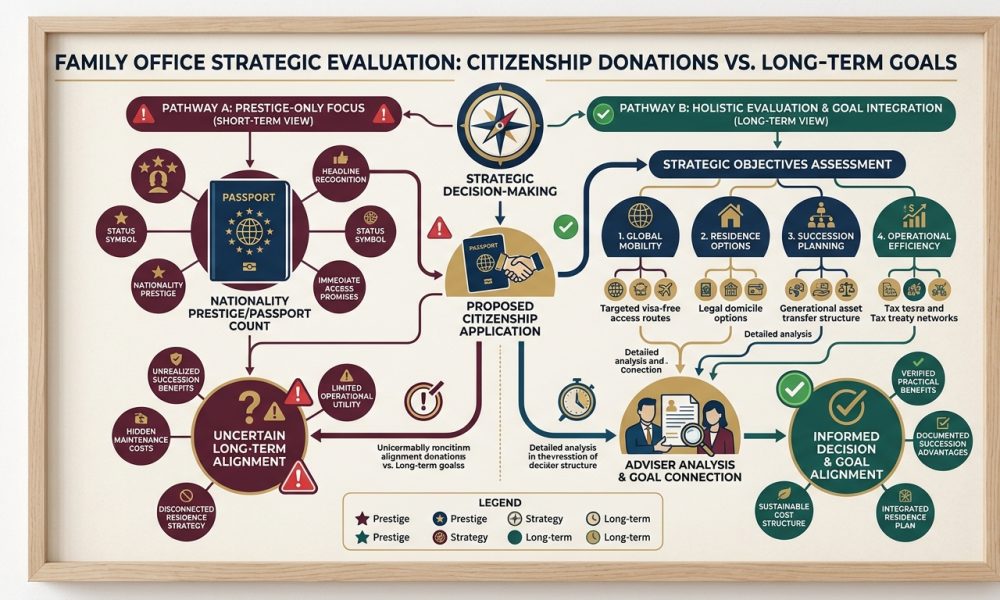
Advisers evaluating a proposed application should connect its costs and practical benefits with the family’s mobility, succession and residence objectives rather than rely on passport prestige alone.
WASHINGTON, DC, November 9, 2026 — Wealthy American families considering citizenship by investment are increasingly asking whether substantial government contributions provide lasting advantages for international mobility, succession planning, residential flexibility, and wealth preservation, rather than simply delivering another passport with an attractive global ranking.
For family offices coordinating investments, trusts, inheritance arrangements, and multigenerational financial security, citizenship applications require broader analysis than the individual eligibility assessments often emphasized by international investment migration companies and private immigration consultants.
Although contribution-based nationality programs can offer legitimate pathways to additional citizenship, the value of those arrangements depends on the family’s actual circumstances, the rights acquired, the financial commitments involved, and the stability of the relevant government’s citizenship framework.
The central challenge is establishing whether the proposed expenditure advances documented family objectives while preserving legal compliance, rather than treating an expensive second passport as a prestigious acquisition whose practical benefits remain insufficiently examined.
European Pressure Adds Uncertainty to Caribbean Citizenship Programs
Recent international developments have demonstrated why family offices must consider regulatory risk when evaluating citizenship investments, particularly where foreign governments may revise travel privileges that originally made a particular nationality commercially attractive.
An October 29, 2026, Reuters investigation into European pressure on Caribbean citizenship programs reported that Antigua and Barbuda was considering ending its investment citizenship program following European Union demands affecting five Eastern Caribbean countries.
According to the reporting, European authorities had requested commitments to phase out the programs by June 1, 2028, raising concerns that continued operation could jeopardize visa-free access to European destinations, although suspension would not occur automatically.
For families considering substantial nonrefundable contributions, these developments illustrate why current international travel privileges should be evaluated as potentially changeable benefits rather than permanent guarantees attached to citizenship acquired through government investment programs.
Family Offices Must Begin With Clearly Defined Objectives
A family office typically coordinates financial, legal, administrative, and personal planning across several generations, acquiring another nationality relevant only when it supports identifiable objectives within the family’s broader strategy.
Those objectives may include lawful residence in another jurisdiction, improved travel flexibility, educational opportunities for children, Protection against political uncertainty, or more efficient coordination of family members living and conducting business internationally.
An applicant primarily interested in convenient European travel may need a different citizenship pathway than a family seeking permanent overseas residence, succession continuity, or access to a country where relatives already have substantial personal connections.
A disciplined assessment therefore begins by documenting what the family hopes to accomplish, determining which benefits require citizenship rather than ordinary residence, and identifying the legal and financial circumstances that could undermine the proposed plan.
Contribution Costs Should Be Evaluated Against Actual Benefits
Citizenship by investment programs may require substantial government contributions, application charges, due diligence fees, professional retainers, and additional payments for qualifying dependents, creating financial commitments that extend beyond the program’s advertised minimum contribution.
Unlike a conventional investment that may produce income or retain a transferable ownership interest, a nonrefundable citizenship contribution generally represents an expenditure made to satisfy a government’s nationality requirements without creating a recoverable financial asset.
Family office advisers should therefore examine the full cost of obtaining citizenship, including professional services, documentary preparation, government screening, family application charges, and expenses associated with maintaining the intended international arrangements.
The relevant comparison is not merely whether the family can afford the expenditure, but whether the acquired rights justify the financial commitment when measured against alternative residence programs, existing nationality privileges, and realistic long-term objectives.
Passport Prestige Is an Incomplete Measure of Value
International passport rankings provide convenient comparisons of visa-free destinations. Still, they offer limited insight into whether a particular nationality will support a family’s actual travel patterns, residential plans, or multigenerational mobility requirements.
A passport with extensive visa-free access may seem attractive until advisers examine whether the relevant destinations allow extended stays, employment, permanent residence, or family settlement under the conditions the family intends to pursue.
For families maintaining businesses and residences across several continents, access to a limited number of strategically important countries may provide greater practical value than a higher overall ranking supported by destinations rarely visited.
Family offices should therefore evaluate travel privileges based on destination relevance, permitted activities, administrative requirements, and the possibility that governments may revise existing visa agreements after the citizenship application is complete.
Succession Planning Requires More Than Additional Nationality
Succession planning involves determining how family wealth, business interests, real estate, and other assets will pass between generations, while considering applicable inheritance laws, tax obligations, ownership arrangements, and the beneficiaries’ personal circumstances.
Acquiring another nationality may introduce additional rights or legal connections. Still, it does not automatically amend existing wills, change trust beneficiaries, transfer asset ownership, or establish that foreign succession legislation will govern the entire estate.
Family offices must examine whether the proposed citizenship affects inheritance rights, forced heirship provisions, matrimonial property rules, or the administration of assets located in different jurisdictions before describing the acquisition as beneficial for succession.
A family whose members hold several nationalities may need coordinated wills, properly structured trusts, and professional advice across jurisdictions to prevent conflicting assumptions about inheritance rights and the management of family assets.
American Estate and Gift Tax Obligations Remain Relevant
For wealthy American families, a second passport should not be confused with a change in federal tax status, because acquiring foreign citizenship generally does not end obligations tied to existing United States nationality.
According to the Internal Revenue Service’s official guidance for United States citizens living abroad, American citizens generally remain subject to federal worldwide income taxation and applicable estate, gift, and financial reporting requirements regardless of foreign residence.
This distinction matters most when families consider substantial asset transfers, foreign trusts, inheritance planning, or changes in residence, because those arrangements can trigger legal consequences that extend well beyond citizenship eligibility.
Family offices should coordinate qualified American and foreign tax advisers before making significant structural changes, ensuring that the anticipated benefits reflect applicable legislation rather than promotional assumptions about a country’s favorable taxation.
Tax Residency and Citizenship Must Be Considered Separately
A citizenship contribution may grant legally recognized nationality without requiring substantial physical residence in the issuing country, meaning the applicant’s tax residence may remain unchanged after receiving the new passport.
Tax residency rules vary internationally and may examine physical presence, residential accommodation, family relationships, economic interests, or other factors, making nationality only one possible consideration within a broader legal determination.
For families seeking international tax efficiency, the practical question is whether they intend to establish genuine residence elsewhere and meet the conditions required for any lawful treatment available under the destination’s legislation.
Without a meaningful change in the underlying circumstances, acquiring an additional passport may provide travel or nationality benefits while changing little or nothing about the family’s existing tax responsibilities.
Family Trusts Require Independent Legal Coordination
Trusts may form an important component of multigenerational wealth management, allowing trustees to administer assets for designated beneficiaries under legally established fiduciary duties and arrangements governing distributions, investment management, and succession.
However, obtaining citizenship in another jurisdiction does not automatically change the governing law of an existing trust, eliminate reporting obligations, or authorize trustees to disregard their responsibilities toward beneficiaries and relevant authorities.
Families considering trusts alongside international mobility plans should examine trustee residence, asset location, beneficiary status, tax reporting, and the legal treatment of foreign structures before making decisions based primarily on nationality.
A carefully coordinated plan can preserve continuity in asset administration while recognizing that succession structures and citizenship applications serve distinct purposes and may require different professional advisers.
Children’s Citizenship Rights Can Influence Long-Term Value
For families considering additional nationality, one of the most significant questions concerns whether citizenship can extend to children and subsequent generations under the issuing country’s applicable nationality legislation.
Some jurisdictions provide mechanisms for qualifying descendants to acquire citizenship, while others impose registration requirements, generational limitations, residency conditions, or restrictions that affect how nationality may be transmitted.
Family offices should review these provisions carefully because an arrangement that benefits the original applicant may offer more limited advantages to children born after naturalization or grandchildren living in another jurisdiction.
The long-term value of citizenship may therefore depend less on immediate travel convenience than on whether future generations can preserve the nationality and exercise meaningful rights without substantial additional administrative expense.
Education Planning Can Shape Citizenship Decisions
International education often shapes family mobility strategies, especially when parents want children to attend foreign schools, universities, or specialized institutions while maintaining flexibility across multiple residential jurisdictions.
A passport may simplify travel to an educational destination without necessarily establishing domestic tuition eligibility, permanent residence rights, or access to public education on the same terms as citizens of that destination.
Families should therefore review the rules governing school enrollment, university fees, residential eligibility, and parental immigration status before assuming another nationality will provide comprehensive educational advantages.
When education is a primary objective, a targeted residence arrangement or citizenship pathway tied directly to the intended country may offer more relevant benefits than a nationality chosen for a high passport ranking.
Healthcare and Retirement Planning: Further Considerations
Older family members may seek additional citizenship because of concerns about healthcare availability, retirement residence, personal security, and the possibility of establishing a permanent home outside their existing country.
Nevertheless, foreign nationality does not necessarily establish immediate eligibility for publicly financed healthcare, long-term care programs, or retirement benefits, particularly where participation depends on contributions, residence, or other statutory conditions.
Family offices should investigate healthcare costs, private insurance, long-term care arrangements, and medical access in the intended residence country before treating citizenship as an adequate substitute for comprehensive retirement planning.
The assessment should also consider whether elderly relatives can lawfully relocate with other family members, since dependent eligibility and immigration procedures may differ substantially from rules for primary citizenship applicants.
Family Members May Have Different Nationality Objectives
A multigenerational family rarely operates as a single applicant with identical needs, particularly when spouses, adult children, business partners, and elderly relatives maintain different residences, nationalities, occupations, and personal priorities.
An additional passport may offer meaningful mobility advantages to one family member while providing limited practical benefits to another who already possesses strong travel privileges or does not intend to relocate.
Family offices should identify which individuals require citizenship, which may qualify through family relationships, and whether certain dependents could achieve their objectives through alternative lawful residence arrangements.
This approach reduces the risk of committing substantial funds to unnecessary applications while allowing the family to concentrate resources on arrangements that genuinely support individual circumstances and shared long-term goals.
Government Approval Remains Outside Private Advisers’ Control
Citizenship by investment applications generally involve official background screening, identity verification, documentary review, and government approval, meaning that eligibility cannot be conclusively established solely through a private adviser’s preliminary assessment.
Applicants may face additional requests about criminal records, residence history, source of wealth, previous names, or financial relationships, even when advisers initially view the proposed application as straightforward.
Family offices should therefore distinguish contractual commitments involving document preparation and professional representation from outcomes requiring independent government authorization, particularly when advisers offer unusually confident completion estimates.
A written agreement should clearly explain payment milestones, nonrefundable charges, unsuccessful application procedures, and circumstances in which regulatory changes could prevent completion of the anticipated citizenship arrangement.
Program Stability Can Influence the Value of Citizenship
Citizenship programs operate within changing political and diplomatic environments, making long-term stability an important consideration for families whose investment decisions are intended to remain useful across several generations.
A government may revise eligibility requirements, raise contribution thresholds, add residence conditions, or discontinue a particular investment pathway without canceling citizenship already lawfully granted under previous legislation.
Nevertheless, changes affecting visa-free travel or international recognition can alter nationality status even when the underlying status remains valid, and the holder continues to receive government-issued documentation.
Family offices should consider these possibilities when evaluating citizenship-by-investment programs, distinguishing enduring legal rights of nationality from external travel privileges that depend on foreign government decisions.
International Banking Requires Independent Eligibility Reviews
Families seeking additional citizenship for financial flexibility should understand that foreign banking institutions maintain their own customer Identification, source-of-wealth, tax residency, and beneficial ownership requirements, regardless of passport nationality.
A newly issued passport may help establish Identification, but it does not automatically compel a financial institution to open an account or accept substantial international transfers.
For families maintaining complex investments and corporate structures, banking eligibility may depend on residence, commercial activities, regulatory exposure, and the institution’s willingness to serve customers with particular international connections.
A responsible family office assessment should therefore address prospective banking arrangements separately from citizenship approval, avoiding assumptions that another nationality guarantees unrestricted financial services or removes legally required reporting obligations.
Residential Flexibility May Be More Valuable Than Passport Rankings
Some families seek second citizenship primarily to maintain alternative residences, improve personal security, or establish an overseas location that can accommodate family members during periods of uncertainty.
In these circumstances, the right to reside lawfully in the intended country may matter more than the number of foreign destinations accessible without conventional visa applications.
Advisers should assess property rights, residence registration, healthcare access, local infrastructure, educational services, and family members’ practical ability to live together before recommending a particular nationality pathway.
A citizenship arrangement that provides strong travel privileges but little relevance to the family’s preferred location may offer less value than a residence strategy directly connected to their relocation objectives.
Privacy Planning Must Remain Consistent With Legal Requirements
Families with substantial assets or public profiles may seek greater residential discretion, Protection against unwanted attention, and confidentiality concerning personal movements, particularly when several generations live or conduct business internationally.
For individuals considering anonymous living and personal privacy planning through Amicus International Consulting, the relevant objective is to establish lawful confidentiality arrangements while respecting Identification and disclosure obligations imposed by governments and regulated institutions.
A second passport does not automatically eliminate historical financial records, exempt family members from immigration screening, or prevent authorities from obtaining information through legally authorized procedures.
Family offices should consequently distinguish legitimate privacy measures from unsupported promises of complete anonymity, ensuring that confidential arrangements remain compatible with financial compliance, judicial obligations, and authentic government documentation.
Second Passport Services Should Reflect Individual Circumstances
Applicants evaluating second passport planning through Amicus International Consulting should examine the specific nationality pathway, documentary requirements, government procedures, and expected benefits before determining whether an international citizenship arrangement supports the family’s objectives.
A contribution-based application may suit one family, while citizenship by descent, ordinary naturalization, or a long-term residence program may better address another family’s financial priorities and intended geographic connections.
The comparison should include family eligibility, program costs, approval uncertainty, travel privileges, and the ability to maintain the acquired rights throughout changing personal circumstances.
Professional advisers can help organize that assessment, although official nationality decisions and foreign immigration policies remain subject to the independent authority of the relevant governments.
Application Timing Can Affect Family Financial Commitments
Citizenship applications may require substantial preparation and government processing, creating uncertainty when families attempt to coordinate an overseas move, business transaction, property purchase, or educational transition around an anticipated approval date.
Document verification, security checks, family eligibility assessments, and requests for supplementary information can delay completion even when an applicant appears to meet the published financial and administrative requirements.
Family offices should identify commitments that must remain conditional on official approval, particularly where premature property purchases, business restructuring, or relocation arrangements could create unnecessary financial exposure.
A realistic implementation schedule separates professional milestones from government decisions and includes alternatives where possible, allowing essential family activities to continue even if nationality processing takes longer than expected.
Multigenerational Planning Requires Regular Reassessment
The value of second citizenship can change as family members marry, have children, relocate, establish businesses, or develop different priorities concerning wealth management, education, healthcare, and inheritance.
A nationality selected primarily for convenient travel may become more relevant for residence or succession planning. At the same time, another passport acquired for an anticipated relocation may provide limited benefits if the family’s plans subsequently change.
Family offices should therefore review international mobility arrangements periodically, assessing whether passport validity, residence rules, family eligibility, and financial obligations remain consistent with the objectives originally identified.
This approach treats citizenship as one component of continuing family governance rather than a single transaction whose value can be determined permanently when an application is first submitted.
Independent Advice Helps Separate Costs From Family Benefits
A family office evaluating a substantial citizenship contribution should coordinate legal, tax, succession, immigration, and financial expertise before recommending an application, particularly when the proposed nationality is expected to support several objectives simultaneously.
An independent assessment can reveal whether an applicant needs citizenship at all, whether an existing nationality already provides the desired rights, or whether a different legal pathway would better preserve financial resources.
The analysis should document anticipated benefits, direct and indirect costs, legal uncertainties, and the circumstances under which the proposed arrangement may no longer meet the family’s needs.
Such documentation also strengthens governance by allowing trustees, beneficiaries, and responsible family representatives to understand why a citizenship expenditure was authorized and how its continuing value will be assessed.
Long-Term Value Matters More Than Passport Prestige
For wealthy families considering citizenship donations in 2026, the central question goes beyond whether another passport can be obtained quickly; it requires considering how nationality rights fit within long-term financial and personal planning.
International mobility, succession continuity, legitimate privacy, residence flexibility, and family security can each provide meaningful reasons to consider another citizenship. Still, the relative importance of those benefits depends on individual circumstances.
Ultimately, family offices should evaluate citizenship donations as long-term strategic expenditures, measuring their costs against demonstrable mobility, succession, and residence objectives rather than relying on passport rankings, promotional prestige, or unsupported assumptions about financial advantages.
The strongest citizenship decisions emerge when families coordinate professional advice, understand government approval requirements, preserve accurate financial records, and select arrangements that remain valuable as international regulations and personal circumstances evolve.




