
Overview
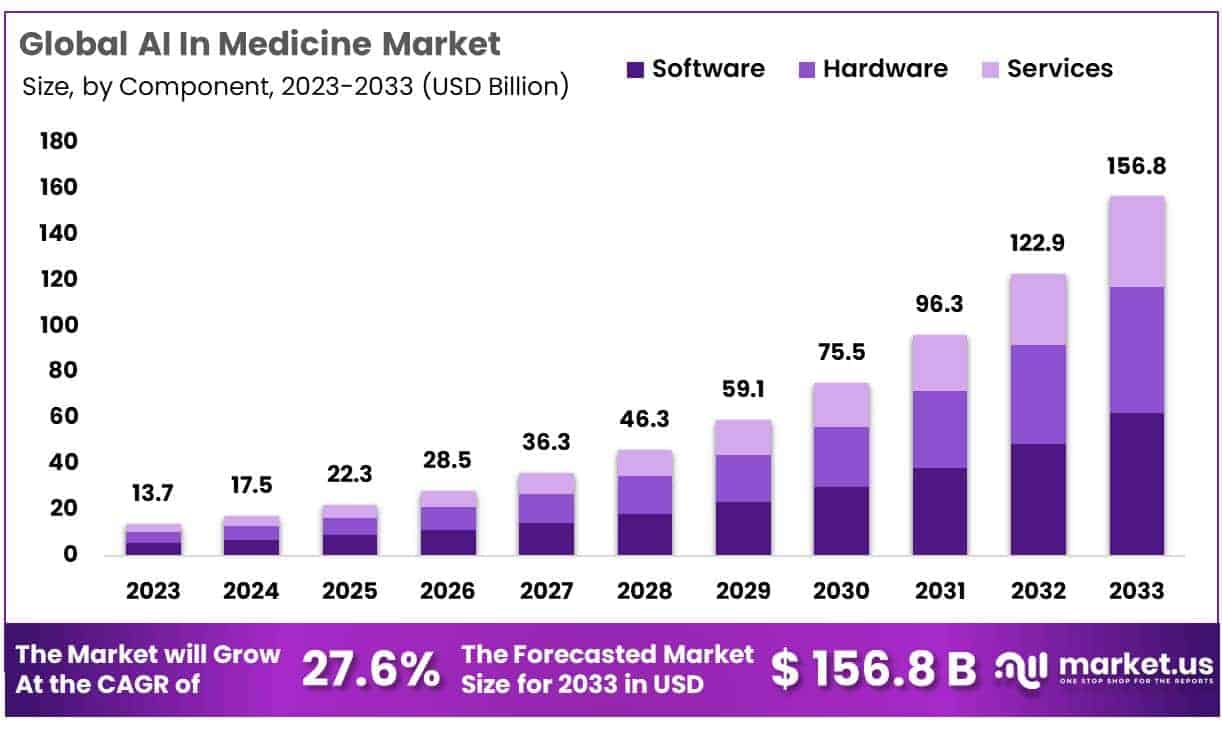
The Global AI In Medicine Market size is expected to be worth around USD 156.8 Billion by 2033 from USD 13.7 Billion in 2023, growing at a CAGR of 27.6% during the forecast period from 2024 to 2033.
The integration of Artificial Intelligence (AI) in medicine is reshaping the global healthcare landscape, offering unprecedented advancements in diagnosis, treatment, and patient care. AI in medicine refers to the use of machine learning algorithms, natural language processing, and data analytics to support clinical decision-making, streamline workflows, and enhance operational efficiency.
Key applications include AI-powered diagnostic imaging, predictive analytics for disease progression, robotic-assisted surgeries, and virtual health assistants. These technologies enable faster, more accurate diagnoses, personalized treatment plans, and proactive patient monitoring, thereby improving healthcare outcomes and reducing costs.
The market is witnessing rapid growth due to increasing healthcare data volumes, rising demand for precision medicine, and growing investments in healthcare IT infrastructure. Hospitals, research institutions, and healthcare providers are actively adopting AI tools to enhance productivity and improve patient safety. Regulatory support and government-led digital health initiatives are further accelerating adoption.
North America currently leads the global AI in medicine market, driven by strong R&D activities and early technology uptake. However, the Asia Pacific region is projected to witness the highest growth rate, supported by expanding healthcare systems and increasing AI investments.
Click here to get a Sample report copy @ https://market.us/report/ai-in-medicine-market/free-sample/
Key Takeaways
- In 2023, the AI in Medicine market was valued at USD 13.7 billion and is projected to reach USD 156.8 billion by 2033, growing at a Compound Annual Growth Rate (CAGR) of 27.6% during the forecast period.
- Based on component segmentation, the software segment held the largest market share in 2023, accounting for 39.7% of total revenue. This reflects the rising adoption of AI-driven software platforms in diagnostics, decision support, and clinical management.
- By technology, machine learning emerged as the leading segment, contributing 43.6% to overall market revenue. Its dominance is attributed to its widespread use in predictive modeling, image analysis, and pattern recognition across various medical disciplines.
- In terms of application, patient data and risk analysis represented the largest share, with 39.5% of the market revenue in 2023. The increasing need for real-time data analytics and early risk detection is driving the adoption of AI in this domain.
- Regionally, North America led the global AI in medicine market, capturing a substantial 41.7% share in 2023. This leadership is supported by advanced healthcare infrastructure, high R\&D investments, and strong regulatory frameworks promoting AI integration in clinical practice.
Segmentation Analysis
- By Component Analysis: In 2023, the software segment led the AI in medicine market, accounting for 39.7% of total revenue. This dominance is expected to continue due to increased demand for AI-powered platforms that enhance diagnostics, data management, and clinical decision-making. A notable trend is the integration of non-procedural languages like SQL, which emphasize outcome-driven approaches. As AI systems evolve, software remains central to achieving scalable and efficient healthcare solutions across various operational settings.
- By Technology Analysis: Machine learning emerged as the top-performing technology in the AI in medicine market in 2023, contributing 43.6% of the total revenue. Its broad applicability across disease prediction, medical imaging, and personalized treatment planning has driven adoption. As healthcare systems increasingly rely on data-intensive solutions, machine learning provides robust tools for analyzing complex datasets, improving diagnostic precision, and supporting predictive modeling, making it the foundational technology within the AI healthcare landscape.
- By Application Analysis: The patient data and risk analysis segment dominated the AI in medicine market in 2023, holding a 39.5% market share. This segment benefits significantly from the integration of Natural Language Processing (NLP), which transforms unstructured medical text into structured data. NLP enables faster clinical insights, early risk identification, and improved patient engagement via chatbots and personalized interventions, thus reshaping healthcare delivery by enhancing accuracy, efficiency, and clinical decision support.
Market Segments
By Component
- Hardware
- Software
- Services
By Technology
- Machine Learning
- Natural Language Processing
- Context-aware Computing
- Computer Vision
By Application
- Patient Data & Risk Analysis
- Medical Administration and Support
- Medical Imaging & Diagnostics
- Research and Development
To Purchase this Premium Report @ https://market.us/purchase-report/?report_id=118688
Regional Analysis
In 2023, North America dominated the AI in medicine market, capturing a 41.7% share. This leadership is driven by the region’s high adoption rate of AI technologies in clinical settings, supported by substantial investments from governments and private stakeholders. AI’s proven utility in assessing chronic conditions and improving patient outcomes has further fueled its integration. Additionally, the increasing prevalence of chronic diseases continues to drive demand for AI-enabled healthcare solutions across the region.
Asia Pacific, on the other hand, is projected to register the highest compound annual growth rate (CAGR) during the forecast period. This growth is supported by rapidly expanding healthcare and IT infrastructure, alongside the emergence of innovative startups and entrepreneurial ventures. Investment inflows from private entities, non-profit organizations, and favorable government policies promoting digital health adoption are collectively creating a conducive environment for AI expansion. As a result, Asia Pacific is poised to become a key growth region in the global AI in medicine landscape.
Key Players Analysis
The AI in healthcare market is marked by the presence of several prominent players actively competing for market share. Key companies such as IBM Watson Health, GE Healthcare, Novo Nordisk, and Atomwise Inc. maintain strong positions by offering advanced AI-driven solutions across diverse applications, including medical imaging, clinical decision support, personalized medicine, and telehealth.
In addition to established players, emerging companies are making noteworthy advancements in AI innovation, contributing to a dynamic and evolving market environment. The competitive landscape is further shaped by strategic collaborations, mergers and acquisitions, and new product developments, as organizations seek to strengthen their technological capabilities, broaden their solution portfolios, and enhance global market presence.
Market Key Players
- GE Healthcare
- Atomwise Inc.
- Novo Nordisk A/S
- Modernizing Medicine Inc.
- Nano-X Imaging Ltd
- Medasense Biometrics Limited
- Other Key Players
Market Dynamics
Market Driver: The primary driver of the AI in medicine market is the rising need for accurate, data-driven clinical decision-making. Increasing healthcare data volumes, demand for personalized treatment, and the burden of chronic diseases are pushing providers to adopt AI technologies. AI enhances diagnostic accuracy, reduces human error, and streamlines workflows, thereby improving patient outcomes and operational efficiency. This technological shift is being further supported by significant investments in healthcare digitization by both public and private sectors globally.
Market Trend: A key trend in the AI in medicine market is the integration of artificial intelligence with electronic health records (EHRs) and cloud-based platforms. The use of machine learning and natural language processing enables real-time data analysis, clinical automation, and personalized care delivery. Additionally, the emergence of AI-powered chatbots and virtual health assistants is transforming patient engagement. These trends are accelerating the shift toward predictive, preventative, and precision medicine across healthcare systems worldwide.
Market Opportunity: Emerging economies present significant opportunities for the AI in medicine market due to improving healthcare infrastructure and rising investments in digital technologies. Government initiatives promoting AI adoption, coupled with the growing number of healthcare startups, are creating a fertile environment for innovation. There is strong potential in areas like telemedicine, remote monitoring, and AI-assisted diagnostics. Vendors offering scalable, cost-effective AI solutions tailored to local needs can capitalize on these developments to expand their market footprint.
Conclusion
The AI in Medicine market is witnessing transformative growth, driven by advancements in data analytics, machine learning, and natural language processing. With a projected CAGR of 27.6%, the market is poised to reach USD 156.8 billion by 2033. Software remains the dominant segment, while machine learning leads in technology adoption.
North America holds the largest share, but Asia Pacific is expected to grow fastest. Increasing healthcare digitization, chronic disease burden, and supportive policies are creating favorable conditions. AI is set to play a central role in shaping the future of global healthcare delivery and patient outcomes.
View More Reports:
U.S. Medical Coding Market Projects 9.4 % CAGR, Hits USD 44 Billion by 2032
Patient Portal Market to Expand 5x, Reaching USD 21.9 Billion by 2033
Healthcare Fraud Analytics Market Gains Momentum with 23.5% CAGR Forecast



