
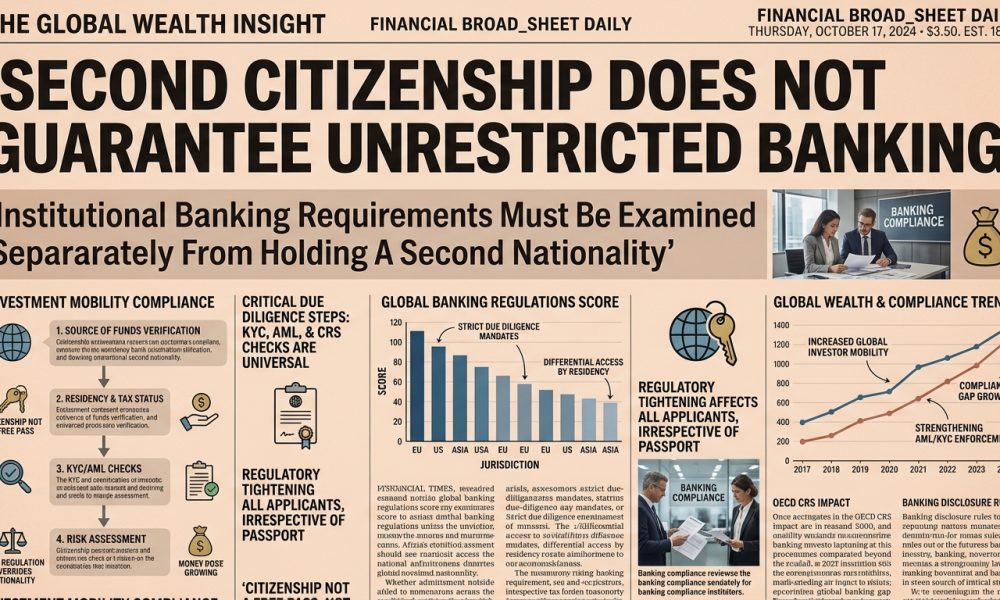
Applicants seeking financial flexibility should review institutional requirements separately, rather than assuming another nationality will establish account eligibility or eliminate questions about their circumstances.
WASHINGTON, DC, November 9, 2026 — Americans pursuing second citizenship to expand their international financial options face an important distinction between acquiring another nationality and qualifying for banking services, as financial institutions maintain independent requirements for identity verification, account eligibility, residence, and the origin of deposited funds.
Although a second passport may provide additional opportunities for international travel, residence, and financial planning, it does not automatically establish the right to open foreign bank accounts or eliminate the compliance obligations imposed on financial institutions.
For entrepreneurs, internationally mobile families, retirees, and investors considering overseas relocation, the distinction can affect financial arrangements because opening a bank account may require substantially more information than presenting a valid passport issued by another country.
The central question is whether a prospective account holder meets the institution’s identification, residency, financial, and regulatory requirements, rather than whether the individual has citizenship documentation from a jurisdiction associated with favorable international banking opportunities.
Banking Access and Citizenship Are Separate Legal Questions
Second, citizenship establishes a legally recognized relationship between an individual and another country, potentially providing nationality rights that include passport eligibility, consular Protection, and opportunities to reside or work under applicable domestic laws.
Banking eligibility, however, is determined through a separate framework involving financial regulations, institutional policies, customer Identification procedures, commercial risk assessments, and sometimes restrictions affecting nonresidents or particular categories of account holders.
A person who legally acquires foreign citizenship may therefore still be unable to open an account at a particular bank, especially where the institution requires local residence, employment documentation, or additional evidence of financial activity.
Conversely, some institutions accept qualifying foreign nationals without local citizenship, showing why nationality alone does not fully explain who may lawfully obtain financial services in a given jurisdiction.
American Banking Scrutiny Illustrates Changing Identification Expectations
An April 30, 2026, Reuters report examining potential changes to citizenship information collected by American banks described industry concerns over a contemplated federal initiative that could require institutions to verify customers’ citizenship or immigration status.
Banking representatives warned that adding documentation requirements could entail substantial operational costs, technology changes, employee training, and difficulty reviewing records for customers who have maintained accounts for many years.
The reporting concerned a possible policy change rather than an established universal requirement, illustrating why applicants should distinguish proposed regulatory measures from rules already in effect when evaluating banking eligibility.
For individuals considering another nationality, the broader lesson is that institutional documentation requirements can evolve independently of citizenship laws, potentially affecting both existing account relationships and future financial services applications.
Customer Identification Rules Remain Central to Banking Decisions
United States banks operate under customer Identification regulations that require institutions to obtain specified information and establish reasonable procedures to verify the identity of individuals and organizations seeking to establish covered accounts.
According to the Financial Crimes Enforcement Network’s official customer Identification guidance, financial institutions must adopt risk-based procedures that enable them to form a reasonable belief that they know each customer’s true identity.
These procedures generally require collecting identifying information and may involve reviewing government-issued documents, consulting independent records, examining customer circumstances, or using additional verification methods appropriate to the institution’s risk assessment.
An authentic foreign passport can help establish identity. Still, it does not necessarily satisfy every requirement for addresses, identifying numbers, account purposes, customer eligibility, or other information requested under applicable banking policies.
A Foreign Passport Does Not Automatically Establish Residence
Banks frequently distinguish citizenship from residence because the country issuing a person’s passport may differ from the jurisdiction where that individual actually lives, conducts business, earns income, or maintains financial interests.
An American citizen who acquires additional nationality but continues residing in the United States may still be classified as a United States resident for relevant banking purposes, depending on the institution and applicable legal definitions.
Similarly, a newly naturalized citizen who has never established a physical address in the issuing country may encounter institutional requirements designed specifically for residents, including proof of local accommodation or acceptable employment documentation.
Applicants should therefore check whether the account they want to open is available to citizens, residents, nonresidents, or specific customer categories, rather than assuming a passport automatically meets a bank’s eligibility criteria.
Tax Residency Creates Additional Documentation Requirements
Tax residency is another important consideration because acquiring another citizenship does not necessarily change where a person is considered resident for taxation or eliminate reporting obligations arising from existing personal circumstances.
Many financial institutions request information about customers’ tax residence and corresponding Identification numbers to comply with applicable international information-exchange arrangements and domestic reporting obligations.
For American citizens, acquiring an additional nationality generally does not terminate federal tax responsibilities arising from United States citizenship, although the exact consequences depend on applicable law and individual circumstances.
Applicants who intend to relocate should distinguish their anticipated future tax residence from their current legal position, ensuring that information provided to banks accurately reflects circumstances existing when an application is submitted.
Source-of-Funds Reviews Remain Important for International Applicants
Financial institutions may examine the origin of deposited funds, particularly where accounts involve substantial initial transfers, international business proceeds, investment distributions, property transactions, or activity inconsistent with an applicant’s stated financial circumstances.
A bank might request employment records, business financial statements, inheritance documentation, property sale agreements, or other evidence explaining how the customer obtained the funds intended for the account.
These inquiries are separate from citizenship verification because a passport provides identifying information but does not explain whether deposited assets come from lawful employment, investments, commercial transactions, or another legitimate source.
For internationally mobile individuals, maintaining organized financial documentation before relocation can reduce avoidable administrative difficulties while supporting accurate explanations of legitimate wealth accumulated under earlier names or in previous countries of residence.
Source of Wealth and Source of Funds Are Different Questions
Source of wealth generally concerns the broader economic activities through which an individual accumulated financial resources. In contrast, source of funds concerns the particular origin of money involved in a transaction or account relationship.
An entrepreneur might build overall wealth through years of business ownership while documenting a bank deposit as proceeds from a specific company sale, dividend distribution, or investment liquidation.
Banks may request information addressing both questions, particularly where substantial assets are involved, or the institution’s assessment indicates that additional customer due diligence is appropriate under applicable requirements.
A new nationality does not eliminate those historical financial connections, so applicants should expect legitimate inquiries into earlier business activities and transactions even when current Identification documents show a different citizenship.
Beneficial Ownership Requirements Affect Corporate Banking
Individuals seeking to establish foreign corporate accounts through holding companies, trusts, or other business structures should recognize that financial institutions may examine the people who ultimately own or control the organization.
These inquiries can extend beyond the passport presented by the person opening the account, especially where the institution must understand ownership arrangements, authorized signatories, business activities, and individuals exercising significant management responsibility.
In February 2026, FinCEN granted certain relief allowing covered institutions to limit repeated beneficial ownership Identification and verification at successive account openings under specified circumstances, without eliminating the broader framework of applicable customer due diligence.
The development shows that financial compliance obligations can evolve while preserving requirements for accurate customer Identification, so it is inappropriate to describe corporate structures as automatically providing anonymous banking or exemption from institutional review.
Banking Relationships Depend on Institutional Risk Assessments
Two banks operating within the same country may reach different account-opening decisions because their products, customer populations, geographic exposure, internal risk policies, and operational capacities differ considerably.
One institution may specialize in international private banking and accept documented nonresident customers. At the same time, another may primarily serve local households and require a residential connection that a foreign applicant cannot establish.
Neither decision necessarily shows that a customer’s citizenship is invalid, because banking approval reflects the institution’s willingness and legal ability to provide specific services within its operating framework.
Applicants should identify suitable account categories before committing to a citizenship or relocation plan, recognizing that general statements about a country’s banking sector cannot guarantee acceptance by an individual financial institution.
Private Banking Does Not Mean Unrestricted Financial Privacy
Private banking services may offer specialized relationship management, investment administration, estate planning coordination, and personalized financial products, but these commercial services remain subject to applicable Identification and compliance requirements.
High-net-worth clients may face extensive documentation requests because substantial assets, international transactions, complex ownership structures, and politically exposed relationships may require enhanced scrutiny under institutional risk-based procedures.
Discretion in customer service should therefore be distinguished from anonymity from regulators or the bank itself, since confidentiality arrangements generally do not authorize the institution to disregard mandatory recordkeeping and reporting obligations.
A second passport may contribute to a broader international financial strategy. Still, it does not independently entitle its holder to confidential accounts that operate outside the laws governing regulated financial institutions.
Previous Names and Citizenship Changes Require Accurate Records
Applicants who legally change their names or acquire another nationality may find that banks require supporting documentation linking current Identification to historical employment records, financial accounts, professional qualifications, or previous government registration details.
These requirements become especially important when substantial wealth was accumulated under an earlier name, because the institution may need to establish that the person presenting updated Identification legitimately owns the assets involved.
Court orders, authenticated civil records, and other official documentation may provide appropriate evidence of continuity, although the particular records accepted depend on the bank and the relevant legal requirements.
A legal identity change should not be used to erase financial obligations, create fictitious transaction histories, or avoid legitimate institutional questions about previous identifying information and existing economic relationships.
Second Passport Planning Should Account for Banking Eligibility
Individuals evaluating second passport services through Amicus International Consulting should distinguish the benefits of lawful additional citizenship from the separate financial services they hope to access after obtaining nationality documentation.
An appropriate preliminary assessment can examine the applicant’s desired banking jurisdiction, anticipated residence, financial circumstances, documentary history, and the particular account categories that may support future international activities.
However, a citizenship adviser should not guarantee bank approval merely because a government has issued an authentic passport, since regulated institutions retain responsibility for their own customer acceptance decisions.
The most useful financial planning begins before citizenship-related expenses become irreversible, allowing applicants to assess whether their desired banking arrangements realistically fit their existing circumstances and proposed relocation.
Anonymous Living Does Not Eliminate Banking Disclosure Duties
Individuals seeking greater personal privacy may want reduced public visibility, confidential residential arrangements, and secure financial administration while still meeting legitimate Identification requirements imposed by governments and regulated institutions.
For applicants exploring lawful anonymous living and privacy services through Amicus International Consulting, the distinction between public discretion and institutional Identification matters most when financial relationships involve substantial assets or international transactions.
A bank may protect customer information from unnecessary public disclosure while still collecting accurate identifying records, verifying beneficial ownership, and responding to legally authorized government inquiries under applicable procedures.
Responsible confidentiality planning should therefore focus on lawful information Protection and appropriate financial structures, not on promising that another citizenship will remove compliance obligations or prevent banks from examining historical financial circumstances.
International Transfers Introduce Additional Questions
Customers transferring substantial assets between countries may face banking reviews of transaction purposes, sending and receiving institutions, account ownership, currency conversion, and documentation supporting unusually large or complex transfers.
Even when the customer lawfully owns both accounts, an international payment may require additional clarification if the transaction differs materially from the activity originally described during account opening.
A second passport does not necessarily accelerate these procedures, because transaction monitoring focuses on financial activity and applicable compliance obligations rather than treating foreign citizenship as conclusive evidence of financial legitimacy.
Applicants planning major relocation-related transfers should coordinate with receiving institutions beforehand, ensuring that sufficient information is available to support legitimate transactions without relying on assumptions about automatic acceptance or immediate settlement.
Investment Accounts May Have Separate Eligibility Restrictions
Banking access should also be distinguished from securities brokerage, managed investment services, retirement administration, and other financial products that may operate under different licensing requirements and customer eligibility rules.
An individual may qualify for an ordinary deposit account while remaining ineligible for a particular investment platform because of residence restrictions, regulatory limitations, tax documentation requirements, or institutional policies affecting cross-border customers.
Similarly, acquiring foreign citizenship does not automatically authorize transferring an existing retirement account or securities portfolio to another jurisdiction without considering the rules governing the assets.
For internationally mobile investors, a comprehensive assessment should examine deposit banking and investment services separately, identify which financial relationships can lawfully continue, and determine which may require restructuring or additional professional advice.
Banking Denials Do Not Necessarily Invalidate Citizenship
An unsuccessful bank application does not establish that the customer’s passport is fraudulent, that the person’s nationality lacks legal recognition, or that all financial institutions within the relevant jurisdiction will reach the same decision.
The institution may have declined the application because the applicant could not satisfy product eligibility requirements, failed to provide sufficient documentation, or fell outside the customer categories supported by its commercial policies.
Applicants should seek clarification through appropriate customer service or complaint procedures where available, while recognizing that institutions may have lawful reasons for limiting disclosures concerning certain compliance decisions.
This distinction protects consumers against misleading claims that banking approval is a guaranteed consequence of citizenship, while also avoiding unsupported conclusions about the validity of nationality documents after an adverse institutional decision.
Financial Flexibility Requires More Than Another Nationality
The growing appeal of second citizenship reflects legitimate interest in international mobility and financial diversification. Still, applicants should recognize that passport acquisition and banking eligibility remain separate processes governed by different institutions and legal obligations.
A practical financial strategy considers residence, tax status, lawful source of wealth, account purpose, required documentation, and institutional acceptance policies before making substantial commitments to citizenship programs or international relocation arrangements.
Professional advisers can help applicants understand these considerations and coordinate appropriate documentation. Still, neither citizenship approval nor an additional government-issued passport should be presented as a guarantee of unrestricted financial access.
Ultimately, second citizenship may expand international opportunities without establishing an automatic right to foreign banking, making accurate Identification, transparent financial records, and independent institutional eligibility assessments essential to successful cross-border planning.
For Americans considering additional nationality in 2026, the strongest approach combines lawful citizenship planning with realistic banking expectations, ensuring that personal privacy, financial flexibility, and international mobility are pursued through arrangements consistent with applicable legal and regulatory requirements.




