
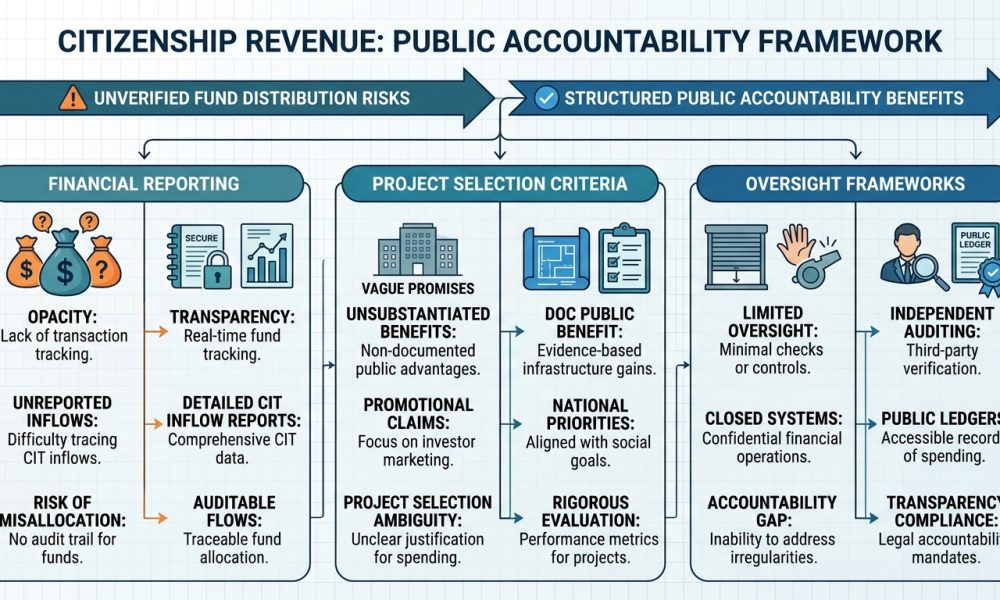
Development-focused programs invite scrutiny of financial reporting, project selection and oversight, helping distinguish documented public benefits from the broader promises used to promote contribution pathways.
WASHINGTON, DC, November 9, 2026 — Citizenship by investment programs have become important sources of government revenue for several smaller nations, raising questions about how governments record, allocate, independently audit, and ultimately convert financial contributions from foreign applicants into measurable public benefits.
Although investment migration programs are often promoted as ways to finance infrastructure, housing, healthcare, education, and economic development, the success of individual initiatives depends on transparent public administration rather than the amount of money collected through citizenship applications alone.
For American investors, international entrepreneurs, and families considering contribution-based second citizenship, the distinction matters because a government-approved donation pathway can provide legitimate nationality opportunities without guaranteeing that every advertised development project will achieve its stated objectives.
Public accountability therefore requires examining both sides of the arrangement, including whether applicants obtain citizenship through lawful procedures and whether participating governments provide sufficiently reliable information about how they collect, manage, and spend program revenues.
Caribbean Citizenship Programs Face Growing Financial Scrutiny
Several Eastern Caribbean countries have developed citizenship-by-investment programs that allow qualifying foreign nationals to seek citizenship through government contributions or approved investments, subject to national legislation and applicable background screening requirements.
An October 29, 2026, Reuters investigation into Antigua and Barbuda’s citizenship investment revenues and European regulatory pressure illustrated how passport-related revenue has become financially significant while remaining vulnerable to changing international travel policies.
According to Reuters, Antigua and Barbuda collected approximately $58 million from citizenship investment arrangements in 2025 and budgeted roughly $44.4 million for 2026, representing a meaningful share of the government’s recurring revenue.
The reporting also described European Union pressure on several Eastern Caribbean countries to end their citizenship investment programs, creating uncertainty about future revenue streams and development projects supported by those arrangements.
These developments show why public accountability extends beyond tracking how much money enters government accounts, requiring scrutiny of how those receipts are budgeted and whether fiscal plans remain sustainable if international demand declines.
Citizenship Contributions Have Become Significant Public Revenue Sources
Citizenship by investment programs can provide governments with revenue that does not arise from conventional taxation, potentially creating additional fiscal resources for public infrastructure, debt management, disaster recovery, and other national development priorities.
For small island economies facing limited domestic markets, exposure to natural disasters, and substantial infrastructure requirements, successful programs may generate financial resources that would otherwise require borrowing, taxation, or external development assistance.
However, the economic importance of citizenship receipts can create additional risks when government budgets depend on income that fluctuates with foreign investor demand, diplomatic relations, and changes in immigration policies.
Public officials must therefore determine how much program revenue can responsibly support recurring obligations, particularly when long-term expenditure commitments could continue after the volume of citizenship applications declines substantially.
Government Revenue Is Not the Same as Total Investment Activity
An important distinction concerns the difference between money paid directly into public accounts and the broader value of investments associated with citizenship programs, particularly when applicants purchase qualifying property or finance approved developments.
A real estate project promoted as generating millions of dollars in investment does not necessarily provide the government with an equivalent amount of freely available revenue, because the funds may support private construction and commercial activities.
Conversely, a nonrefundable contribution deposited into an authorized government fund may become public revenue. However, professional commissions, administrative expenses, screening costs, and other obligations can reduce the amount available for public expenditure.
Accurate financial reporting should therefore distinguish gross program receipts, net government revenue, private investment flows, and project-related expenditures, rather than combining these categories into a single promotional figure.
Independent Audits Strengthen Government Financial Accountability
Independent auditing provides a mechanism for examining whether government revenue has been accurately recorded, whether expenditure complies with applicable rules, and whether financial controls operate consistently with established public administration requirements.
The United States Government Accountability Office’s 2025 Standards for Internal Control in the Federal Government provide a useful reference framework emphasizing reliable reporting, compliance, fraud prevention, risk assessment, and effective stewardship of public resources.
Although these American federal standards do not directly govern foreign citizenship programs, their principles demonstrate why reliable records, appropriate authorizations, independent scrutiny, and documented financial controls are central to credible public administration.
For citizenship investment authorities, meaningful auditing should address the full financial process, including application fees, qualifying contributions, payments to authorized agents, government expenditure, project financing, and corrective action when irregularities arise.
Regional Oversight Reforms Reflect Public Concerns
Eastern Caribbean governments have undertaken initiatives to strengthen regional oversight of citizenship investment programs, reflecting concerns about financial integrity, inconsistent screening practices, government accountability, and the international reputation of participating jurisdictions.
The Eastern Caribbean Citizenship by Investment Regulatory Authority framework includes provisions for independent financial and operational audits, establishing a regional approach to examining how program authorities manage revenue and comply with administrative requirements.
Under legislation adopted by participating states, the framework provides for annual independent financial audits and independent operational audits every two years, along with requirements to publish audit reports and regulatory supervision.
The effectiveness of these reforms will depend on implementation, the independence of appointed auditors, the availability of reliable financial information, and whether oversight authorities possess sufficient powers to address documented deficiencies.
Project Selection Deserves Scrutiny Before Funds Are Committed
A government may announce that citizenship contributions will support hospitals, schools, affordable housing, roads, or renewable energy infrastructure, but selecting an appropriate project requires more than demonstrating that a proposed development serves an appealing public purpose.
Responsible project evaluation considers construction costs, expected demand, operational requirements, procurement arrangements, environmental effects, and whether the completed facility can be maintained without creating unsustainable financial obligations.
For example, a hospital built with citizenship revenue may require substantial ongoing spending on medical personnel, equipment, supplies, and maintenance, creating financial commitments that persist long after the initial construction contribution is exhausted.
Independent review can help determine whether the anticipated public benefits justify the project’s total costs, particularly where competing priorities require governments to choose between infrastructure investment, debt reduction, and essential public services.
Development Announcements Are Not Evidence of Completed Results
Citizenship investment programs are often linked to highly visible development announcements, but a proposed project, an approved funding allocation, and a completed public facility represent different stages of government performance.
A government announcing that citizenship contributions will finance a new school has not necessarily shown that construction has begun, that contractual milestones have been met, or that the completed building is delivering educational services.
Public accountability improves when authorities publish information on project approval dates, allocated budgets, payments made, construction progress, completion status, and measurable outcomes tied to the original development objectives.
Without such records, investors and citizens may struggle to distinguish projects genuinely supported by citizenship revenue from initiatives described in promotional materials before the necessary financing or implementation arrangements were secured.
Public Financial Reports Should Explain Where Contributions Go
Transparent reporting can begin with a straightforward accounting of citizenship applications received, those approved or rejected, the associated fees collected, and the amounts deposited into authorized government accounts.
Additional disclosure can explain administrative costs, agent commissions, approved expenditure categories, outstanding financial commitments, and transfers between government funds, while respecting legitimate confidentiality obligations concerning individual applicants.
The distinction between gross receipts and net available funds matters because a government collecting substantial citizenship payments may incur significant operating expenses before allocating the remaining revenue to development activities.
Clear financial statements enable legislators, auditors, researchers, and members of the public to evaluate the program’s actual fiscal contribution without relying exclusively on announcements describing total investment commitments or anticipated economic benefits.
Agent Commissions Create Another Accountability Question
Citizenship programs may depend on authorized agents, international marketing representatives, legal professionals, and other intermediaries who assist applicants with eligibility assessments, documentation, application submissions, and communication with government authorities.
These services can involve legitimate commercial compensation, but public financial reporting should explain how commissions and administrative expenses affect the net revenue received from each qualifying citizenship contribution.
Where governments permit agents to receive substantial payments, oversight arrangements should examine whether compensation structures create conflicts of interest, encourage misleading representations, or complicate the accurate recording of program receipts.
Applicants should also distinguish fees payable to private representatives from mandatory government contributions, ensuring that written agreements identify payment recipients and do not misrepresent professional charges as public development expenditures.
Procurement Procedures Influence the Value of Public Investments
When citizenship revenue finances government construction or service contracts, the procurement process becomes essential to determining whether public money is spent efficiently and whether objective evidence supports project selections.
Competitive bidding, appropriate conflict-of-interest protections, contract documentation, and independent review can reduce the risk that development funds are directed to overpriced projects or arrangements that benefit connected commercial interests.
A project can appear beneficial in principle while providing poor value if construction costs exceed reasonable estimates, contractual safeguards are inadequate, or the government assumes unexpected financial obligations after completion.
Transparent procurement records can therefore provide stronger evidence of responsible public expenditure than promotional announcements alone, particularly when projects involve large infrastructure commitments or long-term agreements with private developers.
Economic Benefits Should Be Evaluated After Projects Are Completed
Citizenship program promoters may emphasize employment creation, tourism development, foreign investment, and improved infrastructure, but these potential benefits require careful assessment using information collected after projects become operational.
A new resort may create construction jobs and attract more visitors, but its lasting economic contribution depends on occupancy, local purchasing, wages, taxation, and the sustainability of related commercial activities.
Similarly, publicly financed infrastructure should be evaluated by actual improvements in services, accessibility, reliability, and operating costs rather than by the amount originally allocated from citizenship investment revenue.
Independent evaluations can help governments identify successful approaches, discontinue ineffective initiatives, and improve future project selection, providing evidence that the public has received measurable value from the resources collected.
Fiscal Dependence Can Create Difficult Budget Decisions
Governments receiving substantial citizenship revenue may use those proceeds to support infrastructure spending or reduce borrowing. Still, unpredictable application volumes can complicate financial planning when the revenue becomes essential to routine operations.
International Monetary Fund research published in 2025 identified significant fiscal risks associated with fluctuating citizenship investment receipts in the Eastern Caribbean, emphasizing clearer budget arrangements, stronger transparency, and assessments of completed development projects.
The financial challenge becomes particularly serious when recurring government expenses rely on income dependent on foreign demand, since a sudden decline can require expenditure reductions, new borrowing, or alternative domestic revenue measures.
A sustainable budget should therefore distinguish extraordinary citizenship receipts from predictable recurring revenue, ensuring that essential public services can continue even when international investment conditions or foreign travel privileges change unexpectedly.
Applicants Have Legitimate Questions About Public Benefits
Individuals considering contribution-based citizenship should understand that a qualifying payment generally satisfies a legal program requirement, rather than constituting a private investment that provides ownership or a guaranteed financial return.
Nevertheless, prospective applicants may reasonably examine published budgets, government project reports, independent audits, and regulatory findings when evaluating the credibility and administration of a nationality program they are considering.
A program with transparent government accounting and independently verified development outcomes may provide more meaningful information than marketing materials that emphasize proposed hospitals, infrastructure, or national economic transformation without supporting documentation.
Applicants should also recognize that favorable public financial reporting does not independently guarantee citizenship approval, because eligibility screening and the government’s nationality decision remain separate legal requirements.
Second Passport Decisions Require Independent Verification
For individuals exploring second citizenship pathways, the practical value of a contribution program depends on eligibility requirements, authentic documentation, government procedures, and the personal rights associated with the nationality ultimately acquired.
Applicants considering second passport services through Amicus International Consulting should review program documentation independently and distinguish government-approved financial requirements from promotional descriptions of how contributions may eventually be used.
A written service agreement should identify professional fees, government contributions, payment milestones, refund provisions, and the responsibilities of authorized representatives, allowing applicants to understand their financial commitments before submitting an application.
Financial transparency concerning government expenditure is an important consideration. Still, it should complement, not replace, verification of the program’s legal authority, due diligence procedures, and capacity to issue valid citizenship documentation.
Personal Privacy and Public Accountability Serve Different Purposes
Citizenship applicants may have legitimate interests in protecting personal financial information, residential details, and family circumstances. At the same time, governments have separate responsibilities to disclose enough information about how they administer public revenue.
For individuals examining lawful anonymous living and personal privacy arrangements through Amicus International Consulting, this distinction illustrates how appropriate personal confidentiality can coexist with accurate financial disclosures and accountable government procedures.
Public authorities can report aggregate application receipts, development expenditure, procurement results, and audit findings without necessarily disclosing each applicant’s private identifying information, subject to the jurisdiction’s legal transparency requirements.
Effective public accountability therefore does not require abandoning all personal privacy protections. Still, it does require reliable mechanisms to identify financial irregularities and show that government resources have been administered lawfully.
Public Confidence Depends on More Than Revenue Announcements
Citizenship investment programs can contribute to national development when qualifying contributions are lawfully collected, carefully managed, and applied to projects supported by credible financial planning and appropriate oversight.
However, revenue alone offers only a partial measure of program performance, because taxpayers and applicants also have legitimate interests in administrative costs, project outcomes, procurement integrity, and long-term fiscal sustainability.
Independent auditing, accessible financial reports, documented project assessments, and effective regional supervision can provide evidence that citizenship revenue has delivered the public benefits described by participating governments.
Ultimately, citizenship revenue raises questions about public accountability because development promises matter only when transparent financial records and independently verifiable outcomes show how governments collect, allocate, and use contributions.
For investors and international mobility advisers, the responsible approach is to assess both the legal advantages of citizenship and the credibility of the issuing government’s financial administration, without confusing promotional development objectives with completed public achievements.




