
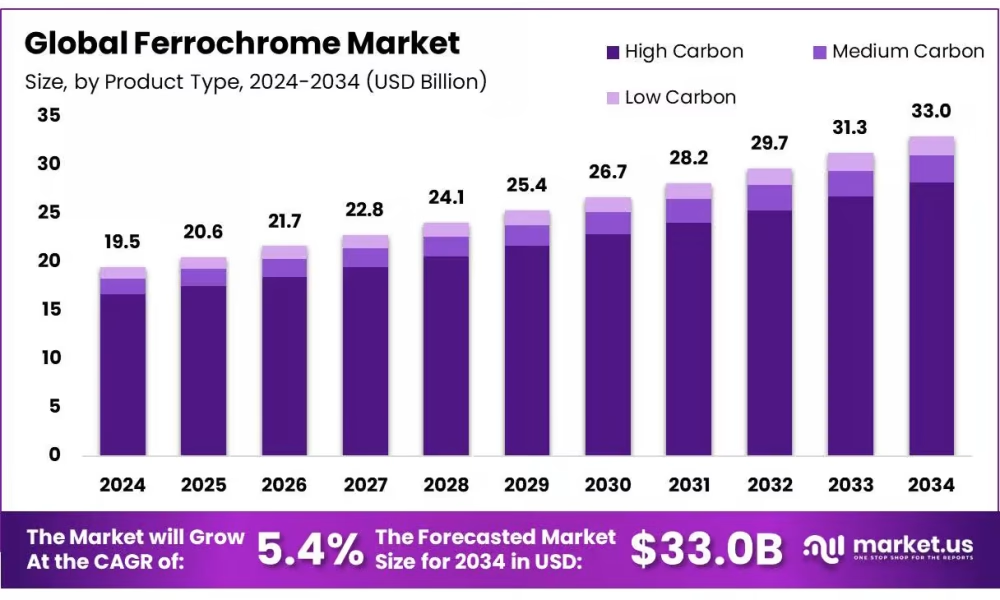
According to market.us, Global Ferrochrome Market size is expected to be worth around USD 33.0 Billion by 2034, from USD 19.5 Billion in 2024, growing at a CAGR of 5.4% during the forecast period from 2025 to 2034.
The ferrochrome market plays a pivotal role in global metallurgy, driven by rising demand from the stainless steel and specialty alloy sectors. Ferrochrome, an alloy comprising 50% to 70% chromium and the remainder iron, is primarily produced via electric arc melting of chromite ores. Its key function lies in enhancing the hardness, corrosion resistance, and tensile strength of steel, thereby making it indispensable for applications across automotive, construction, aerospace, chemical processing, and household appliance industries.
According to the US Geological Survey (USGS) Mineral Commodity Summaries 2022, global ferrochrome production reached 13.91 million tons in 2021. China accounted for the largest share with 5.98 million tons, followed by South Africa with approximately 3.77 million tons, underscoring the geographical concentration of supply.
Additionally, sustainability has emerged as a significant trend, with the International Energy Agency (IEA) noting that incorporating low-carbon ferrochrome (LCFC) can reduce energy consumption in steelmaking by up to 15%. This aligns with global decarbonization goals, boosting the appeal of energy-efficient ferrochrome in the transition toward greener industrial processes.
Key Takeaways
- The global ferrochrome market was valued at USD 19.5 billion in 2024.
- The global ferrochrome market is projected to grow at a CAGR of 5.4 % and is estimated to reach USD 33.0 billion by 2034.
- Among product types, high carbon accounted for the largest market share of 85.5%.
- Among forms, granules accounted for the majority of the market share at 26.3%.
- By application, stainless steel accounted for the largest market share of 77.8%.
- By end-use, building & construction accounted for the majority of the market share at 46.4%.
- Asia Pacific is estimated as the largest market for ferrochrome with a share of 67.4% of the market share.
Access a Complimentary Sample of This Premium Report: https://market.us/report/ferrochrome-market/request-sample/
Factors Affecting the Growth of the Ferrochrome Market
Rising Stainless Steel Production: The demand for ferrochrome is closely tied to stainless steel manufacturing, as it serves as a key alloying element. Growth in sectors such as automotive, construction, and consumer appliances significantly boosts stainless steel consumption, which in turn drives ferrochrome demand.
Availability and Cost of Chromite Ore: Ferrochrome production is heavily reliant on the availability of high-grade chromite ore. Fluctuations in chromite supply or mining restrictions in major producing countries can directly impact production capacity and pricing, thereby influencing market growth.
Energy Costs and Environmental Regulations: Ferrochrome smelting is energy-intensive. Changes in electricity prices, especially in key producing regions, can affect production costs. Additionally, stricter environmental regulations regarding emissions and waste management may compel producers to invest in cleaner technologies or reduce output.
Geopolitical and Trade Dynamics: Global trade policies, export restrictions, and geopolitical tensions can disrupt the ferrochrome supply chain. Tariffs, import duties, and trade agreements between major producing and consuming nations affect the flow of raw materials and finished products, impacting market stability.
Technological Advancements in Steelmaking: The development and adoption of advanced steelmaking technologies, including energy-efficient furnaces and alternative alloying strategies, can influence ferrochrome demand. The industry’s shift toward low-carbon or recycled inputs may also reshape long-term consumption patterns.
Key Market Segmentation
By Product Type Analysis
In 2024, the high carbon ferrochrome segment accounted for a dominant 85.5% revenue share in the market, driven by its extensive use in stainless steel production. Containing 60–70% chromium and 4–6% carbon, this variant is essential for producing high-tensile and corrosion-resistant steels. Its cost-efficiency, compatibility with diverse steel grades, and suitability for large-scale manufacturing make it the preferred option. Additionally, its ability to meet strict metallurgical standards with low impurity levels further strengthens its leading position in the product segment.
By Form Analysis
In 2024, granules held the leading position in the ferrochrome market by form, capturing a significant 26.3% share. This dominance is attributed to their superior handling characteristics, consistent particle size, and ease of blending in steelmaking operations. Granulated ferrochrome ensures precise alloying, minimizes material wastage, and enhances furnace efficiency.
Its form also supports better storage, streamlined transportation, and compatibility with automated feeding systems, making it highly suitable for large-scale stainless steel production. These operational benefits have driven its widespread adoption across the industry.
By Application Analysis
In 2024, the stainless steel segment dominated the ferrochrome market with a 77.8% share, reflecting its vital role in enhancing steel’s hardness, corrosion resistance, and durability. Around 80% of global ferrochrome output is used in stainless steel production, driven by strong demand across construction, automotive, consumer goods, and industrial equipment sectors. This widespread use continues to position stainless steel as the primary application for ferrochrome globally.
By End-Use Analysis
In 2024, the building & construction segment led the ferrochrome market by end-use, accounting for 46.4% of the total share. This dominance is driven by the increasing adoption of smart infrastructure and energy-efficient building technologies that require durable, corrosion-resistant stainless steel. The use of ferrochrome-enhanced materials in applications such as structural frameworks, fixtures, and systems aligned with sustainable construction practices continues to support growth in this segment.
Key Market Segments
By Product Type
- High Carbon
- Medium Carbon
- Low Carbon
By Form
- Granules
- Powder
- Lumps
By Application
- Stainless steel
- 200 Series
- 300 Series
- 400 Series
- Duplex Series
- Others
- Cast Iron
- Specialty Steel
- Others
By End-Use
- Building & Construction
- Automotive & Transportation
- Consumer Goods
- Mechanical Engineering & Heavy Industries
- Aerospace and Defense
- Others
Geopolitical Impact Analysis
The US-China-European trade conflict has significantly reshaped the global ferrochrome market, disrupting traditional trade flows and prompting strategic shifts. Following the imposition of a 25% tariff on steel and 10% on aluminum imports by the U.S., effective March 12, 2025, Chinese ferro-alloy exporters redirected their focus to emerging regions such as Southeast Asia, the Middle East, and Africa, where steel demand is rising due to infrastructure and industrial growth. In response, the U.S. increased domestic stainless steel production, boosting ferrochrome imports from non-Chinese sources like India.
Simultaneously, regional agreements such as the Regional Comprehensive Economic Partnership have given Chinese producers tariff advantages in Asian markets. Additionally, the conflict has driven China to accelerate its production of low-carbon ferroalloys, reflecting global trends toward environmentally sustainable materials. This geopolitical tension has led to greater supply diversification, regional expansion, and investment in greener production practices.
The Major Players in The Industry
- Samancor Chrome
- Eurasian Resources Group
- Hernic
- Vargön Alloys AB
- Ferbasa
- Yilmaden
- Glencore
- ALBCHROME
- Outokumpu
- IMFA
- Balasore Alloys Limited
- Ferro Alloys Corporation
- Indiano Chrome Pvt Ltd
- Other Key Players
Get in Touch with Us:
Market.us (Powered By Prudour Pvt. Ltd.)
Address: 420 Lexington Avenue, Suite 300 New York City, NY 10170, United States
Send Email: [email protected]
Refer More Related Reports:



