
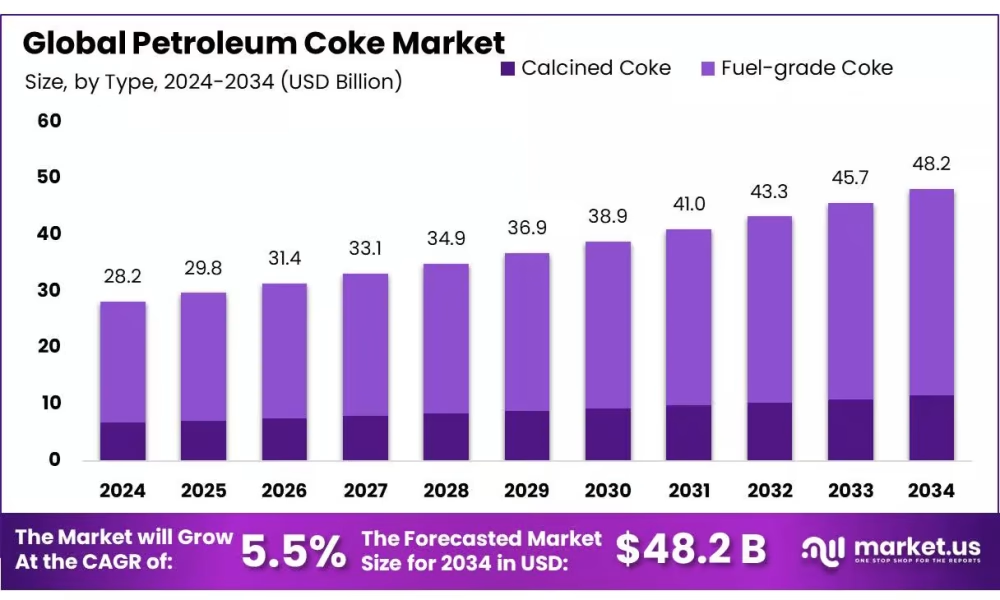
According to market.us, the global petroleum coke market is projected to grow from USD 28.2 billion in 2024 to approximately USD 48.2 billion by 2034, registering a CAGR of 5.5% over the forecast period. Petroleum coke, or petcoke, is a carbon-rich solid derived from refinery coker units and cracking processes. It serves as a key fuel in cement kilns and power generation, and as a feedstock in aluminum and steel industries due to its high energy content and lower cost compared to coal.
In 2023, U.S. refineries produced nearly 60.5 million metric tons of petcoke, reflecting its industrial significance, as reported by the U.S. Energy Information Administration (EIA). However, environmental concerns tied to its sulfur and heavy metal content have prompted regulatory scrutiny.
For instance, India’s Ministry of Environment, Forest and Climate Change has restricted petcoke use as fuel but permits its application in controlled industries like cement and steel. Still, demand remains high, with India importing 14.2 million metric tons of petcoke in 2023, according to the Ministry of Commerce & Industry.
The market is further bolstered by rising aluminum and steel production. Green petroleum coke (GPC) is vital for anode manufacturing in aluminum smelting, with global aluminum consumption forecasted to rise 3% annually through 2030, as per the International Aluminium Institute.
Key Takeaways
- Petroleum Coke Market size is expected to be worth around USD 48.2 Bn by 2034, from USD 28.2 Bn in 2024, growing at a CAGR of 5.5%.
- Fuel-grade Coke held a dominant market position, capturing more than a 76.50% share.
- Delayed Coking held a dominant market position, capturing more than an 87.40% share in the Petroleum Coke Market by Coking Process.
- Cement held a dominant market position, capturing more than a 38.40% share in the Petroleum Coke Market by Application.
- Asia-Pacific (APAC) region stands as the dominant force in the global petroleum coke market, holding a substantial market share of approximately 44.30%, which translates to a market value of USD 12.4 billion.
Access a Complimentary Sample of This Premium Report: https://market.us/report/petroleum-coke-market/request-sample/
Factors Affecting the Growth of the Petroleum Coke Market
Expansion of the Aluminum and Steel Industries: Petroleum coke, especially green petroleum coke (GPC), is a critical input in the production of anodes used in aluminum smelting and also finds application in steel manufacturing. As the global demand for aluminum and steel continues to rise—driven by infrastructure, automotive, and packaging sectors—the need for petroleum coke as a feedstock is increasing accordingly.
Rising Cement and Power Generation Demand: Fuel-grade petroleum coke is widely used in cement kilns and thermal power plants due to its high calorific value. In developing countries, where infrastructure development is accelerating, the growing consumption of cement and industrial energy supports the demand for petcoke as an economical fuel alternative.
Environmental Regulations and Policy Restrictions: The high sulfur content and heavy metals in fuel-grade petcoke pose environmental challenges. Governments, particularly in regions with strict emission standards, have implemented regulations limiting its usage, especially for power generation. These environmental policies significantly impact its trade and consumption patterns.
Crude Oil Refining Capacity and Petcoke Supply: Petroleum coke is a byproduct of oil refining. The availability and quality of petcoke are directly linked to global refining operations, especially in countries with high conversion refinery capacities. Any changes in refining throughput or technology can influence petcoke supply volumes.
Trade Dynamics and Import Restrictions: Geopolitical decisions, import bans, and regional trade policies can influence the cross-border movement of petroleum coke. Countries may restrict imports for environmental reasons or prioritize domestic sources, impacting market accessibility and influencing prices and availability in key consuming nations.
Key Market Segmentation
By Type Analysis
In 2024, fuel-grade coke accounted for over 76.50% of the petroleum coke market, maintaining a dominant position due to its low cost and high-energy output. It is widely used in cement production, power generation, and steel manufacturing, particularly in emerging economies reliant on thermal fuels.
This segment is projected to retain its lead in 2025, driven by ongoing infrastructure development in Asia-Pacific and Latin America. Additionally, the adoption of advanced combustion technologies to reduce emissions supports its continued industrial use, despite growing environmental concerns.
By Coking Process Analysis
In 2024, Delayed Coking dominated the petroleum coke market by coking process, accounting for over 87.40% of the total share. This method is widely adopted for its efficiency in converting heavy residual oils into lighter products and solid coke.
Its flexibility, high yield of valuable by-products, and capability to process various feedstocks make it the preferred technology. In 2025, Delayed Coking is expected to maintain its leadership, supported by increased heavy crude processing and refinery expansions, particularly in Asia-Pacific and the Middle East.
By Application Analysis
In 2024, the cement industry accounted for over 38.40% of the petroleum coke market by application, making it the leading segment. Petroleum coke is favored in cement manufacturing due to its high calorific value and lower cost compared to coal. The rising demand from infrastructure and construction projects, particularly in Asia-Pacific and the Middle East, has significantly boosted its usage.
In 2025, the cement segment is expected to retain its dominance, supported by ongoing housing, transportation, and industrial development projects. Upgrades in cement plants to enhance petcoke efficiency and emission control will further ensure its continued use in the sector.
Key Market Segments
By Type
- Calcined Coke
- Fuel-grade Coke
- Shot Coke
- Sponge Coke
By Coking Process
- Delayed Coking
- Fluid Coking
By Application
- Cement
- Ceramic
- Power Generation
- Industrial Boilers
- Aluminum and Other Metals
- Carbon Products
- Others
Regional Analysis
In 2024, the Asia-Pacific region led the global petroleum coke market with a 44.30% share, valued at USD 12.4 billion. This dominance is driven by intensive industrial activity in countries like China and India.
China, the region’s largest consumer, uses petroleum coke extensively in its aluminum and steel industries, which are fueled by ongoing urbanization and infrastructure development. India also contributes significantly, using petcoke to meet growing energy demands driven by rapid economic expansion and increasing power consumption.
Top Key Players in the Market
- BP p.l.c.
- Chevron Corporation
- Oxbow Corporation
- The Phillips 66 Company
- Aminco Resources LLC
- Reliance Industries Ltd
- HPCL-Mittal Energy Limited
- Indian Oil Corporation Ltd
- Marathon Petroleum Corporation
- China Petrochemical Corporation
- Bharat Petroleum Corporation Limited
- Rain Carbon Inc
- Repsol S.A.
- Valero Energy Corporation
- Other Key Players
Get in Touch with Us:
Market.us (Powered By Prudour Pvt. Ltd.)
Address: 420 Lexington Avenue, Suite 300 New York City, NY 10170, United States
Send Email: [email protected]
Refer to More Related Reports:



