
The global pedestrian entrance control systems market is entering a transformative phase, driven by rising security concerns, rapid urbanization, and the integration of advanced technologies. As organizations across industries prioritize safety, compliance, and operational efficiency, entrance control systems are evolving from simple physical barriers into intelligent, connected ecosystems.
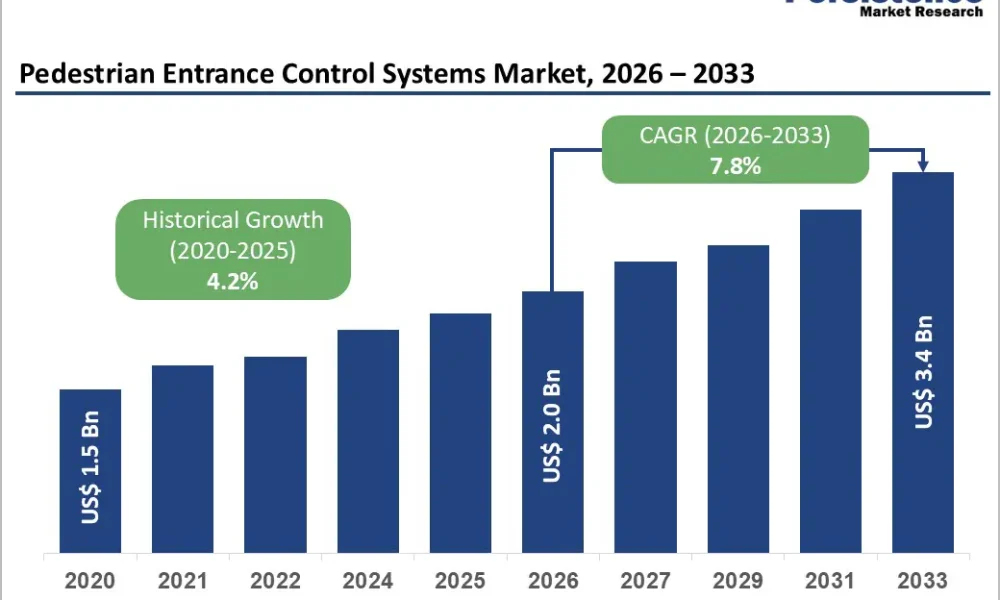
Valued at approximately US$ 2.0 billion in 2026, the market is projected to reach US$ 3.4 billion by 2033, growing at a CAGR of 7.8%. This growth reflects increasing adoption across commercial buildings, transportation hubs, and government facilities, where managing pedestrian flow and ensuring secure access have become mission-critical.
Market Overview: Growth Backed by Security and Digital Transformation
Pedestrian entrance control systems include a range of solutions such as turnstiles, speed gates, security doors, and biometric access systems designed to regulate and monitor foot traffic. These systems are widely deployed in offices, airports, metro stations, stadiums, and critical infrastructure facilities.
The market’s steady expansion is supported by multiple macro trends:
- Escalating global security threats
- Growing need for regulatory compliance
- Rapid infrastructure development
- Increasing adoption of smart building technologies
Additionally, the shift toward digitized and automated access control systems is reshaping how organizations manage entry points. Traditional card-based systems are increasingly being replaced by biometric and mobile-enabled solutions, offering enhanced security and convenience.
Key Market Drivers
Rising Global Security Concerns and Compliance Requirements
One of the most significant factors driving market growth is the increasing need for robust security systems. Governments and enterprises are investing heavily in infrastructure that can prevent unauthorized access, protect sensitive assets, and ensure personnel safety.
Post-pandemic awareness has further amplified the importance of controlled access. Organizations now demand systems that not only secure premises but also maintain detailed logs, audit trails, and real-time monitoring capabilities.
Industries such as banking, healthcare, and telecommunications are particularly proactive due to strict regulatory frameworks. Compliance mandates require:
- Verified identity authentication
- Controlled access to restricted areas
- Continuous monitoring and reporting
These requirements are pushing organizations to adopt advanced entrance control systems with integrated software platforms.
Integration of Biometric and Contactless Technologies
Technological innovation is another major growth driver. Biometric authentication methods—such as facial recognition, fingerprint scanning, and iris detection—are becoming standard in modern access control systems.
Contactless solutions gained widespread popularity during the pandemic and continue to dominate due to their hygiene benefits and user convenience. Key advancements include:
- AI-powered facial recognition with high accuracy
- Mobile credentials using NFC and Bluetooth
- Integration with IoT-enabled security systems
These technologies not only enhance security but also improve throughput, making them ideal for high-traffic environments like airports and metro stations.
Market Restraints
High Initial Investment and Complex Implementation
Despite strong growth prospects, the market faces challenges related to cost and complexity. Deploying a comprehensive entrance control system requires significant capital investment, including:
- Hardware installation
- Software integration
- System customization
- Staff training
For small and medium-sized enterprises, these costs can be prohibitive. Additionally, integrating new systems with existing IT and security infrastructure can be technically challenging and time-consuming.
Retrofitting older buildings also presents structural and aesthetic challenges, often leading to operational disruptions during installation.
Privacy Concerns and Regulatory Challenges
The use of biometric data raises serious privacy concerns. Regulations governing data protection, such as GDPR in Europe, impose strict requirements on how biometric data is collected, stored, and processed.
Organizations must address issues such as:
- Data security and breach risks
- User consent and transparency
- Compliance with regional laws
Public scrutiny and resistance to surveillance technologies can also slow adoption, particularly in regions with strong privacy advocacy.
Emerging Opportunities
Cloud-Based Unified Security Platforms
A major opportunity lies in the development of cloud-based security platforms that integrate multiple functions, including access control, video surveillance, and analytics.
These platforms offer several advantages:
- Centralized monitoring across multiple locations
- Real-time alerts and remote management
- Scalability and reduced infrastructure costs
They also enable advanced analytics, allowing organizations to derive insights from access data, such as occupancy trends and behavioral patterns.
Recent industry developments, including major acquisitions and funding rounds, highlight the growing importance of unified security ecosystems.
Mobile Credentials and Smartphone Integration
The adoption of mobile credentials is another promising trend. Smartphones are increasingly being used as digital keys, replacing traditional access cards and fobs.
Benefits of mobile-based access control include:
- Enhanced user convenience
- Reduced reliance on physical hardware
- Improved security through device-level authentication
Integration with digital identity platforms and payment systems further expands the potential use cases, making entrance control systems part of a broader digital ecosystem.
Category-Wise Analysis
Solution Insights: Hardware vs. Software
Hardware components currently dominate the market, accounting for approximately 49% of the total share. These include:
- Turnstiles (full-height and optical)
- Speed gates
- Security doors
- Tripod barriers
Turnstiles alone represent a significant portion of hardware revenue due to their reliability and efficiency in managing high pedestrian volumes.
However, access control software is the fastest-growing segment, with a CAGR of 9.5%. Cloud-based platforms and SaaS models are driving this growth by offering scalable and cost-effective solutions.
Software solutions provide:
- Real-time monitoring
- Predictive analytics
- Automated threat detection
Operation Mode Insights
Automatic systems dominate the market, holding around 70% share. Their popularity is driven by:
- Reduced labor costs
- Improved efficiency
- Consistent security enforcement
These systems use electronic credentials and biometric sensors to enable seamless access without human intervention.
Manual systems, while smaller in share, continue to grow at 6.2% CAGR. They are preferred in scenarios requiring human judgment or where budget constraints limit automation.
Vertical Insights
Commercial Buildings
Commercial applications lead the market with a 30% share. Offices, retail spaces, and hotels require advanced access control to manage employees, visitors, and restricted zones.
Transportation Hubs
Transportation is the fastest-growing segment, expanding at 10.5% CAGR. Airports, railway stations, and metro systems rely heavily on entrance control systems for:
- Passenger flow management
- Ticket validation
- Security screening
The global push for infrastructure modernization is creating significant opportunities in this segment.
Regional Analysis
Asia Pacific: The Market Leader
Asia Pacific dominates the global market with a 35% share, driven by rapid urbanization and large-scale infrastructure projects.
Key factors include:
- Expanding commercial real estate
- Government-led smart city initiatives
- Increasing security awareness
Countries like China, Japan, and India are at the forefront of adoption, with significant investments in transportation and public infrastructure.
North America: Technology-Driven Growth
North America holds around 28% of the market, supported by advanced technology adoption and stringent regulatory frameworks.
The region benefits from:
- Mature security infrastructure
- Strong presence of leading vendors
- High demand from financial and government sectors
Organizations in the U.S. are particularly focused on integrating advanced technologies such as AI and cloud computing into their security systems.
Europe: Regulation and Innovation
Europe is experiencing steady growth at approximately 8.3% CAGR. The region’s strict data protection laws influence the adoption of biometric technologies.
While regulatory complexity can slow deployment, it also drives innovation in privacy-compliant solutions. Countries like Germany, France, and the UK are key markets with strong demand for advanced systems.
Competitive Landscape
The pedestrian entrance control systems market is moderately consolidated, with a mix of global players and specialized providers competing on technology, innovation, and regional expertise.
Leading companies include:
- Dormakaba Holding
- Honeywell International Inc.
- ASSA ABLOY Global Solutions
- Johnson Controls International plc
- Gunnebo Entrance Control
- Magnetic Autocontrol
These companies focus on expanding their portfolios through acquisitions, partnerships, and product innovation.
Strategic Developments Shaping the Market
Recent developments highlight the dynamic nature of the industry:
- Strategic acquisitions are enabling companies to strengthen their market presence and expand capabilities
- Partnerships with cloud providers are accelerating digital transformation
- Investment in IoT platforms is driving innovation in connected security systems
These initiatives are helping companies transition from hardware providers to comprehensive security solution providers.
Future Outlook: Toward Smart and Connected Security Ecosystems
The future of the pedestrian entrance control systems market lies in the convergence of physical security and digital intelligence. As technologies such as AI, IoT, and cloud computing continue to evolve, entrance control systems will become more intelligent, adaptive, and user-centric.
Key trends shaping the future include:
- Increased adoption of AI-driven analytics
- Expansion of smart city initiatives
- Growth of integrated security platforms
- Rising demand for contactless and mobile-based solutions
Organizations will increasingly view entrance control systems not just as security tools but as strategic assets that enhance operational efficiency and user experience.
Conclusion
The pedestrian entrance control systems market is poised for steady growth, driven by the need for enhanced security, regulatory compliance, and technological innovation. While challenges such as high costs and privacy concerns persist, the market’s long-term outlook remains positive.
With advancements in biometrics, cloud computing, and mobile integration, entrance control systems are evolving into sophisticated, interconnected platforms that redefine how organizations manage access and security.
As global infrastructure continues to modernize and security threats evolve, the demand for intelligent entrance control solutions will only intensify—making this market a critical component of the future security landscape.
Related Reports:




