
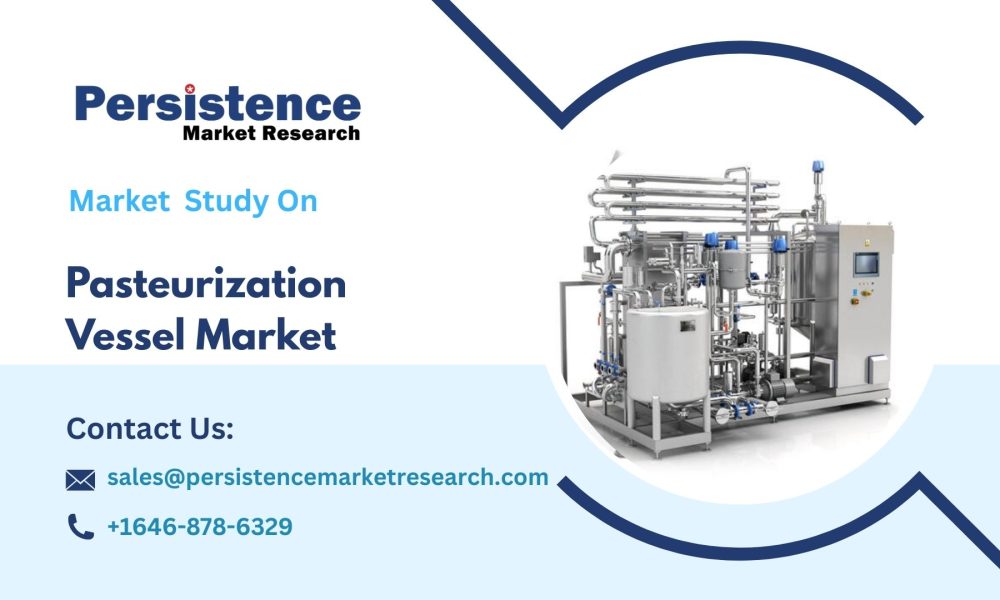
The pasteurization vessel market plays a foundational role in ensuring food and beverage safety across global supply chains. Pasteurization vessels are specialized thermal processing equipment designed to eliminate pathogenic microorganisms while preserving product quality, flavor, and nutritional value. These vessels are widely used in dairy processing, beverage manufacturing, liquid food preparation, and pharmaceutical applications, where hygiene, consistency, and regulatory compliance are critical. As food safety standards tighten worldwide and consumer awareness of contamination risks increases, pasteurization vessels have become indispensable assets for manufacturers seeking reliable and scalable processing solutions.
The global pasteurization vessel market size is likely to be valued at US$6.0 billion by 2026 and is expected to reach US$8.5 billion by 2033, expanding at a CAGR of 5.1% between 2026 and 2033. Market growth is driven by heightened food safety regulations, increasing demand from dairy and beverage industries, and technological advancements in thermal processing equipment. The leading segment remains mid-range capacity vessels (1,001–5,000 liters), as they offer an optimal balance between throughput, flexibility, and cost efficiency. Geographically, Europe leads the market due to stringent food safety regulations, strong dairy processing infrastructure, and early adoption of advanced pasteurization technologies, while Asia Pacific is emerging as the fastest-growing region supported by rising consumption of packaged food and beverages.
Overview of the Pasteurization Vessel Market
The pasteurization vessel market has evolved significantly in response to changing food consumption patterns, regulatory expectations, and manufacturing scale requirements. Pasteurization, once a batch-oriented process used primarily in dairy applications, has expanded into diverse sectors including juices, alcoholic beverages, plant-based drinks, sauces, liquid eggs, and pharmaceutical liquids. Pasteurization vessels are now designed to accommodate a wide range of temperatures, pressures, and product viscosities, enabling manufacturers to process both heat-sensitive and robust formulations efficiently.
From a market perspective, investment decisions are closely linked to regulatory compliance, production scalability, and operational efficiency. Manufacturers are increasingly shifting toward vessels with automated temperature controls, digital monitoring systems, and enhanced cleaning-in-place (CIP) capabilities to ensure consistent product safety while minimizing downtime. Continuous pasteurization systems are gaining traction alongside traditional batch vessels, particularly among high-volume producers seeking improved throughput and energy efficiency. These trends collectively contribute to the steady expansion of the pasteurization vessel market across both developed and emerging economies.
𝐃𝐨𝐰𝐧𝐥𝐨𝐚𝐝 𝐅𝐫𝐞𝐞 𝐒𝐚𝐦𝐩𝐥𝐞 & 𝐂𝐡𝐞𝐜𝐤 𝐭𝐡𝐞 𝐋𝐚𝐭𝐞𝐬𝐭 𝐌𝐚𝐫𝐤𝐞𝐭 𝐀𝐧𝐚𝐥𝐲𝐬𝐢𝐬: https://www.persistencemarketresearch.com/samples/32689
Key Highlights from the Report
• The pasteurization vessel market is projected to grow from US$6.0 billion in 2026 to US$8.5 billion by 2033 at a CAGR of 5.1%.
• Heightened food safety regulations across developed and emerging economies remain a primary market driver.
• Dairy and beverage industries account for the largest share of pasteurization vessel demand globally.
• Mid-range capacity vessels (1,001–5,000 liters) dominate due to flexibility and cost optimization benefits.
• Europe leads the global market, supported by strict regulatory frameworks and advanced processing infrastructure.
• Continuous pasteurization technologies are increasingly adopted to improve efficiency and reduce operational costs.
Market Segmentation Analysis
The pasteurization vessel market is segmented based on capacity, design type, heating method, end-user industry, and operation mode, each reflecting different production needs and investment priorities. Capacity-based segmentation includes small vessels (up to 1,000 liters), mid-range vessels (1,001–5,000 liters), and large vessels (above 5,000 liters). Among these, mid-range capacity vessels represent the largest market share as they cater effectively to both medium-sized and large manufacturers seeking scalable production without excessive capital expenditure. These vessels are particularly popular in dairy processing, craft beverage manufacturing, and specialty food production.
Design-based segmentation distinguishes between batch pasteurization vessels and continuous pasteurization systems. Batch vessels remain widely used due to their simplicity, versatility, and suitability for diverse product types and smaller production runs. However, continuous pasteurization vessels are gaining increasing attention, especially in high-volume beverage and dairy processing, where consistent output, reduced processing time, and lower energy consumption are critical. Continuous systems enable manufacturers to maintain steady production flows while minimizing thermal stress on products.
Heating method segmentation includes steam-heated, electric-heated, and indirect heating vessels. Steam-heated pasteurization vessels dominate the market due to their efficiency, reliability, and compatibility with large-scale industrial operations. Electric-heated systems, while less common, are gaining adoption in regions emphasizing energy efficiency and reduced carbon emissions. Indirect heating systems, which use heat exchangers, are preferred for heat-sensitive products requiring precise temperature control.
From an end-user perspective, the dairy industry remains the largest consumer of pasteurization vessels, driven by sustained demand for milk, cheese, yogurt, and other dairy products. Beverage manufacturers, including juice, beer, wine, and non-alcoholic drinks, represent another significant segment. Additional end-users include food processors producing sauces, soups, and liquid foods, as well as pharmaceutical and nutraceutical companies requiring sterile processing environments.
Regional Insights and Market Trends
Europe dominates the global pasteurization vessel market, supported by stringent food safety regulations enforced by agencies such as the European Food Safety Authority (EFSA). The region’s strong dairy industry, advanced beverage manufacturing sector, and emphasis on quality assurance drive consistent investment in modern pasteurization infrastructure. European manufacturers are early adopters of continuous pasteurization systems and digitally enabled vessels that support traceability, compliance reporting, and energy optimization.
North America represents a mature but stable market, characterized by high per capita consumption of dairy and packaged beverages. The United States and Canada continue to invest in equipment upgrades and modernization to meet evolving regulatory requirements and consumer expectations for product safety and transparency. Demand in this region is largely driven by replacement cycles, capacity expansion in beverage processing, and growing interest in plant-based alternatives that require specialized pasteurization solutions.
Asia Pacific is the fastest-growing regional market, fueled by rapid urbanization, rising disposable incomes, and expanding consumption of packaged food and beverages. Countries such as China, India, Japan, and Southeast Asian nations are witnessing increased investments in dairy processing plants and beverage manufacturing facilities. Government initiatives promoting food safety and quality standards further support market growth, while local equipment manufacturers are increasingly offering cost-competitive pasteurization vessels tailored to regional needs.
Latin America and the Middle East & Africa regions present emerging opportunities as food processing infrastructure develops and regulatory oversight strengthens. While market penetration remains lower compared to developed regions, growing awareness of food safety and expanding dairy and beverage industries are expected to drive gradual adoption of pasteurization vessels over the forecast period.
𝐆𝐞𝐭 𝐚 𝐂𝐮𝐬𝐭𝐨𝐦𝐢𝐳𝐞𝐝 𝐌𝐚𝐫𝐤𝐞𝐭 𝐕𝐢𝐞𝐰 𝐢𝐧 𝐎𝐧𝐞 𝐂𝐥𝐢𝐜𝐤 : https://www.persistencemarketresearch.com/request-customization/32689
Market Drivers
The primary driver of the pasteurization vessel market is the intensification of food safety regulations worldwide. Governments and regulatory bodies are enforcing stricter standards to prevent foodborne illnesses and ensure consumer safety. Compliance with these regulations necessitates reliable pasteurization processes, compelling food and beverage manufacturers to invest in advanced pasteurization vessels capable of precise temperature control and consistent performance.
Increasing demand from the dairy and beverage industries further fuels market growth. Dairy products remain staple food items globally, and rising consumption of value-added products such as flavored milk, yogurt, and cheese drives capacity expansion. Similarly, the beverage sector—encompassing juices, ready-to-drink beverages, alcoholic drinks, and plant-based alternatives—relies heavily on pasteurization to extend shelf life and maintain product quality without chemical preservatives.
Technological advancements in thermal processing equipment also act as a key growth driver. Modern pasteurization vessels incorporate automation, digital monitoring, and advanced control systems that improve efficiency, reduce energy consumption, and minimize human error. These innovations not only enhance operational performance but also support traceability and data-driven compliance, making them increasingly attractive to manufacturers operating in regulated environments.
Market Restraints
Despite favorable growth prospects, the pasteurization vessel market faces certain challenges that can limit adoption. High initial capital investment remains a significant barrier, particularly for small and medium-sized food processors. Advanced vessels equipped with automation and digital features require substantial upfront expenditure, which may deter investment in price-sensitive markets or during periods of economic uncertainty.
Operational complexity and maintenance requirements also pose challenges. Pasteurization vessels must be maintained meticulously to ensure hygiene and performance, requiring skilled personnel and regular inspections. Downtime due to maintenance or equipment failure can disrupt production schedules and impact profitability, particularly for high-volume manufacturers.
Energy consumption and sustainability concerns present additional constraints. Pasteurization is inherently energy-intensive, and rising energy costs can affect operating expenses. While technological advancements aim to improve efficiency, manufacturers may hesitate to upgrade equipment due to cost considerations, slowing the pace of market adoption in certain regions.
Market Opportunities
The pasteurization vessel market offers substantial opportunities driven by evolving consumer preferences and technological innovation. One major opportunity lies in the growing demand for plant-based beverages and functional drinks, which require specialized pasteurization processes to preserve nutritional content and sensory attributes. Equipment manufacturers that develop vessels optimized for these products can capture a rapidly expanding customer base.
The shift toward continuous pasteurization systems represents another key opportunity. Continuous processes offer improved efficiency, reduced energy consumption, and consistent product quality, making them increasingly attractive to large-scale producers. As manufacturers seek to optimize production costs and throughput, demand for continuous pasteurization vessels is expected to rise steadily.
Emerging markets also present long-term growth opportunities as food processing infrastructure expands and regulatory frameworks strengthen. Investments in dairy processing plants, beverage facilities, and cold chain logistics in Asia Pacific, Latin America, and Africa will create sustained demand for pasteurization vessels. Suppliers that offer modular, scalable, and cost-effective solutions tailored to local market conditions are well-positioned to benefit from this growth.
𝐂𝐥𝐢𝐜𝐤 𝐭𝐨 𝐏𝐮𝐫𝐜𝐡𝐚𝐬𝐞 𝐭𝐡𝐞 𝐅𝐮𝐥𝐥 𝐑𝐞𝐩𝐨𝐫𝐭 & 𝐒𝐭𝐚𝐫𝐭 𝐄𝐱𝐩𝐥𝐨𝐫𝐢𝐧𝐠 : https://www.persistencemarketresearch.com/checkout/32689
Company Insights
The pasteurization vessel market is moderately competitive, with global equipment manufacturers and specialized processing technology providers competing on performance, compliance, and service capabilities. Leading players invest heavily in research and development to enhance vessel efficiency, automation, and hygienic design while expanding their global service networks.
• Tetra Pak
• GEA Group
• SPX FLOW, Inc.
• Alfa Laval AB
• Krones AG
• Paul Mueller Company
• Feldmeier Equipment, Inc.
• JBT Corporation
• IDMC Limited
• Stainless Fabrication, Inc.
Recent developments in the market include the launch of next-generation pasteurization vessels with integrated digital monitoring platforms that enable real-time temperature tracking and predictive maintenance. Additionally, several leading manufacturers have expanded production facilities and service centers in Asia Pacific to support rising demand from dairy and beverage processors in the region.
Competitive Landscape and Strategic Developments
Competition in the pasteurization vessel market is driven by technological innovation, regulatory compliance, and customization capabilities. Global players differentiate themselves through advanced engineering, hygienic design standards, and comprehensive after-sales support. Strategic partnerships with food and beverage manufacturers enable equipment suppliers to develop tailored solutions that address specific processing challenges.
Mergers and acquisitions continue to shape the competitive landscape, allowing companies to expand their product portfolios and geographic reach. Sustainability considerations are also influencing product development, with manufacturers focusing on energy-efficient designs, heat recovery systems, and reduced water usage to meet environmental goals and customer expectations.
Conclusion
The pasteurization vessel market is set for sustained growth through 2033, supported by stringent food safety regulations, rising demand from dairy and beverage industries, and continuous technological innovation. With the market expected to expand from US$6.0 billion in 2026 to US$8.5 billion by 2033 at a CAGR of 5.1%, opportunities remain strong across both developed and emerging regions. Europe’s regulatory leadership and Asia Pacific’s rapid market expansion ensure balanced global growth. As manufacturers increasingly prioritize efficiency, compliance, and sustainability, pasteurization vessel suppliers that invest in advanced technology, flexible designs, and customer-centric solutions will be best positioned to succeed in the evolving global marketplace.




