
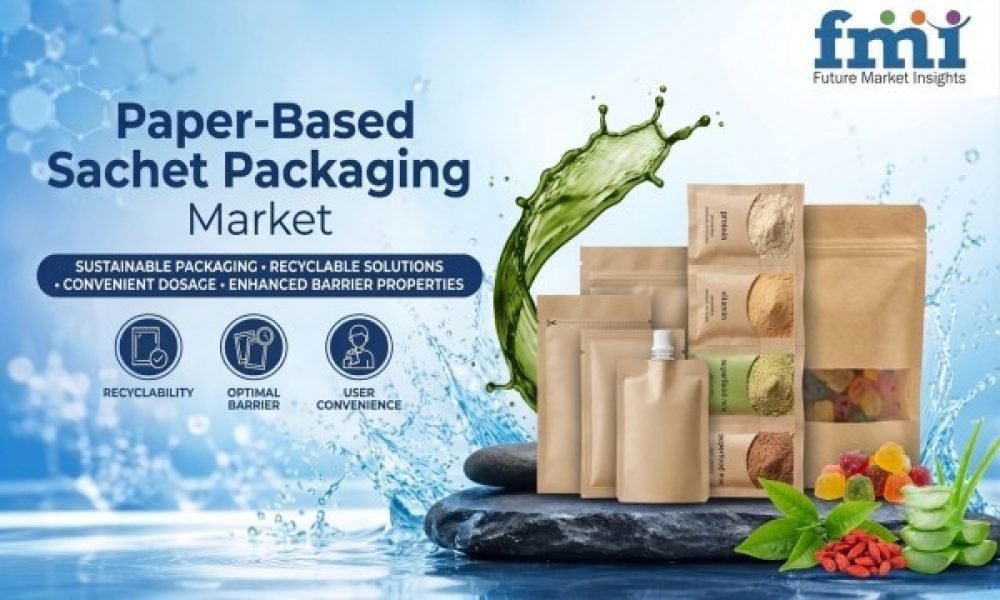
The global Paper-Based Sachet Packaging Market is projected to grow from USD 464.0 million in 2026 to USD 947.5 million by 2036, advancing at a 7.4% CAGR, as food and household brands evaluate compact fiber-based formats for dry products.
The market is being shaped by efforts to reduce plastic content without giving up portion control, established filling-line output, or product protection. Paper is expected to account for 52.0% of material demand in 2026, while food is projected to represent 54.0% of end-use demand.
Commercial adoption, however, depends on more than the paper substrate. Coatings, sealing layers, machine performance, food-contact requirements, and the recovery route for the complete finished structure all influence qualification.
Get detailed market forecasts, competitive benchmarking, and pricing trends:
https://www.futuremarketinsights.com/reports/sample/rep-gb-34249
Paper Formats Move From Trial to Commercial Qualification
Paper-based sachets are being assessed for products with manageable moisture and oxygen exposure, including seasonings, beverage powders, dry foods, and household applications.
The American Forest & Paper Association reported in August 2025 that 60% to 64% of available paper was recycled during 2024. This recovery base supports broader paper packaging programs, but the figure does not establish recyclability for every coated or sealed sachet.
For commercial programs, packaging developers therefore need to test the finished structure. Barrier performance, seal integrity, shelf life, machine compatibility, and documented repulpability all need to work together.
Grease-resistant structures are expected to hold 29.0% of the market in 2026. This reflects the need to protect food products from oil migration while maintaining printed-surface quality and mechanical strength.
Food Remains the Largest End-Use Opportunity
Food applications are projected to account for 54.0% of demand in 2026, supported by recurring portion-pack requirements across dry ingredients, seasonings, and beverage powders.
Paper also offers established printing and converting processes. For dry products with controlled moisture exposure, developers can often work with fewer barrier layers than would be required for liquids or retort applications.
Recent industry developments show the technical direction of the category. In March 2025, Amcor launched an 85% fiber stand-up refill pouch for instant coffee and dry beverages. The structure was supported by documented barrier and seal performance, with CEPI and Aticelca certification covering the finished structure.
In March 2025, Ahlstrom introduced LamiBak Flex for barrier-coated papers used in pouches and sachets. The PFAS-free base paper combines grease protection with documented recyclability certified in the United States and Europe.
Regulations Increase the Need for Complete-Pack Evidence
Regulatory requirements are making recovery claims more application-specific. In February 2025, the European Commission stated that Regulation 2025/40 had entered into force and would generally apply from August 2026.
The regulation covers packaging placed on the European Union market and increases the need for evidence around package composition and recoverability.
The United States presents another layer of complexity. In July 2025, the Oregon Department of Environmental Quality announced the statewide launch of producer responsibility for packaging and paper. CalRecycle later reported in May 2026 that permanent SB 54 regulations had become effective.
These developments mean packaging teams cannot assume that one recovery assessment will apply across every market. Complete sachet structures must be considered alongside local collection, sorting, and recycling conditions.
Regional Growth Varies Across Major Markets
India is projected to record the highest country-level CAGR among the markets profiled, at 10.0% through 2036. The United States follows at 9.3%, while Japan and Germany are forecast at 8.5% and 7.8%, respectively.
The United Kingdom is projected to expand at 7.0%, followed by France at 6.3%.
Each market presents different qualification conditions. India combines expanding dry-food and personal-care applications with established regional converting capacity. Japan operates within formal paper-recycling obligations, while Germany places emphasis on practical sorting and recovery assessment.
The United Kingdom is moving toward fee modulation based on recyclability, while France continues to evaluate paper substitution across established packaged-goods applications.
Analyst Perspective
“Paper sachets create commercial value through a careful balance of barrier protection and sealing speed across a recoverable finished pack. Small formats leave little room for weak folds or unstable heat windows during high-volume filling. Packaging developers that prove shelf life and repulpability on the same structure can shorten qualification without transferring performance risk to food manufacturers.”
Nandini Roy Choudhury, Principal Analyst, Future Market Insights
Competitive Landscape
The competitive environment includes integrated flexible packaging companies and specialist paper suppliers.
Amcor, Mondi, Huhtamaki, Constantia Flexibles, ProAmpac, Sappi, Ahlstrom, and Koehler Paper are identified as notable companies in the market.
Recent developments include Mondi’s expanded production of FunctionalBarrier Paper Ultimate in August 2025, Sappi’s Guard Pro OHS and Guard Pro OMH launches in September 2025, and Koehler Paper’s introduction of NexPlus Seal Coat in September 2025.
In February 2026, Constantia Flexibles presented its commercially available EcoPaper family for food-contact packaging. ProAmpac also expanded its RP-2000 high-barrier fiber platform across pouches and rollstock for sensitive dry foods.
See All the Details—Click Here for Full Report Information!
https://www.futuremarketinsights.com/reports/paper-based-sachet-packaging-market
Market Scope
The FMI study covers the Paper-Based Sachet Packaging Market by material, format, barrier or feature, end use, and region.
Materials include paper, molded fiber, recycled PET, mono-material PE, and bio-based polymers. Formats include pouches, trays, labels, mailers, and inserts. Barrier and feature categories include grease resistant, high barrier, tamper evident, traceable, and freshness indicating.
End-use coverage includes food, pharmaceutical, e-commerce, personal care, and cold chain.
The geographic scope covers North America, Europe, East Asia, South Asia and Pacific, Latin America, and the Middle East and Africa, with country-level analysis across India, the United States, Japan, Germany, the United Kingdom, France, and more than 30 countries.
FMI Custom Research: Strategic Intelligence for Confident Decision-Making
In today’s rapidly evolving business environment, leadership teams need more than market data—they need clear, actionable intelligence tailored to their strategic objectives. FMI’s Custom Research solutions are designed around the specific business questions organizations need answered, enabling executives to evaluate growth opportunities, validate investments, assess competitive dynamics, and reduce uncertainty before making critical decisions. By combining deep industry expertise, primary research, and proprietary market intelligence, FMI delivers insights that help organizations move from assumptions to evidence-based strategies with greater speed and confidence.
Business Impact
FMI helps organizations transform market complexity into strategic clarity, enabling leadership teams to identify growth opportunities faster, optimize resource allocation, strengthen competitive positioning, and make high-stakes business decisions with confidence.
To explore how FMI Custom Research can support your strategic priorities, please connect with our team at – [email protected]
About Future Market Insights (FMI)
Future Market Insights, Inc. (FMI) is an ESOMAR-certified, ISO 9001:2015 market research and consulting organization, trusted by Fortune 500 clients and global enterprises. With operations in the U.S., UK, India, and Dubai, FMI provides data-backed insights and strategic intelligence across 30+ industries and 1200 markets worldwide.



