
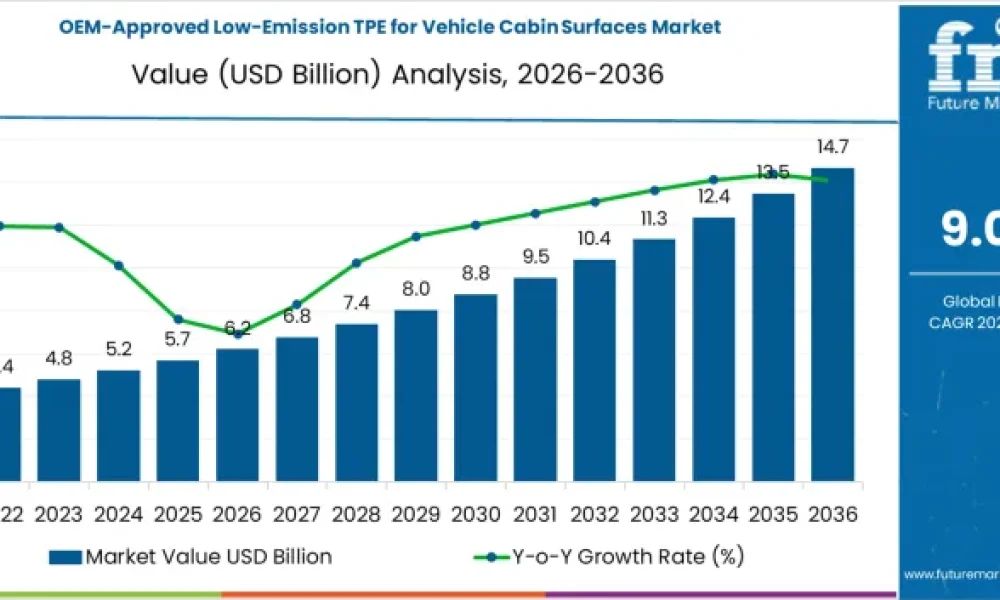
The OEM-approved low-emission thermoplastic elastomer (TPE) for vehicle cabin surfaces market is on a dynamic growth trajectory, projected to expand from approximately USD 6.2 billion in 2026 to USD 14.7 billion by 2036, reflecting a robust 9% compound annual growth rate (CAGR) through the decade. This significant uptrend is being driven by increasingly stringent interior air quality standards, heightened consumer demand for sustainable and low-VOC materials, and regulatory emphasis on healthier cabin environments.
Key Market Insights at a Glance show a rapidly evolving landscape where low-emission TPE compounds are becoming essential in automotive cabin interiors to reduce volatile organic compound (VOC) emissions while delivering performance and design flexibility. With instrument panels commanding an estimated 65% share of the application segment, these materials are increasingly seen as a core component of OEM sustainability strategies.
The market’s growth is being propelled by several intersecting forces, including the global pivot toward electric vehicles (EVs), consumer preference for healthier in-car environments, and regulatory mandates that require automotive interior materials to meet strict air quality criteria. The rise of electrification and advanced mobility solutions also stimulates demand for low-emission TPEs, which contribute to both environmental goals and occupant comfort without compromising material performance.
Segment Overview reveals a detailed picture of material and application dynamics. Thermoplastic olefins (TPO/TPE-O) are forecast to lead the polymer mix with around 38% share, favored for their balanced performance, low emission profiles, and processing efficiency. Other key polymer types include styrenic block copolymers (SBC), thermoplastic vulcanizates (TPV), and thermoplastic polyurethane (TPU). On the application front, instrument panels, door panels, center consoles, soft-touch interior surfaces, and seals or weatherstrips collectively drive market demand as OEMs strive to improve aesthetics and indoor air quality in passenger cabins.
Regional Overview underscores strong growth across major automotive markets. China leads the expansion curve with a projected 10.5% CAGR, supported by its dominance in EV production and aggressive green manufacturing initiatives. The United States follows with a forecast 9.8% CAGR, bolstered by environmental regulations and consumer awareness of sustainable vehicle materials. Europe, including Germany, is also a key region with a 9.3% CAGR, driven by stringent regulatory frameworks and high standards for interior air quality. Other notable markets such as Japan and South Korea are growing steadily, driven by advanced automotive technologies and rising adoption of low-emission materials.
To access the complete data tables and in-depth insights — Request Your Sample Report Now
The Competitive Landscape is becoming increasingly sophisticated as manufacturers introduce proprietary formulations and enhanced low-emission TPE platforms tailored for specific OEM interior requirements. Leading players are deploying innovation strategies that emphasize VOC performance, texture quality, and regulatory compliance. Companies with established portfolios in this space include Kraton Corporation, Teknor Apex Company, Avient Corporation, Kuraray Co., Ltd., Mitsui Chemicals, Inc., Covestro AG, and The Lubrizol Corporation, all focusing on solutions that meet evolving automotive standards while addressing design and comfort expectations.
Market Outlook: Powering the Next Decade reflects the industry’s transition toward sustainability and health-centric cabin surfaces. As global automotive manufacturers pursue carbon reduction strategies and interior air quality improvements, demand for low-emission TPE will continue to rise. Technological advancements in polymer chemistry, emission control, and processing will further enhance material capabilities, enabling OEMs to integrate low-emission TPEs seamlessly into vehicle design and production workflows. This outlook suggests that low-emission TPE is not merely a compliance asset but a strategic enabler of automotive innovation, supporting lightweighting, design versatility, and enhanced occupant experience.
Recent Strategic Developments across the sector include the launch of next-generation TPE compounds with ultra-low VOC profiles, expanded partnerships between material suppliers and global OEMs, and accelerated qualification processes for sustainable materials in mass production. These initiatives align with broader industry trends emphasizing decarbonization, health-oriented materials, and lifecycle sustainability. As automakers ramp up electrification and focus on passenger wellness, low-emission TPEs are positioned at the forefront of interior material solutions.
Looking ahead, the OEM-approved low-emission TPE for vehicle cabin surfaces market is poised for sustained momentum driven by regulatory pressure, consumer demand for healthier vehicle interiors, and continuous technological innovation. Stakeholders across the automotive value chain — from polymer developers to OEMs — are collaboratively shaping a future where interior materials not only meet performance demands but also contribute to broader sustainability and health objectives.
Have a specific Requirements and Need Assistant on Report Pricing or Limited Budget please contact us – [email protected]
About Future Market Insights (FMI)
Future Market Insights, Inc. (FMI) is an ESOMAR-certified, ISO 9001:2015 market research and consulting organization, trusted by Fortune 500 clients and global enterprises. With operations in the U.S., UK, India, and Dubai, FMI provides data-backed insights and strategic intelligence across 30+ industries and 1200 markets worldwide.
Why Choose FMI: https://www.futuremarketinsights.com/why-fmi



