
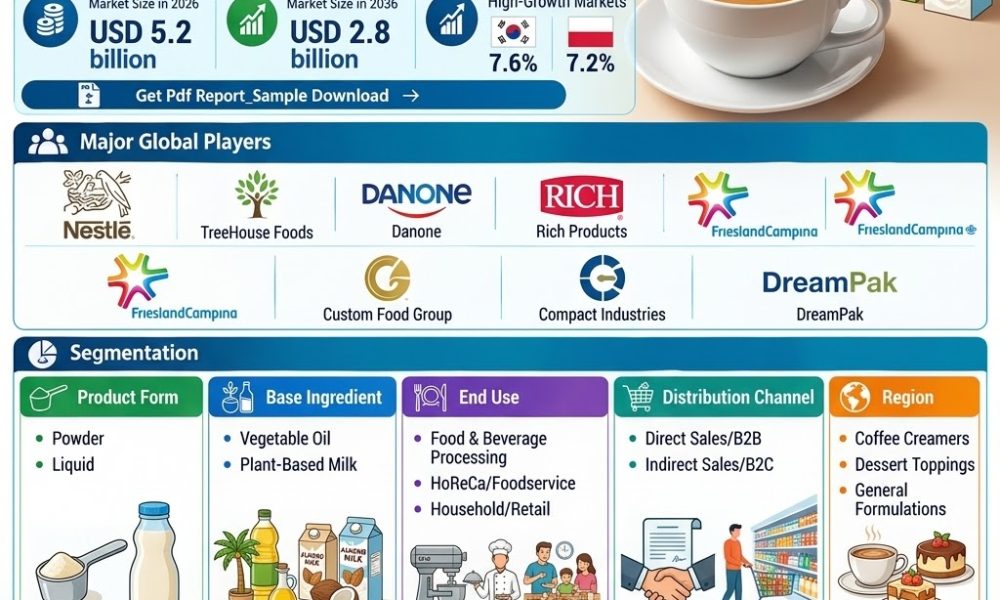
NEWARK, Del., October 8, 2026. — The global non-dairy creamers market is estimated at USD 2.9 billion in 2026 and is projected to reach USD 5.2 billion by 2036, expanding at a CAGR of 6.2% from 2026 to 2036, according to Future Market Insights (FMI). The market stood at USD 2.7 billion in 2025.
The growth outlook is being shaped by increasing coffee consumption and the expansion of creamer use beyond a single morning beverage. FMI says demand is widening across hot coffee, cold coffee, flavored drinks and multiple daily servings, while consumers increasingly seek premium flavors, improved mouthfeel and products that disperse effectively in both hot and cold beverages.
Processing consistency puts greater weight on formulation performance
Non-dairy creamers are increasingly being evaluated on more than whitening performance. Food and beverage processors require stable emulsions, predictable dispersion and similar cup results across production batches. FMI says these requirements are supporting demand for vegetable-oil-based formulations, while powder formats benefit from ambient storage, longer handling convenience and easy reconstitution.
👉 Get Detailed Market Forecasts, Competitive Benchmarking & Pricing Trends: https://www.futuremarketinsights.com/reports/sample/rep-gb-8691
Where growth is fastest
- South Korea — 7.6% CAGR: A large and expanding café market is supporting demand for premium, cold-beverage and flavored creamer applications. In August 2026, the Ministry of Agriculture, Food and Rural Affairs reported that South Korea’s coffee market had expanded to KRW 3.74 trillion across more than 100,000 coffee shops.
- Poland — 7.2% CAGR: Demand is being shaped by changing dairy-alternative formulations and European labeling requirements. Plant-based products must comply with restrictions around dairy-reserved names, making compliant naming and supporting documentation important for wider retail adoption.
What leads the market
- Powder — 62.0% share in 2026: Ambient handling, storage convenience and easy reconstitution support powder as the leading form.
- Vegetable oil — 55.0% share in 2026: Whitening, mouthfeel and stable emulsion performance support vegetable oil as the leading base.
- Food and beverage processing — 48.0% share in 2026: Repeat formulations and the need for consistent cup performance across production batches support the leading end-use position.
- Hot and cold beverages: Wider consumption occasions are expanding creamer applications beyond traditional coffee whitening.
- Premium and flavored formats: Demand for improved taste, mouthfeel and beverage compatibility is creating opportunities for differentiated formulations.
The hurdle
Formulation consistency and regulatory compliance remain key considerations. FMI says processors need reliable dispersion, stable emulsions and consistent taste across batches, while manufacturers entering markets with dairy-alternative labeling requirements must ensure compliant product names and supporting documentation. These requirements can influence shelf adoption and commercial scalability.
Recent developments
The market is seeing greater investment in production capacity and product flexibility as manufacturers respond to changing beverage consumption patterns:
- January 2025: Nestlé USA opened a 630,000-square-foot factory in Arizona following a USD 675 million investment, adding production capacity and supporting greater flexibility across packs and flavors.
- August 2026: The Ministry of Agriculture, Food and Rural Affairs reported that South Korea’s coffee market had reached KRW 3.74 trillion across more than 100,000 coffee shops, highlighting the scale of the country’s café and coffee consumption ecosystem.
FMI profiles Nestlé, TreeHouse Foods, Danone, Rich Products, FrieslandCampina, Custom Food Group, Compact Industries and DreamPak among the notable companies operating in the non-dairy creamers market.
Analyst perspective
“Cold beverage adoption will move creamers beyond one regular cup. Stable taste and dispersion will decide which products gain repeat demand.”— Nandini Roy Choudhury, Principal Consultant, Future Market Insights.
What this means for food manufacturers and non-dairy creamer brands
- Prioritize consistent formulation performance. Stable dispersion, whitening, mouthfeel and emulsion performance can help manufacturers meet repeat processing requirements.
- Expand beyond traditional coffee occasions. Cold coffee, flavored beverages and multiple daily servings provide opportunities to increase creamer consumption across retail and foodservice.
- Build flexible product portfolios. Powder formats can support ambient distribution, while formulation flexibility can help manufacturers respond to changing beverage applications and flavor preferences.
- Strengthen regulatory readiness. Manufacturers entering markets with dairy-alternative labeling requirements should ensure compliant naming and supporting documentation before pursuing wider shelf distribution.
About Future Market Insights
Future Market Insights, Inc. (FMI) is an ESOMAR-certified market research and consulting firm headquartered in Delaware, USA, with offices in the United Kingdom, the United Arab Emirates and India. FMI delivers syndicated and custom research across food and beverage, healthcare, chemicals, technology, packaging, consumer goods and industrial sectors.
For Press & Corporate Inquiries
Rahul Singh
AVP – Marketing and Growth Strategy
Future Market Insights, Inc.
+91 8600020075
For Sales: [email protected]
For Media: [email protected]
For Web: https://www.futuremarketinsights.com/



