
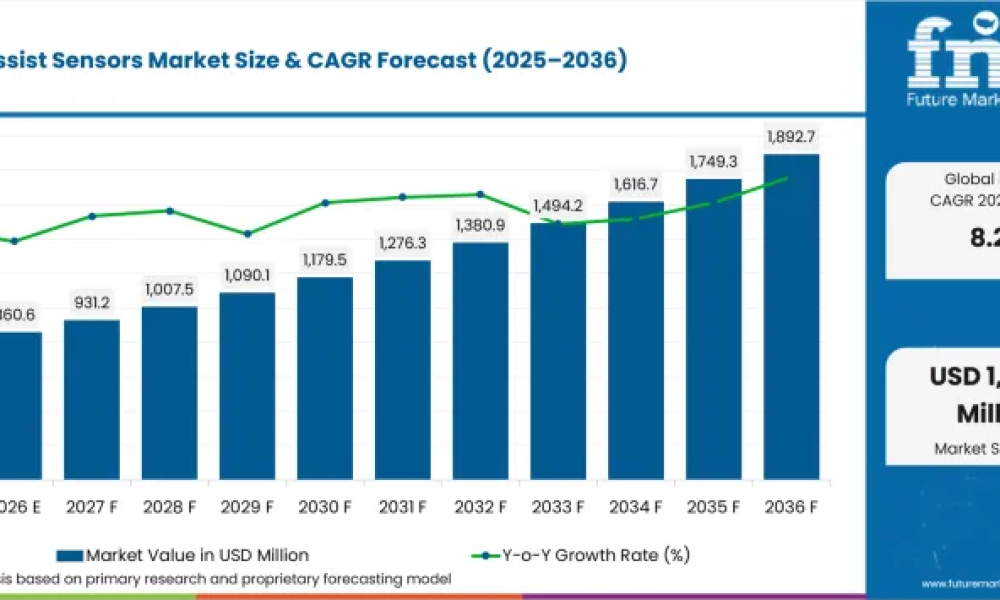
The global docking assist sensors market is projected to expand from USD 860.6 million in 2026 to USD 1,892.7 million by 2036, advancing at an 8.2% CAGR from 2026 to 2036. Demand is being supported by vessel operators seeking more accurate low-speed position data during close-quarter maneuvers, particularly where restricted sightlines and limited clearance increase docking complexity.
Docking assist sensors can feed position and clearance information into marine propulsion and maneuvering systems without requiring a completely separate alarm architecture at the helm. In January 2025, Dockmate redesigned its DPS V2 for easier retrofit and integrated engine or thruster control. The receiver upgrade can reduce installation work for boat owners seeking position assistance without replacing an entire helm system.
Country-level conversion depends heavily on the installed vessel base and service availability. Sweden provides a substantial recreational boating retrofit opportunity, with the Swedish Transport Agency counting nearly 1.3 million seaworthy recreational boats in September 2025. Japan, meanwhile, records the lowest CAGR among the seven profiled countries, with demand more closely tied to selective replacement cycles and compact integration requirements.
What Are the Key Segments in the Docking Assist Sensors Market?
- Ultrasonic Sensors — 26.0% share: Ultrasonic sensors lead the sensor-type segment because compact short-range ranging hardware can provide useful clearance information during low-speed maneuvering.
- Sensor Only — 22.0% share: Sensor-only systems represent the leading system-scope category because modular sensors can integrate with existing helm electronics without requiring replacement of the complete control system.
- Yachts — 31.0% share: Yachts lead the vessel-type segment because larger hulls can create greater blind-zone exposure during close-quarter maneuvering.
- Retrofit Installation: Retrofit demand remains important as owners seek docking assistance without replacing established propulsion, helm, or navigation equipment.
- Distance Sensing: Distance sensing provides a core function by giving operators information about nearby objects and clearance during docking and other low-speed maneuvers.
Get detailed market forecasts, competitive benchmarking, and pricing trends:
https://www.futuremarketinsights.com/reports/sample/rep-gb-35029
Which Countries Are Showing the Strongest Growth in Docking Assist Sensors?
Sweden is projected to record the highest CAGR among the profiled countries at 8.9% through 2036. A substantial recreational boating base supports opportunities for docking-assistance retrofits, particularly where owners seek additional maneuvering support without replacing existing helm systems. The country’s nearly 1.3 million seaworthy recreational boats provide a sizeable installed base for sensor upgrades.
Norway is expected to expand at an 8.3% CAGR, supported by its extensive boating activity and established marine equipment ecosystem. Demand is influenced by the need for reliable low-speed maneuvering information across recreational vessels and other craft operating in confined waterways and harbors.
The Netherlands is projected to grow at an 8.0% CAGR, supported by a strong marine and recreational boating environment. Docking-assist systems can provide additional clearance information in crowded marinas and other restricted operating areas where precise maneuvering is important.
Australia is expected to record a 7.5% CAGR, supported by recreational boating and marine aftermarket activity. Retrofit accessibility and installer capability remain important as boat owners evaluate sensor upgrades alongside existing navigation and propulsion equipment.
The United States is projected to expand at a 7.2% CAGR, supported by its broad recreational boating base and demand for marine electronics. Sensor-based docking assistance can complement existing propulsion and helm systems, particularly on larger boats where visibility around the vessel is restricted.
Germany is expected to grow at a 7.0% CAGR, supported by established marine technology capabilities and demand for integrated vessel electronics. Installation quality, calibration, and compatibility with existing control systems remain important considerations.
Japan is projected to record the lowest CAGR among the profiled countries at 6.1%. Market development is more selective, with compact integration and vessel-specific installation requirements influencing replacement decisions.
How Is Regional Demand Shaping the Docking Assist Sensors Market?
Northern European markets, led by Sweden and Norway, represent the fastest-growing country group. Their established recreational boating bases and marine service networks create opportunities for retrofit sensor systems that can be integrated with existing helm and propulsion equipment.
The Netherlands and Germany provide additional opportunities through mature marine electronics ecosystems, while Australia and the United States benefit from large recreational boating populations and aftermarket installation channels. Japan represents a more selective market where compact packaging and integration efficiency can have greater influence on purchasing decisions.
What Is Changing the Competitive Landscape?
The competitive landscape includes Volvo Penta, Brunswick Corporation, Dockmate, Mercury Marine, Yamaha Motor Co., Ltd., Simrad Yachting (Navico Group), Furuno Electric Co., Ltd., and VETUS. These companies compete through sensor technologies, propulsion integration, navigation electronics, automated control, and retrofit-compatible marine systems.
Integration is becoming an important competitive factor. Docking assistance becomes more useful when sensor information can be interpreted alongside propulsion and thruster controls rather than operating as an isolated warning system. This creates opportunities for suppliers capable of linking position information with existing vessel-control architectures.
Retrofit simplicity is another area of differentiation. Many vessel owners prefer to improve docking assistance without replacing an entire helm. Systems that minimize cabling, calibration requirements, and control-system modifications can therefore reduce installation barriers.
Sensor technology selection also varies according to operating conditions. Ultrasonic sensors can provide compact short-range measurements, while radar, cameras, LiDAR, and GNSS-assisted systems can address different combinations of range, visibility, positioning, and environmental requirements.
What Does the Analyst Say About the Docking Assist Sensors Market?
“For docking assist sensors, the purchase decision starts with what the helm can see at walking speed and ends with available propulsion authority. Sensor accuracy loses commercial value if hull calibration or control compatibility makes commissioning unreliable on the vessel being upgraded.”
— Nikhil Kaitwade, Principal Consultant, Future Market Insights
What Is Driving Demand for Docking Assist Sensors?
Restricted Visibility During Close-Quarter Maneuvers
Large vessels can create blind zones around the hull, making low-speed maneuvering difficult when approaching docks, piers, and other boats. Sensors can provide additional clearance information that complements direct visual observation from the helm.
Expansion of Retrofit Marine Electronics
Existing vessels represent an important addressable market because owners can add docking assistance without replacing the entire propulsion or helm architecture. Retrofit-compatible sensors can therefore expand adoption beyond newly manufactured boats.
Integration with Propulsion and Thruster Systems
Docking assistance becomes more valuable when sensor information can support engine or thruster control. Integration allows position and clearance information to contribute to a broader maneuvering strategy rather than simply triggering an independent alarm.
Growth of Recreational Boating
Recreational vessels represent a major application base for docking assistance. Sweden’s nearly 1.3 million seaworthy recreational boats illustrate the scale of the installed fleet that can potentially support sensor retrofits.
Drive Your Business Growth Strategy: Checkout the Report for Key Insights!
https://www.futuremarketinsights.com/checkout/35029
What Are the Key Market Restraints?
Vessel-specific sensor placement can increase installation costs. Hull geometry, sensor positioning, cabling, and calibration requirements vary between vessels, making a standardized installation approach difficult across the entire marine market.
Control compatibility is another restraint. A sensor system may provide accurate measurements but deliver limited commercial value if it cannot communicate reliably with the vessel’s existing helm, propulsion, thruster, or navigation equipment.
Environmental conditions can also affect sensor performance. Water surfaces, structures, weather conditions, vessel movement, and installation position can influence the quality of data available during close-quarter maneuvering.
What Opportunities Exist for Docking Assist Sensor Manufacturers?
Retrofit-ready systems represent a significant opportunity as boat owners seek incremental upgrades rather than complete helm replacements. Suppliers can improve adoption by offering simplified wiring, calibration tools, vehicle-specific or vessel-specific installation guidance, and compatibility with common marine control systems.
Integrated docking platforms provide another opportunity. Combining sensors with displays, propulsion controls, thrusters, and automated maneuvering functions can increase system value while reducing the number of separate components operators must manage.
There is also scope for multi-sensor architectures that combine ultrasonic, radar, camera, LiDAR, or GNSS inputs. Such systems can improve the information available to operators across different visibility and maneuvering conditions.
How Is the Docking Assist Sensors Market Segmented?
The docking assist sensors market is segmented by sensor type, system scope, vessel type, installation, function, and region.
By Sensor Type
Sensor technologies include ultrasonic, radar, camera, LiDAR, and GNSS-assisted sensors. Ultrasonic sensors lead the segment with 26.0% share in 2026 because of their suitability for compact short-range ranging applications.
By System Scope
The market includes sensor-only systems, sensor plus display systems, and sensor plus automated control systems. Sensor-only systems account for 22.0% share in 2026, supported by modular integration with installed helm electronics.
By Vessel Type
Vessel categories include yachts, motorboats, sailboats, and commercial craft. Yachts lead with 31.0% share, reflecting the greater blind-zone exposure associated with larger hulls.
By Installation
Installation includes OEM fitment and retrofit. Retrofit systems provide an important route for upgrading existing vessels without replacing complete helm or propulsion systems.
By Function
Functions include distance sensing, position holding, collision warning, and automated docking assistance. These functions range from information-only systems to more integrated control architectures.
What Are the Drivers, Restraints and Opportunities in the Docking Assist Sensors Market?
The docking assist sensors market is being shaped by demand for better low-speed visibility, retrofit-friendly electronics, and greater integration between sensing and propulsion control.
- Driver: Vessel operators increasingly seek additional clearance and position information during close-quarter maneuvering.
- Restraint: Vessel-specific sensor placement, cabling, calibration, and control compatibility can increase installation complexity.
- Opportunity: Integrated sensor, display, propulsion, and thruster systems can deliver more useful docking assistance while reducing dependence on isolated alarm functions.
What Is the Docking Assist Sensors Market Demand Outlook?
The docking assist sensors market is projected to reach USD 1,892.7 million by 2036, rising from USD 860.6 million in 2026 at an 8.2% CAGR.
Demand is expected to remain closely linked to recreational vessel ownership, marine electronics upgrades, and the growing integration of sensing with propulsion and thruster controls. Retrofit systems are particularly important because they allow owners to improve low-speed maneuvering without replacing established helm architectures.
The strongest opportunities are expected in markets with large recreational boating fleets and established marine service networks. Suppliers that reduce installation complexity while providing reliable calibration and control compatibility can strengthen adoption across both new-build and retrofit applications.
How Fast Are Key Countries Growing in the Docking Assist Sensors Market?
Sweden leads the profiled countries with an 8.9% CAGR, followed by Norway at 8.3%, the Netherlands at 8.0%, Australia at 7.5%, the United States at 7.2%, Germany at 7.0%, and Japan at 6.1% through 2036. Sweden’s large recreational boating fleet provides a strong retrofit base, while Norway and the Netherlands benefit from established boating and marine-service ecosystems. Australia and the United States offer opportunities through recreational boating and aftermarket electronics, Germany through marine technology integration, and Japan through selective demand for compact, vessel-specific systems.
About Future Market Insights
Future Market Insights (FMI) is a leading provider of market research and consulting services, offering syndicated and customized research across automotive, marine, energy, industrial automation, and other global industries. FMI delivers market forecasts, competitive intelligence, and strategic analysis to support business decisions across global markets.



