
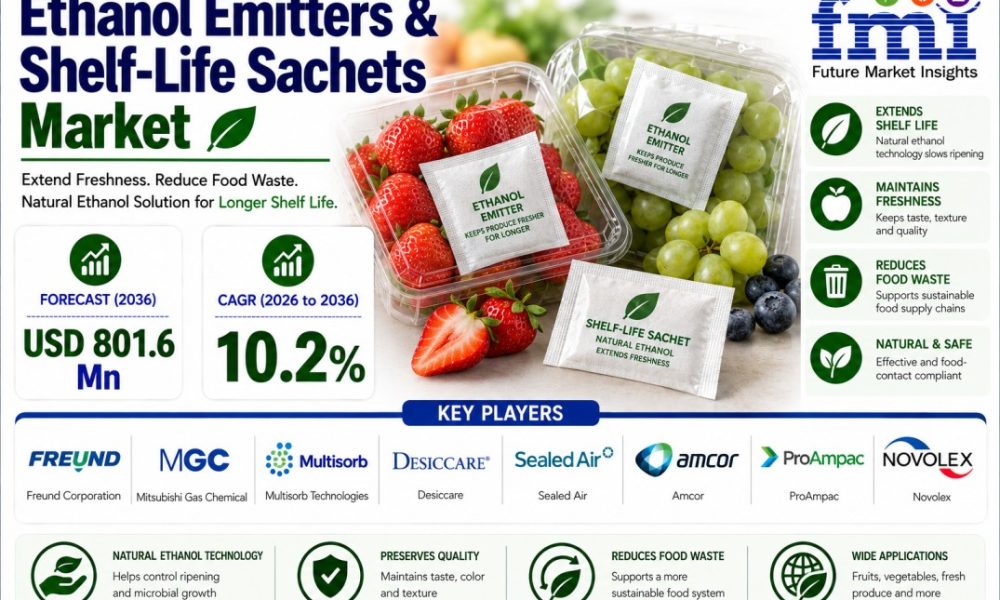
The global ethanol emitters and shelf-life sachets market is projected to reach USD 801.6 million by 2036, rising from USD 303.5 million in 2026 at a 10.2% CAGR, according to Future Market Insights.
Demand is being supported by bakeries looking for ways to extend validated sellable life without reformulating products or slowing established production lines. Ethanol emitters and related shelf-life sachets provide an in-pack preservation approach that can help manage mold and other quality risks under defined storage and distribution conditions.
The commercial case is strongest where additional sellable days can reduce write-offs, support wider distribution windows, or improve inventory planning.
>> Access detailed market insights: https://www.futuremarketinsights.com/reports/brochure/rep-gb-34873
Standard Formats Lead Product Demand
Standard formats are projected to account for 42.0% of product-type demand in 2026.
Fixed dimensions simplify dose selection, automated insertion and repeat ordering. For industrial bakeries running multiple SKUs on established packaging equipment, familiar sachet dimensions can also reduce changeover work.
This makes standardization particularly valuable where packaging teams need to maintain consistent settings across high-volume production runs.
The market is also seeing interest in printed or branded, resealable or functional, and sustainable formats. However, any change in construction must maintain the release characteristics required by the application.
Paper & Board Gains Share
Paper and board are expected to account for 39.0% of material demand in 2026, making the category the leading material segment.
The shift reflects efforts to reduce conventional plastic in visible in-pack components while retaining a printable outer surface.
Material conversion, however, cannot be separated from barrier performance. The sachet or active web needs to control ethanol release and moisture interaction at the intended rate. If the package barrier or active component is mismatched, shelf-life performance can deteriorate.
As a result, material changes require package-level trials before adoption on high-speed bakery lines.
Bread & Rolls Remain the Core Application
Bread and rolls are projected to represent 37.0% of bakery application demand in 2026.
The category combines high production volumes with sensitivity to mold development after sealing. In-pack preservation can provide an additional shelf-life management tool without requiring a change to the underlying dough formulation.
The application also demonstrates why active packaging needs to be evaluated as part of the complete pack.
In February 2025, Amcor partnered with Tip Top on bread bags containing 30% recycled plastic under a mass-balance approach. The initiative illustrates how bakery packaging programs are simultaneously addressing product quality and material conversion.
Primary Packaging Creates the Main Qualification Opportunity
Primary packaging is projected to account for 53.0% of function demand in 2026.
This positioning places the active component directly inside the consumer package, where vapor, oxygen and moisture conditions can influence product stability.
The commercial value therefore depends on the interaction between the emitter and host packaging.
Nandini Roy Choudhury, Principal Consultant at Future Market Insights, states:
“Packaging teams should compare validated sellable days and line performance before they compare sachet unit prices. Commercial value is earned where the emitter and host pack pass qualification together without slowing routine production.”
The statement highlights the main purchasing issue. A low-cost sachet has limited value if it cannot maintain the required release profile or requires disruptive production changes.
Food-Waste Economics Support Adoption
Food-waste reduction is another important demand driver.
Bakeries can justify active packaging when documented shelf-life extension reduces discarded product and preserves a planned retail or distribution window.
The USA Environmental Protection Agency’s January 2026 Wasted Food Scale estimated that food represents 24% of material in municipal solid-waste landfills. This strengthens the broader commercial focus on prevention before disposal.
For bakery operators, the relevant measurement is therefore not simply the technical performance of an emitter. Trials need to establish whether the technology produces additional sellable days under real storage and distribution conditions.
>> Get Detailed Market Forecasts, Competitive Benchmarking, and Pricing Trends: https://www.futuremarketinsights.com/reports/sample/rep-gb-34873
Regional Growth Outlook
Saudi Arabia is projected to record the fastest growth among the profiled markets at 11.2% CAGR, followed by the USA at 10.5%, UK at 10.2%, France at 9.8%, and Germany at 9.5% through 2036.
Saudi Arabia’s hot climate and extended distribution conditions increase the importance of release consistency and package compatibility.
In the USA, long-distance bakery distribution supports demand for additional sellable days, while food-contact requirements encourage documentation before national rollout.
UK bakery groups increasingly evaluate active components alongside packaging recyclability and retailer specifications.
France is balancing shelf-life extension with material use and sustainability expectations, while German packaging teams place emphasis on automated production compatibility and design-for-recycling objectives.
Competitive Landscape
The market includes Freund Corporation, Mitsubishi Gas Chemical, Multisorb Technologies, Desiccare, Sealed Air, Amcor, ProAmpac, and Novolex.
Competition spans preservation-chemistry specialists and integrated food-packaging companies.
Freund Corporation, Mitsubishi Gas Chemical, Multisorb Technologies and Desiccare compete around active-control chemistry, sizing and package-atmosphere management. Sealed Air and ProAmpac bring food-packaging engineering and production integration. Amcor and Novolex leverage their large-scale food-packaging positions and material-conversion capabilities.
Recent industry activity includes ProAmpac’s June 2026 commercialization of MP-1000 with Ozzi, Sealed Air’s September 2025 installation of its 4,000th CRYOVAC rotary vacuum chamber system, and Novolex’s April 2025 combination with Pactiv Evergreen.
As bakeries continue to focus on food loss, shelf-life performance and packaging material efficiency, the market opportunity will depend on proving that active formats can deliver measurable sellable-life gains while remaining compatible with production lines and host-pack barriers.
To explore how FMI Custom Research can support your strategic priorities, connect with our team at – [email protected]
About Future Market Insights (FMI)
Future Market Insights, Inc. is an ESOMAR-certified, ISO 9001:2015 market research and consulting organization trusted by Fortune 500 companies. With a global presence across the U.S., UK, India, and Dubai, FMI delivers data-driven insights across 30+ industries and 1200 markets worldwide.



