
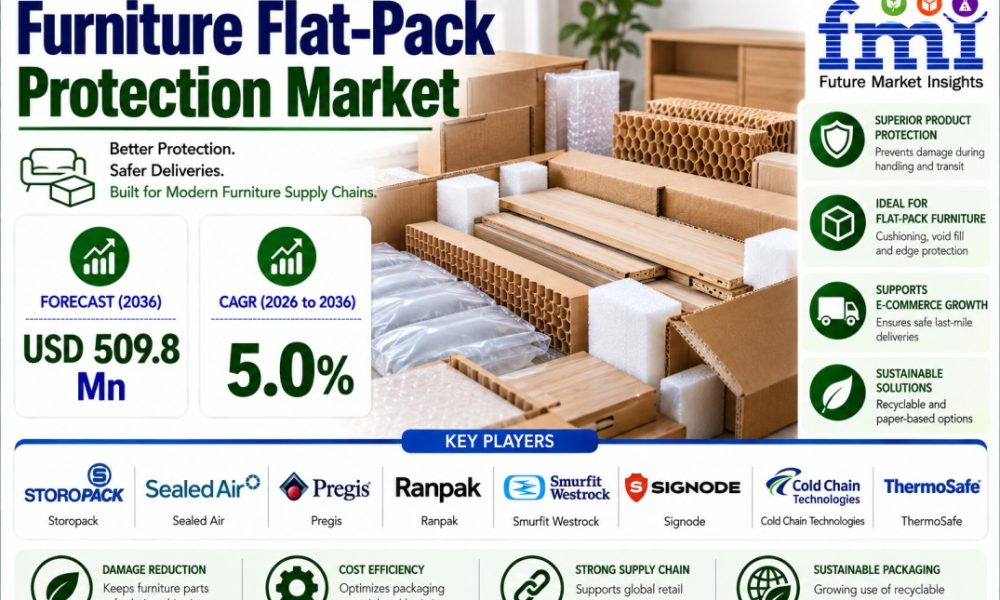
The global furniture flat-pack protection market is projected to reach USD 509.8 million by 2036, rising from USD 313.0 million in 2026 at a 5.0% CAGR, according to Future Market Insights.
Demand is being supported by the continued movement of furniture kits through parcel and less-than-truckload networks. Unlike controlled pallet movements, individually shipped flat packs can encounter repeated conveyor transfers, manual handling and loading events. Corner, edge and surface damage can subsequently result in customer complaints or returns even when the furniture remains functional.
This is placing greater emphasis on protection systems that control damage without unnecessarily increasing package cube, material consumption or packing labor.
>> Access detailed market insights: https://www.futuremarketinsights.com/reports/brochure/rep-gb-34907
Standard Formats Lead Protection Demand
Standard formats are projected to account for 44.0% of format-type demand in 2026.
Repeatable furniture geometries allow packaging teams to establish specifications that can be reused across recurring production runs. Standard pads and inserts can also simplify distributor stocking and replenishment.
For furniture manufacturers and fulfillment operators, the value of standardization extends beyond the protective material itself. A stable specification can reduce quoting, pack-station setup changes and repeated qualification work.
Signode documented an office-furniture program in May 2025 in which engineers assessed the application before developing prototypes and producing the final design locally. The example illustrates how engineered protection can become a standardized specification after initial qualification.
Paper-Based Systems Hold the Largest Material Share
Paper-based systems are expected to account for 31.0% of material demand in 2026.
Paper structures can serve several protection functions, including cushioning, surface protection, blocking and edge reinforcement. Corrugated formats can also provide compression strength for furniture components where dimensional stability is important.
Material documentation is becoming more relevant as recyclability requirements influence packaging approvals. Germany’s ZSVR published its 2025 minimum standard in August 2025, with a longer-term goal of at least 70% recyclability for packaging.
For furniture manufacturers, switching to a new protective material therefore requires more than comparing unit costs. Packaging teams must assess damage performance, recovery documentation and the additional qualification work created by a material change.
Standard-Duty Protection Remains the Main Performance Class
Standard-duty protection is projected to hold 42.0% share in 2026.
Routine parcel and regional distribution generally requires controlled shock and compression protection without the material load associated with heavy-duty systems.
This creates an important balance.
Over-specifying protection can increase material consumption, package weight and cost. Under-protection can increase corner damage, product returns and replacement shipments.
Furniture packaging teams are therefore increasingly sizing protection against the actual parcel or LTL lane rather than the most severe theoretical handling event.
E-Commerce and Parcel Drives End-Use Demand
E-commerce and parcel is expected to account for 34.0% of end-use demand in 2026.
Direct consumer fulfillment increases the number of individual handling events experienced by flat-packed furniture.
The U.S. Census Bureau reported that second-quarter 2026 e-commerce sales increased 12.2% year over year and represented 17.1% of total retail sales. Japan’s 2024 e-commerce ratio for household goods and furniture reached 32.58%, according to METI’s August 2025 survey.
For furniture suppliers, the implication is straightforward: protection specifications need to reflect the actual fulfillment route.
A package designed primarily for palletized distribution may require additional edge or surface protection when the same product begins moving as an individual parcel.
Packaging Automation Adds Another Qualification Layer
Automation is becoming increasingly relevant to flat-pack protection.
Ranpak introduced three automated packaging systems in January 2025, linking paper-based protection with packing-line equipment. One PadPak configuration can serve up to ten pack stations.
Storopack subsequently enhanced AUTO.PROTECT with vision-based void detection and automated paper or air padding placement.
These developments point to a broader shift in packaging procurement. Protection is increasingly being evaluated alongside packing speed, material consumption and labor requirements.
A protective solution that performs well but requires frequent manual adjustment may struggle to deliver its full commercial value during peak fulfillment periods.
Requalification Can Slow Material Conversion
Material switching presents its own challenge.
Changing from foam to paper, introducing a new cushioning construction or modifying dimensions can alter compression and shock performance. The revised package may then require new testing and account approval.
This creates a practical barrier for furniture manufacturers that want to reduce material usage quickly.
PackUK’s 2025 policy introduced red-rated packaging fee multipliers for 2026–2027 and 2027–2028, increasing the commercial importance of recyclability assessments in UK packaging decisions.
The strongest conversion cases therefore need to demonstrate both lower material exposure and acceptable damage rates.
Nandini Roy Choudhury, Principal Consultant at Future Market Insights, states:
“Furniture flat-pack protection earns its margin when packaging engineers match edge, surface and compression controls to the actual parcel or LTL lane. Commercial proposals should quantify damage exposure and packing labor ahead of any request for material requalification or station automation.”
>> Get Detailed Market Forecasts, Competitive Benchmarking, and Pricing Trends: https://www.futuremarketinsights.com/reports/sample/rep-gb-34907
Regional Growth Outlook
Saudi Arabia is projected to record the highest CAGR among the profiled markets at 6.3%, followed by the UAE at 6.0%, South Korea at 5.7%, the USA at 5.4%, and the UK at 5.1% through 2036.
Market requirements differ across these countries.
Saudi furniture distributors often rely on imported cushioning and structural protection, making local stock and replenishment important for national programs.
The UAE’s role as a regional logistics hub creates demand for protective systems that can accommodate different furniture dimensions and destinations.
South Korea’s dense fulfillment environment places greater emphasis on fast insertion and predictable package dimensions.
In the USA, mixed parcel and LTL routes make lane-specific qualification particularly important.
The UK’s producer-responsibility environment adds recyclability and material-fee considerations to packaging decisions.
Competitive Landscape
Key companies profiled by Future Market Insights include Storopack, Sealed Air, Pregis, Ranpak, Smurfit Westrock, Signode, Cold Chain Technologies, and ThermoSafe.
The competitive landscape spans several protection routes.
Storopack, Sealed Air, Pregis and Ranpak combine protective materials with pack-station and automation capabilities. Smurfit Westrock and Signode focus strongly on structural and corrugated protection for large or damage-sensitive shipments.
Cold Chain Technologies and ThermoSafe address the narrower temperature-assured segment within the report’s defined market scope.
Recent developments include Pregis’ August 2026 acquisition of MP Global Packaging’s cold-chain and thermal-packaging business, Cold Chain Technologies’ May 2025 launch of the TRUEtemp Naturals universal parcel shipper, and Storopack’s February 2025 introduction of AIRfiber paper air pillows with a water-soluble inner coating designed for paper-stream recycling.
As furniture moves increasingly through direct-to-consumer fulfillment, protection suppliers will need to balance damage prevention, material efficiency, packing labor and qualification requirements.
The commercial opportunity will favor solutions that can demonstrate measurable protection performance while fitting the actual pack station and distribution lane.
To explore how FMI Custom Research can support your strategic priorities, connect with our team at – [email protected]
About Future Market Insights (FMI)
Future Market Insights, Inc. is an ESOMAR-certified, ISO 9001:2015 market research and consulting organization trusted by Fortune 500 companies. With a global presence across the U.S., UK, India, and Dubai, FMI delivers data-driven insights across 30+ industries and 1200 markets worldwide.



