
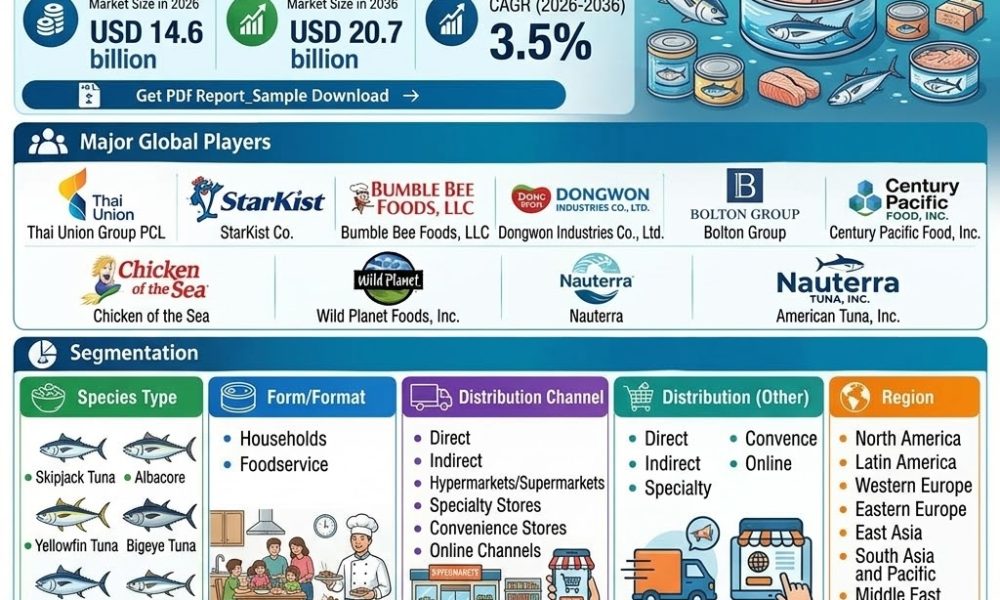
NEWARK, Del., October 8, 2026. — The global canned tuna market is estimated at USD 14.6 billion in 2026 and is projected to reach USD 20.7 billion by 2036, expanding at a CAGR of 3.5% from 2026 to 2036, according to Future Market Insights (FMI). The market stood at USD 14.1 billion in 2025.
The market is being supported by demand for shelf-stable seafood that can be stored easily and added to meals with limited preparation. Tuna is increasingly used in sandwiches, salads, rice dishes and other everyday meals, helping shift demand from occasional consumption toward regular household use.
Shelf-stable seafood gains traction as consumers seek convenience
Canned tuna benefits from a combination of long shelf life, easy storage and minimal preparation. FMI notes that these attributes are supporting repeat household purchases, while growing trade in prepared and preserved tuna is reinforcing demand for seafood products that require less cleaning, thawing and cooking.
FAO GLOBEFISH reported world tuna trade of 4.23 million tonnes in 2025, while imports of prepared and preserved tuna increased by 8.91%. FMI says the increase supports the broader shift toward convenient seafood formats. Certified and traceable products are also gaining visibility in retail, creating opportunities for brands that can combine sourcing transparency with familiar price points.
👉 Get Detailed Market Forecasts, Competitive Benchmarking & Pricing Trends: https://www.futuremarketinsights.com/reports/sample/rep-gb-14896
Where growth is fastest
- Germany — 4.5% CAGR: Germany is expected to record the fastest growth among the highlighted markets, supported by import availability, retail reach and regular household use of shelf-stable tuna. Market performance remains closely linked to European seafood trade, raw fish prices, freight and import costs.
- USA — 4.1% CAGR: The USA is projected to expand at a strong pace as tuna remains widely available through retail channels and continues to serve as a convenient seafood protein. However, sourcing eligibility and harvesting documentation are expected to remain important considerations for market participants.
What leads the market
- Skipjack tuna — 39.4% share in 2026: Wider catch availability and regular use in light-tuna cans support skipjack’s leading position among species types.
- Direct sales — 34.0% share in 2026: Bulk purchasing by retailers and foodservice companies is supporting direct sales as an important distribution channel.
- Households — 50.7% share in 2026: Pantry storage, long shelf life and low preparation requirements make households the leading end-use segment.
- Shelf-stable seafood protein: Regular use in sandwiches, salads, rice dishes and other meals is supporting repeat household consumption.
The hurdle
Sourcing and price stability remain central challenges. FMI says canned tuna availability depends on access to suitable tuna supplies, sourcing documentation and prices that consumers can continue to accept. Import-dependent markets can also be exposed to changes in raw fish prices, freight costs and trade conditions.
In the USA, NOAA stated that 240 fisheries from 46 nations were denied comparability findings, with affected imports restricted from January 1, 2026. FMI says these developments reinforce the importance of eligible fisheries, complete harvesting records and transparent sourcing for companies serving the market.
Certified sourcing creates differentiation opportunities
As consumers and retailers pay greater attention to the origin and traceability of seafood, certified and documented sourcing is becoming an important competitive consideration. FMI expects brands that can maintain sourcing transparency while keeping products at familiar retail price points to be better positioned to capture steady household demand.
The opportunity extends beyond canned tuna into the broader canned food products category, where shelf stability and convenience continue to support household consumption. Foodservice operators also represent an important demand base as tuna provides a practical ingredient for prepared meals.
For full coverage of the Canned Tuna Market, including forecasts by species type, distribution channel, end use, region and country, visit the FMI report: https://www.futuremarketinsights.com/reports/canned-tuna-market
Competitive landscape
The canned tuna market includes large seafood companies, established consumer brands and specialized sustainable seafood producers competing across retail and foodservice channels.
FMI profiles Thai Union Group PCL, StarKist Co., Bumble Bee Foods, LLC, Dongwon Industries Co., Ltd., Bolton Group, Century Pacific Food, Inc., Chicken of the Sea, Wild Planet Foods, Inc., Nauterra, and American Tuna, Inc. The competitive environment includes companies focused on broad retail distribution, seafood sourcing, traceability and differentiated product positioning.
Analyst perspective
“Canned tuna demand is expected to witness steady gains owing to increasing household application and affordable protein focus. Certified sourcing will create better opportunity where brands can retain familiar retail prices.”— Nandini Roy Choudhury, Principal Consultant, Future Market Insights.
What this means for food manufacturers and seafood brands
- Prioritize sourcing transparency. Complete harvesting records, eligible fisheries and traceability can help brands address growing retailer and consumer expectations around seafood sourcing.
- Protect affordable price points. Canned tuna’s role as a convenient protein means maintaining familiar retail prices will remain important for repeat household purchases.
- Build around everyday meal occasions. Positioning tuna for sandwiches, salads, rice dishes and other simple meals can reinforce its role as a regular pantry staple.
- Strengthen retail availability. Wider retail reach remains important in markets where consumers rely on shelf-stable seafood for convenient meal preparation.
- Monitor import and freight conditions. Markets dependent on imported tuna remain exposed to changes in raw fish prices, freight costs and trade eligibility, making supply-chain planning increasingly important.
About Future Market Insights
Future Market Insights, Inc. (FMI) is an ESOMAR-certified market research and consulting firm headquartered in Delaware, USA, with offices in the United Kingdom, the United Arab Emirates and India. FMI delivers syndicated and custom research across food and beverage, healthcare, chemicals, technology, packaging, consumer goods and industrial sectors.
For Press & Corporate Inquiries
Rahul Singh
AVP – Marketing and Growth Strategy
Future Market Insights, Inc.
+91 8600020075
For Sales: [email protected]
For Media: [email protected]
For Web: https://www.futuremarketinsights.com/



