
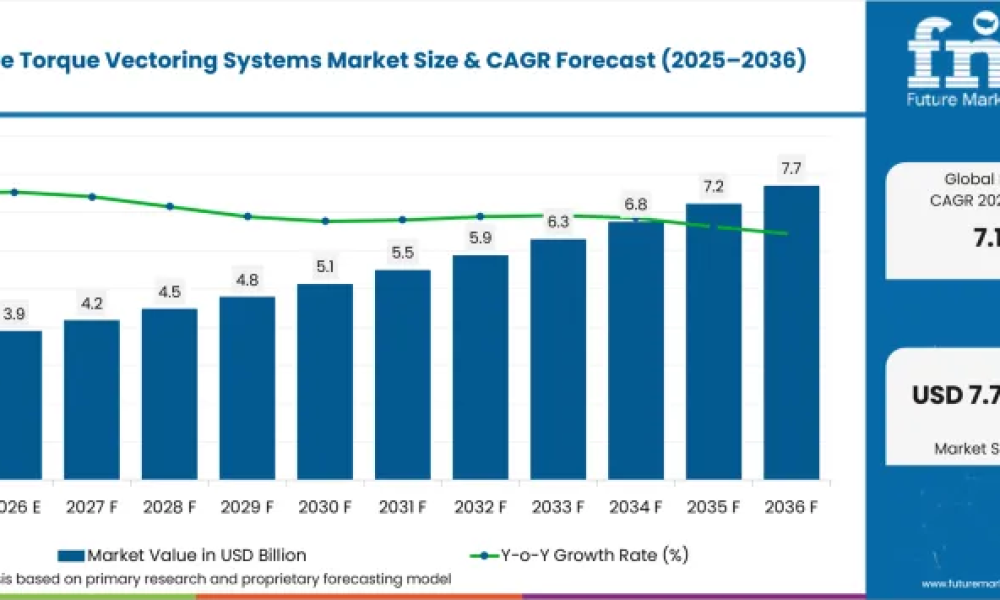
The global automotive torque vectoring systems market is projected to expand from USD 3.9 billion in 2026 to USD 7.7 billion by 2036, advancing at a 7.1% CAGR from 2026 to 2036. Market demand is being supported by electrified drivetrains, rising software content, and OEM efforts to improve traction and vehicle dynamics through more precise control of wheel torque.
Electric motors broaden the addressable control set because they can change axle torque faster than conventional driveline hardware. The International Energy Agency reported in May 2025 that electric cars exceeded 17 million global sales during 2024 and represented more than 20% of new-car sales. The expanding electrified fleet provides OEM engineers with a larger production base for wheel-torque control without requiring an entirely separate propulsion architecture.
Country demand, however, varies according to local platform turnover and propulsion mix. The International Energy Agency documented Korean electric-car sales rising by about 65% during 2025 after several years near 130,000 units. Korea’s faster platform renewal creates additional opportunities for torque-control suppliers across software and electrified axle programs. Japan retains a more hybrid-heavy vehicle mix and a slower battery-electric platform renewal cycle, making OEM awards increasingly dependent on local propulsion economics and validation schedules.
What Are the Key Segments in the Automotive Torque Vectoring Systems Market?
- Brake-Based Torque Vectoring — 27.0% share: Brake-based torque vectoring leads the system-type segment because existing brake actuators can generate corrective yaw without requiring dedicated twin-clutch hardware.
- Passenger Cars — 30.0% share: Passenger cars represent the leading vehicle category because the segment includes mainstream stability systems as well as higher-content performance and electrified chassis packages.
- ICE Vehicles — 34.0% share: ICE vehicles maintain the leading propulsion share because mechanical differentials and stability-control systems are already validated across established combustion-engine platforms.
- Control Software and ECUs: Software and electronic control units remain important as torque-vectoring decisions increasingly depend on inputs from steering, braking, propulsion, and vehicle-dynamics systems.
- OEM Direct Supply: OEM supply remains strategically important because torque-vectoring systems require extensive calibration and validation before vehicle production.
Get detailed market forecasts, competitive benchmarking, and pricing trends:
https://www.futuremarketinsights.com/reports/sample/rep-gb-34987
Which Countries Are Showing the Strongest Growth in Automotive Torque Vectoring Systems?
South Korea is projected to record the highest CAGR among the profiled countries at 8.0% through 2036. Rapid growth in electric-car sales and the country’s established automotive electronics ecosystem are supporting additional opportunities for torque-control systems. Faster platform renewal also gives suppliers opportunities to participate in software-defined chassis and electrified axle programs.
The United States is expected to expand at a 7.3% CAGR, supported by continued vehicle electrification, performance-oriented applications, SUVs, crossovers, and growing demand for advanced vehicle-dynamics controls. Suppliers must demonstrate reliable operation across braking, propulsion, steering, and thermal constraints.
Germany is projected to grow at a 7.0% CAGR, supported by its established automotive engineering base and continued development of electrified and high-performance vehicle platforms. OEM qualification requirements remain significant because torque-vectoring systems must integrate with broader chassis-control architectures.
Italy is expected to record a 6.6% CAGR, with demand influenced by performance vehicles, premium automotive applications, and increasing electrification. Torque-vectoring technology can support vehicle handling objectives where precise wheel-torque management is incorporated into broader dynamics-control strategies.
Japan is projected to record a 5.9% CAGR, the lowest among the profiled countries. The country’s hybrid-heavy vehicle mix and comparatively slower battery-electric platform renewal affect the pace of torque-vectoring adoption, although established automotive technology capabilities continue to support system development.
How Is Regional Demand Shaping the Automotive Torque Vectoring Systems Market?
South Korea and the United States represent the faster-growing country markets, supported by electrification and increasing demand for software-controlled vehicle dynamics. South Korea’s electric-car sales momentum creates opportunities for suppliers developing torque-management functions for new battery-electric platforms.
Germany and Italy continue to offer opportunities through established automotive engineering and performance-vehicle ecosystems. Their markets place emphasis on predictable handling, calibration quality, and integration with existing chassis-control systems.
Japan represents a more gradual growth environment because hybrid vehicles continue to play an important role in the local propulsion mix. This makes the country’s torque-vectoring market dependent on the evolution of hybrid and battery-electric platforms rather than battery-electric adoption alone.
What Is Changing the Competitive Landscape?
The competitive landscape includes BorgWarner, GKN Automotive, Eaton, Magna International, Schaeffler, ZF Friedrichshafen, AUMOVIO, and Bosch. These companies compete through active differential technologies, brake-based control, electrified axle systems, software, ECUs, sensors, and integrated vehicle-dynamics solutions.
Electrification is changing how suppliers approach torque vectoring. Electric motors can provide rapid torque adjustments, allowing engineers to use propulsion control alongside braking and steering inputs. This creates opportunities for e-axle torque vectoring and software-defined control architectures that can respond to wheel-slip and vehicle-motion conditions.
At the same time, conventional ICE vehicles remain an important part of the market. Existing mechanical differentials and electronic stability systems provide validated platforms for brake-based and active torque-control strategies. Suppliers therefore need to support multiple propulsion architectures while managing differences in thermal load, actuator behavior, software logic, and vehicle calibration.
Competitive differentiation increasingly depends on integration rather than actuator capability alone. A torque-vectoring system must produce predictable vehicle behavior within the operating limits of braking, steering, propulsion, and safety systems. Suppliers capable of reducing calibration workload while maintaining consistent vehicle response can strengthen their position during OEM platform selection.
What Does the Analyst Say About the Automotive Torque Vectoring Systems Market?
“OEMs should compare useful yaw correction inside brake, steering, and propulsion limits before paying for a higher-content torque-vectoring architecture. Commercial value comes from repeatable vehicle behavior with manageable heat and calibration work because a stronger actuator does not automatically improve the complete chassis.”
— Nikhil Kaitwade, Principal Consultant, Future Market Insights
What Is Driving Demand for Automotive Torque Vectoring Systems?
Electrification Creates Faster Torque-Control Opportunities
Electric motors can respond rapidly to control commands, allowing OEMs to adjust wheel or axle torque during acceleration, cornering, and traction events. This response capability creates additional opportunities for torque vectoring within battery-electric and hybrid vehicle architectures.
Growing Electric Vehicle Production Expands the Addressable Platform Base
The International Energy Agency reported more than 17 million electric-car sales globally in 2024, with electric cars accounting for more than 20% of new-car sales. The larger electrified fleet gives suppliers more production platforms on which torque-management functions can be integrated.
Performance and Vehicle Dynamics Remain Important
Passenger cars account for 30.0% share in 2026, reflecting demand across mainstream stability applications and higher-content performance chassis systems. Torque vectoring can provide manufacturers with an additional method for managing yaw behavior and traction while supporting specific handling targets.
Software-Defined Chassis Architectures Increase Integration Opportunities
Torque-vectoring decisions increasingly rely on inputs from sensors, ECUs, braking systems, steering systems, and propulsion controllers. Software-defined architectures can coordinate these systems and allow torque requests to be adjusted according to vehicle operating conditions.
Drive Your Business Growth Strategy: Checkout the Report for Key Insights!
https://www.futuremarketinsights.com/checkout/34987
What Are the Key Market Restraints?
Calibration workload remains a major restraint because each torque request must remain predictable alongside braking, steering, propulsion, and safety controls. Higher-content architectures can require extensive vehicle-level validation before OEM approval.
Thermal durability is another consideration. Repeated corrective torque or braking interventions can generate heat in actuators and related components. Suppliers must demonstrate consistent performance under demanding driving conditions rather than focusing only on peak torque-control capability.
The continued use of established ICE platforms also moderates the pace of technology transition. Conventional differentials and stability systems remain capable of meeting many vehicle requirements, limiting the immediate need for higher-content torque-vectoring architectures in some applications.
What Opportunities Exist for Automotive Torque Vectoring System Manufacturers?
Software-defined torque control offers an important opportunity as OEMs consolidate vehicle dynamics functions across centralized electronic architectures. Suppliers can differentiate through algorithms that coordinate torque requests with braking, steering, traction, and stability systems.
Electrified axle systems provide another opportunity. E-axles can integrate motor, reduction gear, differential, and control functions, creating new architectures for torque distribution across driven wheels.
There is also an opportunity to improve calibration efficiency. Tools and control strategies that reduce vehicle-level validation time can create commercial value for OEMs managing increasingly complex chassis software.
How Is the Automotive Torque Vectoring Systems Market Segmented?
The automotive torque vectoring systems market is segmented by system type, vehicle type, propulsion, component, sales channel, and region.
By System Type
System types include brake-based torque vectoring, active differential systems, e-axle torque vectoring, twin-clutch vectoring, and software-defined torque control. Brake-based torque vectoring leads with 27.0% share in 2026.
By Vehicle Type
Vehicle categories include passenger cars, SUVs and crossovers, electric vehicles, performance cars, and commercial vehicles. Passenger cars account for 30.0% share in 2026.
By Propulsion
The market covers ICE vehicles, battery electric vehicles, hybrid vehicles, and plug-in hybrids. ICE vehicles retain the leading position with 34.0% share, reflecting the large installed base of conventional drivetrains.
By Component
Components include differentials, control software, ECUs, actuators, and sensors. Increasing integration between hardware and software is making control architecture an important part of system development.
By Sales Channel
Sales channels include OEM direct supply, Tier-1 integrated systems, performance aftermarket, and software licensing. OEM and Tier-1 channels remain central because torque-vectoring systems require vehicle-level validation.
What Are the Drivers, Restraints and Opportunities in the Automotive Torque Vectoring Systems Market?
The automotive torque vectoring systems market is being shaped by electrification, software-defined chassis development, and the need to balance advanced torque control with calibration and thermal constraints.
- Driver: Electrified drivetrains provide faster and more controllable torque paths for vehicle-dynamics applications.
- Restraint: Calibration workload and thermal durability requirements can increase development complexity for higher-content systems.
- Opportunity: E-axle torque vectoring and software-defined control can integrate propulsion, braking, and vehicle-dynamics functions into increasingly centralized architectures.
What Is the Automotive Torque Vectoring Systems Market Demand Outlook?
The automotive torque vectoring systems market is projected to reach USD 7.7 billion by 2036, rising from USD 3.9 billion in 2026 at a 7.1% CAGR.
Electrification is expected to remain a major source of new platform opportunities. Electric motors provide faster torque response than conventional mechanical driveline hardware, allowing OEMs to explore more precise control strategies across acceleration, cornering, and traction events.
However, ICE and hybrid platforms will continue contributing to market demand during the forecast period. Suppliers therefore need architectures that can operate across different propulsion configurations while maintaining predictable vehicle behavior and manageable calibration requirements.
How Fast Are Key Countries Growing in the Automotive Torque Vectoring Systems Market?
South Korea leads the profiled countries with an 8.0% CAGR, followed by the United States at 7.3%, Germany at 7.0%, Italy at 6.6%, and Japan at 5.9% through 2036. South Korea’s faster electric-vehicle platform renewal supports new torque-control programs, while the United States benefits from electrification and performance-oriented applications. Germany and Italy remain important through their automotive engineering and premium vehicle ecosystems, while Japan’s hybrid-heavy market structure results in comparatively slower growth.
About Future Market Insights
Future Market Insights (FMI) is a leading provider of market research and consulting services, offering syndicated and customized research across automotive, energy, industrial automation, and other global industries. FMI delivers market forecasts, competitive intelligence, and strategic analysis to support business decisions across global markets.



