
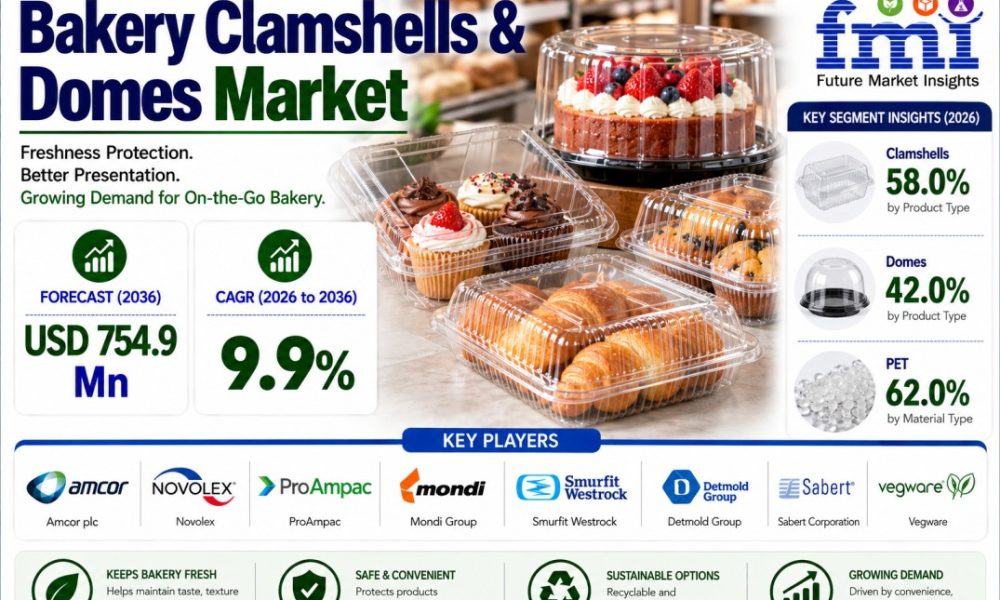
The global bakery clamshells and domes market is projected to reach USD 754.9 million by 2036, rising from USD 293.7 million in 2026 at a 9.9% CAGR, according to Future Market Insights. Demand is being shaped by bakery-pack redesign, crush protection, retail presentation, and changing packaging recovery requirements.
For industrial bakeries, the package has to perform several functions at once. It needs to protect products from crushing, maintain presentation quality, close consistently, and fit established filling, stocking, and distribution routines. At the same time, packaging teams are assessing whether the selected material and coating can support the recovery requirements of the destination market.
This combination is making bakery clamshell and dome selection increasingly specification-led.
>> Access detailed market insights: https://www.futuremarketinsights.com/reports/brochure/rep-gb-34942
Standard Formats Lead Product Demand
Standard formats are projected to account for 46.0% of product-type demand in 2026. Common dimensions help reduce tooling changes and inventory complexity, particularly for high-volume bakery operations. Packaging engineers can also validate closure force and case fit on established footprints before extending the specification across multiple SKUs.
Standardization can be especially valuable when bakery groups operate several production facilities. A common format can simplify replenishment and reduce the number of separate packaging specifications that procurement teams need to manage.
The market also includes printed and branded, resealable or functional, and sustainable formats. However, additional functionality can introduce new qualification requirements around closure, coatings, visibility, and recovery.
Paper & Board Holds the Leading Material Share
Paper and board are estimated to hold 37.0% of material demand in 2026. The material benefits from printable surfaces and established fiber-conversion capacity, making it relevant to bakery presentation formats where branding and structural performance are both important.
Board can be used for bakery bases and hinged structures, but coatings and windows require additional scrutiny. A barrier that improves grease resistance or product protection can also affect local recycling compatibility.
This creates a practical tradeoff for converters. Lower-plastic content can support material-transition objectives, but the replacement structure still needs to provide sufficient rigidity, grease control, visibility, and stacking performance.
Mondi expanded its food-packaging portfolio with solid-board formats and food-safety testing support in November 2025, while Sabert launched PULP Ultra in January 2026 with more than 95% natural fibers and less than 5% barrier coating.
Bread & Rolls Account for the Largest Application Share
Bread and rolls are projected to account for 36.0% of bakery application demand in 2026.
High-volume bread and roll production creates a recurring need for reliable packaging. Products need protection during filling, stocking, handling, and short retail distribution cycles.
Dome height and venting can also influence the final specification. Soft bakery products and crustier products behave differently with respect to moisture, making package geometry relevant to the finished product.
For high-throughput bakeries, a package that requires repeated adjustment can create unnecessary operational friction. Repeatable closure and dimensional consistency are therefore important alongside appearance.
Primary Packaging Dominates the Functional Category
Primary packaging is expected to account for 56.0% of function demand in 2026.
Because the package directly contacts the bakery product, primary formats must satisfy food-contact, contamination-control, closure, and shelf-handling requirements before broader secondary-packaging economics are considered.
This creates a higher qualification threshold for new material systems.
A redesigned clamshell or dome may appear attractive from a sustainability perspective, but commercial approval requires evidence that the finished package continues to protect the product under normal operating conditions.
Regulation Is Changing the Packaging Brief
Packaging regulations are increasingly becoming part of bakery packaging specification reviews.
The European Commission confirmed that the Packaging and Packaging Waste Regulation entered into force on February 11, 2025 and generally applies from August 12, 2026. The framework is increasing the importance of material and recovery evidence for packaging entering European specification renewals.
California’s permanent SB 54 regulations took effect on May 1, 2026, introducing producer obligations around single-use plastic reduction and recyclable or compostable packaging.
These changes make it increasingly difficult for bakery groups to evaluate a clamshell solely on unit price.
The complete specification needs to consider material composition, coating, recovery pathway, tooling, closure performance, and line compatibility.
Nandini Roy Choudhury, Principal Consultant at Future Market Insights, explains:
“Bakery clamshells and domes lose commercial appeal when dome height or hinge force forces a line change for each product family. Stronger specifications protect decorated products while keeping lids and bases compatible with existing tools and documented recovery routes.”
Fiber Formats Create an Opportunity
Lower-plastic bakery formats can gain traction when they fit existing production and stocking routines without compromising product visibility.
The report identifies fiber bases with controlled barriers and compatible lids as an opportunity for reducing plastic content while retaining familiar packaging equipment. Vegware’s February 2026 launch of square kraft food containers with compatible lid options and stackable paperboard construction illustrates the broader direction toward component-compatible fiber formats.
The opportunity is therefore not simply to replace plastic with fiber.
Converters need to design the lid, base, barrier, dimensions, and recovery pathway as one system.
>> Get Detailed Market Forecasts, Competitive Benchmarking, and Pricing Trends: https://www.futuremarketinsights.com/reports/sample/rep-gb-34942
Regional Growth Outlook
Saudi Arabia is projected to grow at 11.0% CAGR, followed by the USA at 10.3%, Germany at 10.0%, UK at 9.7%, and France at 9.4% through 2036.
The growth rates reflect different packaging environments.
Saudi Arabia’s expanding packaged-food and hospitality activity creates demand for reliable bakery presentation formats, while long distribution routes increase the importance of heat performance and conformity documentation.
In the USA, cube-efficient nesting and standardized cases matter across multi-state distribution networks.
Germany’s established paperboard conversion and recovery infrastructure can reduce trial friction for fiber-led formats.
The UK emphasizes compact formats that maintain bakery presentation across established retail and foodservice channels, while France balances presentation quality with material efficiency.
Competitive Landscape
Key companies profiled by Future Market Insights include Amcor plc, Novolex, ProAmpac, Mondi Group, Smurfit Westrock, Detmold Group, Sabert Corporation, and Vegware.
The competitive landscape combines multi-material packaging platforms, fiber and food-board producers, and foodservice-format specialists.
Amcor and Novolex bring broad food-packaging capabilities. ProAmpac, Mondi, Smurfit Westrock, and Detmold have significant paperboard and fiber-conversion capabilities. Sabert and Vegware focus on foodservice formats that combine fiber bases with compatible lid systems.
Recent developments include ProAmpac’s December 2025 expansion of food-board manufacturing in Donegal for confectionery and cake applications, Amcor’s April 2025 combination with Berry Global, and Novolex’s April 2025 combination with Pactiv Evergreen.
As bakery brands redesign packaging around recovery requirements, the commercial advantage will increasingly go to formats that combine reliable product protection with documented material performance and minimal disruption to established production systems.
To explore how FMI Custom Research can support your strategic priorities, connect with our team at – [email protected]
About Future Market Insights (FMI)
Future Market Insights, Inc. is an ESOMAR-certified, ISO 9001:2015 market research and consulting organization trusted by Fortune 500 companies. With a global presence across the U.S., UK, India, and Dubai, FMI delivers data-driven insights across 30+ industries and 1200 markets worldwide.



