
Non-Alcoholic Spirits Market Overview :
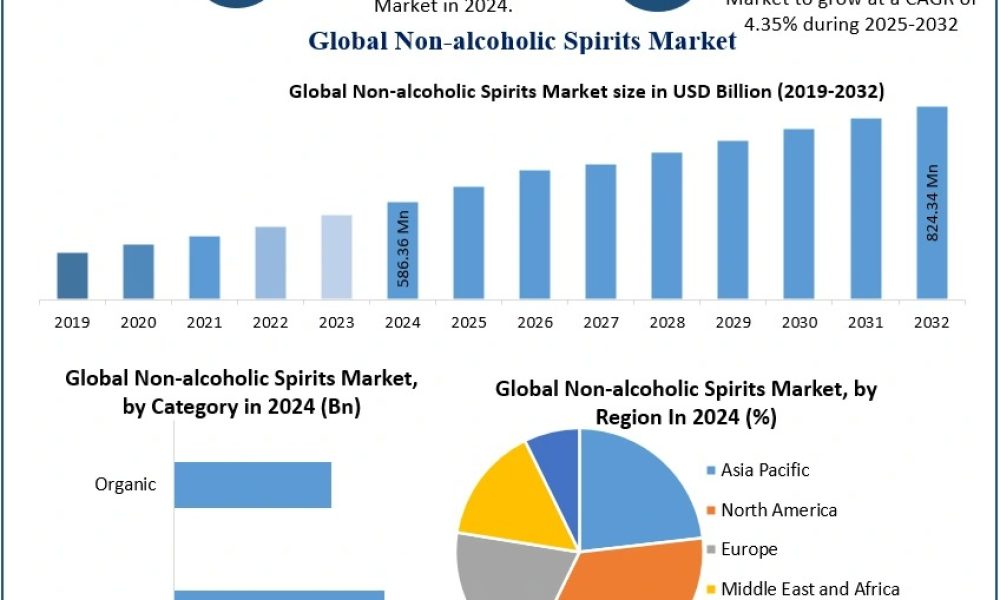
Non-Alcoholic Spirits Market is poised for substantial growth, with the global market size anticipated to climb from USD 586.36 million in 2024 to nearly USD 824.34 million by 2032, registering a CAGR of 4.35%. Driven by shifting attitudes toward alcohol consumption, health and wellness priorities, and product innovation, this sector is transforming the global beverage landscape—placing North America at the forefront of this evolution.
Key Highlights & Insights
Market Size & Growth: Market value will rise from USD 586.36 million (2024) to USD 824.34 million (2032), growing at a CAGR of 4.35%.
Dominating Region: North America dominates the market, supported by a strong culture of mindful drinking, rapid proliferation of new brands and flavors, and leading consumer demand for health-conscious, alcohol-free alternatives.
Leading Segment: The gin segment accounted for the largest share at 36% in 2024, reflecting consumer preference for botanically complex, versatile non-alcoholic gins in cocktails and mocktails.
Key Driver: The principal growth driver is the surge in consumers adopting sober or mindful drinking lifestyles, enhanced by public health awareness and the desire for sophisticated non-alcoholic options at social gatherings.
Recent Developments
Brands such as Seedlip continue to innovate with launches like “Grove 42,” a citrus-forward non-alcoholic spirit crafted with oranges and botanicals, accentuating refreshment and premium sensory experience.
Lyre’s expanded its product portfolio in 2020 with offerings like “Aperitif Rosso,” providing non-alcoholic alternatives that authentically replicate traditional spirits, broadening their appeal among cocktail enthusiasts.
New product launches by both established alcoholic beverage companies and startups introduce innovations in flavor complexity, botanical infusions, and sustainability, elevating the quality and diversity of offerings.
Market Dynamics
Growth Drivers:
Rising interest in health and wellness, and the ongoing mindful drinking movement, prompt consumers to seek flavorful, sophisticated alcohol-free alternatives.
Increasing demand for non-alcoholic cocktails among millennials and health-focused consumers amplifies the market for mixable, versatile non-alcoholic spirits.
Innovations in beverage science—including advanced distillation, infusion, and fermentation techniques—enable products that closely match the taste, aroma, and mouthfeel of traditional spirits.
Adoption of these beverages is further pushed by growing awareness of the risks of excessive alcohol consumption, thus attracting consumers from diverse age groups.
Restraints:
Elevated production costs due to advanced manufacturing techniques and specialized ingredients often result in higher retail prices for non-alcoholic spirits compared to alcoholic alternatives.
Price sensitivity among consumers could hinder widespread adoption and limit market penetration in some regions.
Regulatory complexities regarding labeling, marketing, and distribution remain challenging for new entrants and established players alike.
Regional Analysis
North America: Retains the largest market share owing to consumer openness toward alcohol-free innovation, an expanding sober-curious demographic, and a robust ecosystem of brands, including Curious Elixirs, Monday, Ghia, Ritual Zero Proof, and more.
Europe: Exhibits strong growth, particularly in the UK, Germany, and Sweden, where demand for health-conscious, alcohol-free social experiences is accelerating.
Asia Pacific: Shows rapid growth in countries like Japan, India, Singapore, China, South Korea, and Australia, driven by urban health trends, cultural shifts, and premium beverage demand.
Rest of World: Growing awareness and niche adoption in Latin America, the Middle East, and Africa, where changing social habits and premiumization drive modest growth.
Product Segmentation
By Type: Gin (leading, 36% share), whiskey, rum, vodka, tequila, others.
By Distribution Channel: Offline (retail, food services, restaurants, and bars) and online.
By Category: Conventional and organic offerings.
Key Trends
Surge in healthy living and zero-proof lifestyles supports year-round demand for non-alcoholic spirits.
Technological advances in distillation, botanicals extraction, and flavor chemistry deliver more authentic and complex products.
Growth of virtual tastings, e-commerce, and digital marketing expands category reach and consumer engagement.
Collaborations between established distilleries and health-oriented beverage startups fuel product innovation and market expansion.
Quote
North America’s leadership in the non-alcoholic spirits market reflects a broader consumer shift toward wellness, sophistication, and inclusion. As mindful drinking gains momentum, the sector stands ready to deliver diverse, high-quality, and experiential alternatives that resonate with modern lifestyles.




