
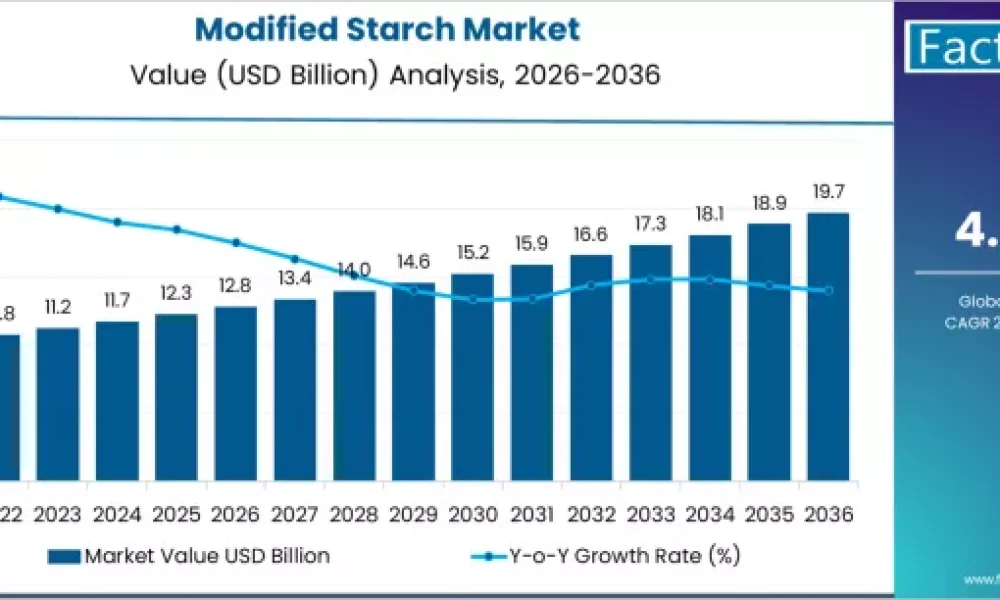
The global modified starch market is poised for steady expansion over the next decade as demand for enhanced functional ingredients continues to rise across food, pharmaceutical, and industrial sectors. In 2026, the market is estimated at USD 12.8 billion and is expected to grow to USD 19.7 billion by 2036, reflecting an absolute increase of USD 6.9 billion over the forecast period. This growth represents a compound annual growth rate (CAGR) of 4.4% between 2026 and 2036, underpinned by innovation in starch modification technologies and broader adoption across diverse applications.
Modified starches — engineered derivatives of native starches such as corn, potato, wheat, and tapioca — are increasingly used for their superior performance properties, including improved viscosity, stability, moisture retention, and texture control. These attributes position modified starch as a key ingredient in processed foods, pharmaceuticals, textiles, and industrial applications where consistent quality and specific functionality are critical.
Quick Market Snapshot (2026–2036)
Market Value (2026): USD 12.8 billion
Market Forecast Value (2036): USD 19.7 billion
Forecast CAGR (2026–2036): 4.4%
Leading Application Segment: Food & Beverage (67.2%)
Leading Modification Type: Chemical Modification (45.7%)
Key Growth Regions: North America, Europe, Asia Pacific, Latin America, Middle East & Africa
Key Players: Cargill Incorporated, Archer Daniels Midland Company, Ingredion Incorporated, Tate & Lyle PLC, Roquette Frères
To Access the Complete Data Tables & in-depth Insights, Request a Discount on this report: https://www.factmr.com/connectus/sample?flag=S&rep_id=12779
Market Overview
Modified starch plays a vital role in modern manufacturing due to its engineered properties. By altering native starch structures through physical, chemical, or enzymatic methods, producers can achieve targeted performance that meets the specific demands of end-use applications. These include thickening and gelling in food systems, binding and disintegration in pharmaceuticals, and film formation or adhesion in industrial settings.
The food and beverage segment dominates the market with more than 67.2% share in 2026, as modified starch is widely used in soups, sauces, dairy products, baked goods, and convenience foods to deliver texture, stability, and process reliability.
Chemical modification leads the market in terms of modification type, capturing 45.7% share in 2026 due to its ability to impart highly specific, robust functional properties needed in demanding applications. These include cross-linked starches for heat and acid stability and acetylated variants for enhanced freeze-thaw performance.
Key Demand Drivers
1. Growth in Processed and Convenience Foods
The global rise in consumption of processed and ready-to-eat products is a key driver for modified starch demand. Its ability to maintain texture and viscosity under varied processing conditions makes it indispensable in modern food manufacturing.
2. Clean-Label and Natural Ingredient Trends
Consumer preference for clean-label foods is encouraging the development of physically and enzymatically modified starches. These alternatives allow manufacturers to list simpler ingredient names while still achieving desirable functionality.
3. Expansion Beyond Food Applications
Modified starches are increasingly used in pharmaceuticals as excipients and binders, and in industrial sectors such as paper, textiles, and adhesives where performance properties are essential.
4. Demand for Specialty Starch Solutions
Growth in plant-based, gluten-free, and other specialty food categories creates new opportunities for tailored starch formulations that address unique functional challenges.
Market Segmentation Analysis
By Modification Type
Chemical Modification:
Holds the largest share due to its capacity to deliver precise and durable functional characteristics.Physical Modification:
Increasingly preferred for clean-label applications.Enzymatic Modification:
Gains traction as consumers demand natural ingredient labels.Cross-linked and Other Configurations:
Provide high performance where specialized stability functions are needed.
By Application Sector
Food & Beverage:
The dominant application due to wide usage in processed foods.Pharmaceuticals:
Growth driven by increased use as functional excipients.Industrial Applications:
Includes textiles, adhesives, and biodegradable materials.Others:
Animal feeds and niche uses.
By Source Material
Corn, Potato, Wheat, Tapioca:
Core starch sources providing diverse functional profiles.
Regional Demand Dynamics
North America
North America remains a strong market, with established food processing infrastructure and sustained demand for functional ingredients.
Europe
Europe’s focus on clean-label products and advanced food technology supports consistent growth.
Asia Pacific
Asia Pacific is emerging as a high-growth region driven by expanding food industries, rising disposable incomes, and increased industrial applications.
Latin America and Middle East & Africa
These regions are witnessing growth as food processing and industrial activities expand, offering incremental market opportunities.
Competitive Landscape Overview
The modified starch market is competitive and dominated by large global agribusiness and ingredient companies. These players are investing in innovation to meet evolving demands, particularly for clean-label and high-function starch solutions. Strategic focuses include expanding product portfolios, enhancing production capabilities, and developing application-specific solutions.
Notable companies include Cargill Incorporated, Archer Daniels Midland Company, Ingredion Incorporated, Tate & Lyle PLC, Roquette Frères, Avebe U.A., Emsland-Stärke GmbH, and Grain Processing Corporation.
Future Outlook
The modified starch market is expected to experience continued growth through 2036 as functional performance demands increase across food and non-food industries. As manufacturers innovate and diversify starch modification techniques — especially those that align with clean-label and sustainability trends — modified starch will maintain its role as a core ingredient in global product formulations.
Have specific requirements or need assistance on report pricing or have a limited budget? Please contact [email protected]
About Fact.MR:
Fact.MR is a global market research and consulting firm, trusted by Fortune 500 companies and emerging businesses for reliable insights and strategic intelligence. With a presence across the U.S., UK, India, and Dubai, we deliver data-driven research and tailored consulting solutions across 30+ industries and 1,000+ markets. Backed by deep expertise and advanced analytics, Fact.MR helps organizations uncover opportunities, reduce risks, and make informed decisions for sustainable growth



