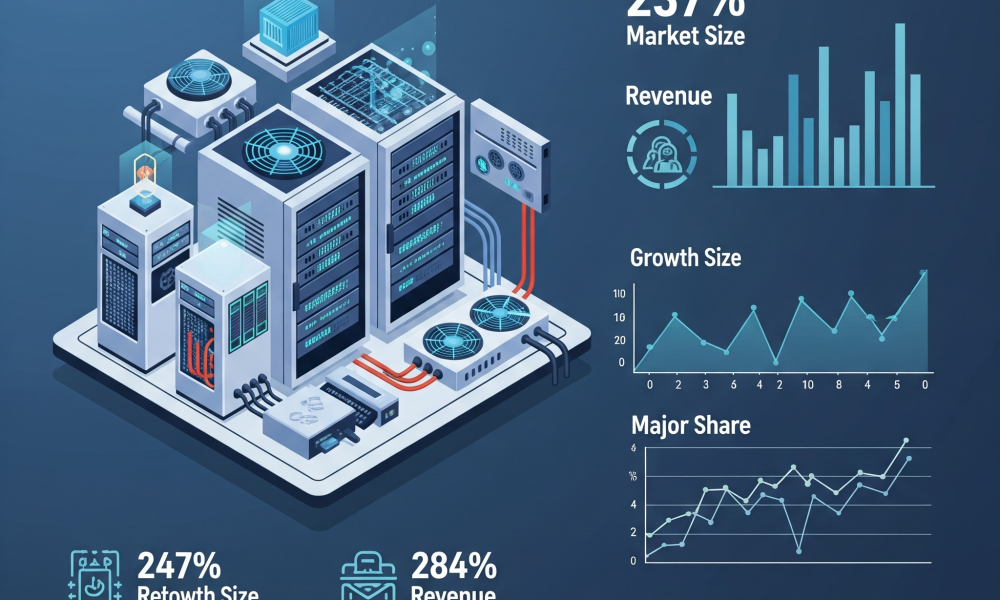
The global Mini Data Center Market is rapidly evolving, driven by increasing demand for edge computing, latency reduction, and data processing close to the source. Unlike traditional centralized facilities, mini data centers are compact, self-contained units capable of hosting critical IT infrastructure with reduced operational complexity.
These centers are ideal for remote locations, small-to-medium enterprises, and emerging edge computing environments, offering faster deployment, energy efficiency, and greater scalability. As industries undergo digital transformation and applications require real-time data processing, mini data centers are becoming integral to modern IT ecosystems.
Mini Data Center Market Segmentation:
By Product Type:
Containerized Data Center
These are modular, portable data centers housed in shipping containers or prefabricated enclosures. They support rapid deployment in disaster recovery zones, military operations, and remote industrial locations.Micro Data Center
Even smaller than containerized solutions, micro data centers are single-rack or compact enclosures used for local processing at the edge. They often come with integrated cooling, power, and security systems, making them ideal for IoT-heavy environments and branch offices.
Regional Insights:
North America leads the mini data center market due to the presence of major technology companies, advanced infrastructure, and early adoption of edge computing.
Europe follows closely, with increasing investments in smart cities, 5G rollout, and decentralized IT systems.
Asia-Pacific is expected to register the fastest growth, driven by rapid urbanization, data localization laws, and rising digital infrastructure development in countries like India, China, and Southeast Asia.
Mini Data Center Market Drivers:
1. Edge Computing Growth
The explosion of IoT devices and latency-sensitive applications (e.g., autonomous vehicles, smart manufacturing) is creating demand for localized computing. Mini data centers meet this need by offering processing power close to the data source.
2. Cost-Effective Infrastructure
For SMEs and remote installations, building a full-scale data center is impractical. Mini data centers offer a cost-efficient, plug-and-play alternative with minimal operational overhead.
3. Rapid Deployment & Scalability
Mini data centers can be deployed in weeks instead of months, enabling fast time-to-market. They are also modular, making it easy to scale as data demands grow.
4. Support for 5G Networks
The rollout of 5G demands low-latency data processing at the edge. Mini data centers serve as critical infrastructure in enabling next-gen mobile networks.
5. Disaster Recovery & Backup
Containerized centers can be relocated easily and used as backup sites, offering agility during natural disasters or emergencies.
Mini Data Center Market Challenges:
1. Limited Capacity
Mini data centers, by definition, have limited space for hardware, making them unsuitable for data-heavy workloads or large enterprise requirements.
2. Security Risks
Their small and often remote deployment locations make mini data centers more vulnerable to physical and cyber threats if not properly protected.
3. Complex Integration with Centralized Systems
Integrating mini centers with traditional centralized data infrastructures or hybrid clouds can pose challenges in terms of synchronization, monitoring, and network management.
4. Heat and Power Management
Ensuring efficient cooling and power supply in compact setups remains a technical and cost-intensive hurdle.
Strategic Insights:
🔹 Modular & All-in-One Systems
Vendors are increasingly offering pre-configured, all-in-one systems with built-in UPS, HVAC, and fire suppression—streamlining deployment and maintenance.
🔹 AI & Remote Monitoring
AI-powered monitoring systems are enabling predictive maintenance, energy optimization, and security management across distributed mini data center networks.
🔹 Green Data Center Solutions
Sustainable technologies such as free cooling, solar integration, and energy-efficient designs are gaining traction, especially in regions with strict environmental regulations.
🔹 Vertical Market Focus
Industries like healthcare, military, oil & gas, retail, and BFSI are emerging as lucrative end-users for mini data centers due to their need for real-time, localized data processing.
Competitive Landscape:
The mini data center market is moderately competitive, with both global tech giants and niche players offering customized solutions. Companies are focusing on R&D, strategic alliances, and geographic expansion.
Key Players:
Canovate Elektronik Endustri VE Ticaret AS
Emerson Network Power Holding Srl
Hewlett Packard Enterprise (HPE)
Huawei Technologies Co., Ltd.
Instant Data Forms Ltd
Rittal Corp.
Schneider Electric SE
Advanced Facilities, Inc.
Altur SA
Cancom SE
These firms are investing in compact, secure, and energy-efficient designs to cater to diverse applications—from smart retail stores to telecom towers.
Future Outlook (2024–2034):
The mini data center market is expected to witness robust growth over the next decade, propelled by the convergence of edge computing, 5G, AI, and data localization policies. As digital infrastructure moves closer to users and devices, demand for decentralized, easy-to-manage, and scalable computing solutions will accelerate.
By 2034, mini data centers will likely be foundational to smart cities, autonomous systems, industrial automation, and next-gen communication networks—especially in emerging economies with growing connectivity and limited centralized infrastructure.
Conclusion:
Mini data centers are reshaping the landscape of IT infrastructure by making data processing more agile, localized, and efficient. With the growing need for edge computing, decentralized networks, and flexible data architectures, mini data centers offer a compelling value proposition for enterprises and governments alike.
Vendors that prioritize modular innovation, robust security, energy efficiency, and remote management will lead the next wave of data infrastructure evolution.
Author: Shweta R., Business Development Specialist at Prophecy Market Insights
This report is based on a mix of primary interviews, secondary research, and data modeling to offer actionable insights into the future of the global mini data center market.