
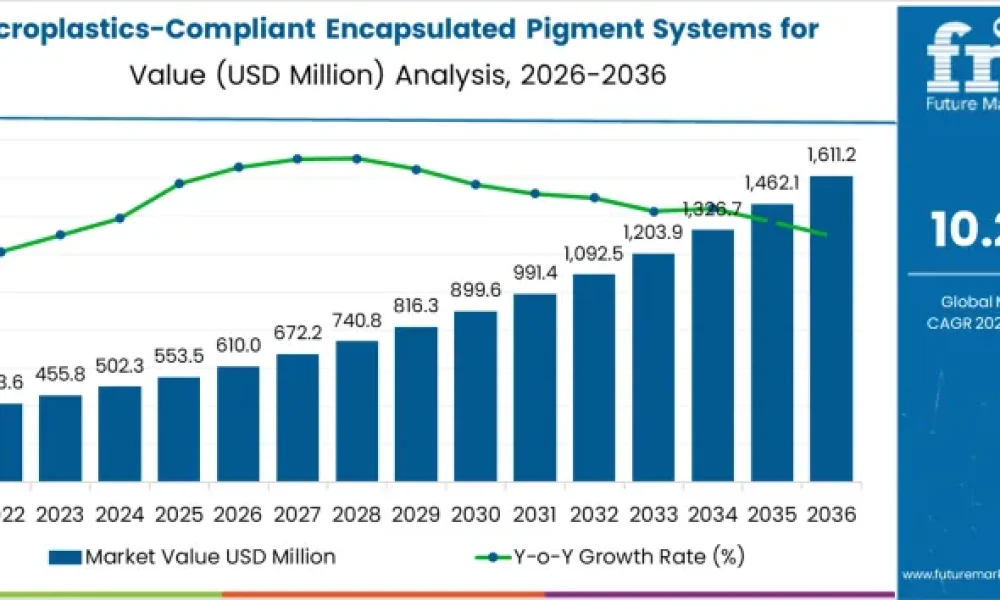
The global Microplastics-Compliant Encapsulated Pigment Systems for Leave-On Makeup Market is entering a decisive growth phase as cosmetic manufacturers accelerate reformulation strategies to meet tightening environmental regulations and rising consumer demand for sustainable beauty. Valued at USD 610.0 million in 2026, the market is projected to reach USD 1,611.2 million by 2036, expanding at a strong CAGR of 10.2% over the forecast period.
Unlike traditional color cosmetics growth driven by volume expansion, this market’s momentum is shaped by regulatory exposure, compliance depth, and early-stage formulation decisions. Leave-on makeup products such as foundations, skin tints, and concealers face higher scrutiny, as pigments remain on the skin for extended periods and contribute directly to environmental release during use and removal. As a result, compliant encapsulated pigment systems are increasingly specified at the beginning of formulation pipelines to avoid late-stage reformulation risks, relabeling costs, or regional market exclusions.
Explore comprehensive market trends, regional outlooks, and competitive intelligence – Get a Sample Copy Now
Market Growth Highlights and Outlook
- Market Value (2026): USD 610.0 million
• Forecast Value (2036): USD 1,611.2 million
• Forecast CAGR (2026–2036): 10.2%
• Leading Pigment Type: Polymer-Free Encapsulated Pigments
• Fastest-Growing Countries: Germany, France, Italy, China, India
Growth quality remains strongest where compliant pigment systems are embedded into core complexion portfolios, rather than short-run or trend-driven launches. Regulated retail channels, pharmacies, and premium beauty outlets continue to reinforce demand, as ingredient documentation and compliance directly influence shelf access.
Why Demand Is Rising Worldwide
Global demand for microplastics-compliant encapsulated pigment systems is expanding due to stricter regulations on intentionally added microplastics and growing expectations for ingredient transparency. Governments across Europe, North America, and Asia-Pacific are restricting solid polymer particles in cosmetics, pushing brands to adopt biodegradable, mineral-based, or polymer-free encapsulation technologies.
At the same time, advances in encapsulation chemistry are enabling manufacturers to preserve key performance attributes such as color stability, dispersion uniformity, skin feel, and long wear—without relying on restricted polymers. Certifications, eco-labels, and sustainability claims further support adoption among environmentally conscious consumers and global retailers.
Key Segments of the Market Report
By Pigment System Type
• Polymer-Free Encapsulated Pigments (35.0% share) – Lead global demand due to direct regulatory alignment
• Silica & Mineral Shell Encapsulated Pigments (29.0%) – Favored for durability and low environmental persistence
• Biodegradable Polymer Encapsulation Systems (21.0%) – Support transitional compliance strategies
• Hybrid Bio-Based Encapsulated Pigments (15.0%) – Balance performance and sustainability goals
By Encapsulation Technology
• Inorganic Shell Encapsulation (34.0%) – Widely adopted for compliance clarity and pigment protection
• Biopolymer Microencapsulation (28.0%) – Driven by plant-based and fermentation-derived materials
• Sol-Gel Encapsulation Systems (22.0%) – Enable uniform shell formation and controlled release
• Layer-by-Layer Bio-Coatings (16.0%) – Used in premium formulations requiring surface precision
By Application
• Foundations & Skin Tints (38.0%) – Highest demand due to extended wear and skin-contact exposure
• Concealers & Correctors (26.0%) – Require opacity and color accuracy
• Cream Blush & Bronzers (21.0%) – Benefit from controlled dispersion in cream formats
• Highlighters & Illuminators (15.0%) – Depend on shell integrity for optical effects
Regional and Country-Level Momentum
Europe continues to lead adoption, with Germany recording a 10.8% CAGR, driven by early enforcement of EU microplastics regulations and strict certification requirements. France (10.5%) and Italy (10.3%) follow closely, supported by sustainable cosmetics policy, premium makeup manufacturing, and rapid regulatory alignment.
Asia-Pacific shows strong expansion as well. China (10.1%) benefits from export-oriented manufacturing aligned with EU standards, while India (9.9%) sees steady growth through export reformulation and rising domestic clean beauty awareness.
Competitive Landscape: Established Leaders and Emerging Innovators
The market features a mix of established global suppliers and new technology-focused manufacturers seeking to expand their presence through compliant pigment innovation. Leading players include Sensient Technologies, Clariant AG, DSM-Firmenich, Sun Chemical (DIC Group), and BASF SE, all of which leverage advanced encapsulation know-how, regulatory documentation, and global supply capabilities.
At the same time, emerging manufacturers are investing in polymer-free shells, bio-based coatings, and scalable mineral encapsulation technologies to capture opportunities created by reformulation mandates. Competitive differentiation increasingly depends on shell integrity, particle size control, formulation support, and the ability to scale compliant solutions across global leave-on makeup portfolios.
Conclusion
As microplastics regulations reshape the global cosmetics industry, microplastics-compliant encapsulated pigment systems are becoming a foundational technology rather than a niche alternative. With strong growth across Europe and Asia, rising adoption in core complexion products, and continuous innovation from both established and new manufacturers, the market is set to play a central role in the future of sustainable, high-performance leave-on makeup from 2026 to 2036.
Have a specific Requirements and Need Assistant on Report Pricing or Limited Budget please contact us – [email protected]
About Future Market Insights (FMI)
Future Market Insights, Inc. (FMI) is an ESOMAR-certified, ISO 9001:2015 market research and consulting organization, trusted by Fortune 500 clients and global enterprises. With operations in the U.S., UK, India, and Dubai, FMI provides data-backed insights and strategic intelligence across 30+ industries and 1200 markets worldwide.



