
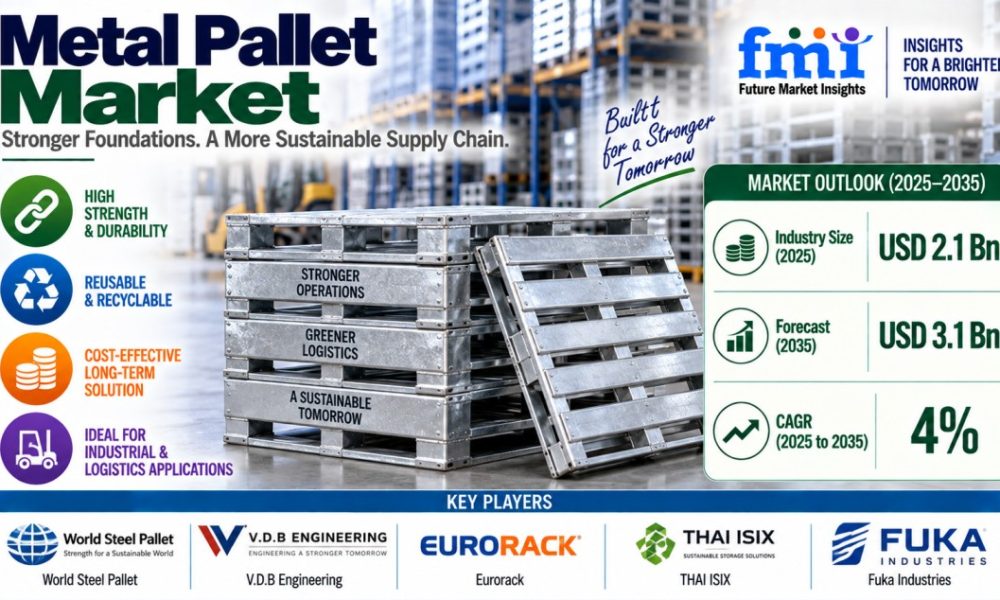
The global metal pallet market is projected to grow from USD 2.1 billion in 2025 to USD 3.1 billion by 2035, registering a 4% CAGR during the forecast period, according to Future Market Insights (FMI).
The market is benefiting from increasing demand for durable material handling platforms across logistics, warehousing, manufacturing, and industrial supply environments. Metal pallets offer high load-bearing capacity, fire resistance, hygiene control, dimensional consistency, and extended service life, making them suitable for heavy-duty operations and automated material handling environments.
Demand is particularly relevant across automotive manufacturing, pharmaceuticals, chemicals, cold chain logistics, and large-scale distribution centers, where pallet reliability can directly influence handling efficiency and operational safety.
>> Get Detailed Market Forecasts, Competitive Benchmarking, and Pricing Trends:https://www.futuremarketinsights.com/reports/sample/rep-gb-27929
Steel Pallets Maintain Market Leadership
Steel pallets account for 74% of the metal pallet market, making them the leading material type.
Their position is supported by structural reliability, load-bearing performance, long service life, and compatibility with warehouse infrastructure. Steel pallet systems can also provide standardized dimensions and integration with automated handling equipment.
The supplied market analysis indicates that well-designed steel pallets can achieve a 10-15 year lifespan, reducing replacement frequency and supporting lifecycle-focused procurement decisions.
Other metal pallets account for the remaining 26% of the market. These include specialized systems where characteristics such as lightweight construction and corrosion resistance are important. Such solutions can be relevant to pharmaceutical and food applications where material-specific requirements influence pallet selection.
Warehouse Automation Creates New Demand
Logistics and transportation enterprises represent a major growth area for metal pallets, with the segment projected to expand at a 4.6% CAGR.
The increase is linked to warehouse automation, fulfillment center development, e-commerce logistics, and supply chain efficiency initiatives. Automated storage and retrieval systems require pallets with consistent dimensions and structural rigidity to support reliable movement through automated equipment.
Cold chain logistics and pharmaceutical distribution are also contributing to demand. Metal pallets can provide durable, cleanable surfaces suitable for environments where hygiene and contamination control are important considerations.
Manufacturing enterprises remain another important application area, using heavy-duty pallets in production facilities, assembly operations, and industrial plants where material loads and handling reliability are key requirements.
Sustainability Is Shifting Pallet Procurement
Sustainability and circular economy initiatives are increasingly influencing pallet purchasing decisions.
Metal pallets can support longer operating cycles and reduce the frequency of pallet replacement. Repair, refurbishment, recycling, pooling, and lifecycle management can further extend asset utilization.
The market analysis indicates that revenue is also gradually expanding beyond new pallet sales. Current revenue is estimated to come primarily from new steel, aluminum, and other metal pallet sales, while pallet rental and pooling, repair and refurbishment, and accessories provide additional revenue streams.
Over the next three to five years, smart pallet systems and pallet-as-a-service models are expected to gain greater importance. RFID tracking, IoT connectivity, digital asset management, and logistics analytics can expand the value proposition beyond the physical pallet.
Smart Pallets and Digital Tracking Create New Opportunities
Digitization is emerging as an important development area.
RFID-enabled pallets and IoT tracking systems can provide greater visibility into pallet location, inventory movement, and asset utilization. Integration with warehouse management systems can also support automated inventory processes.
For pallet manufacturers, this creates opportunities to offer products alongside maintenance programs, tracking services, pooling solutions, and logistics analytics.
The market analysis also points toward greater use of real-time load monitoring, structural integrity validation, automated quality verification, and digital maintenance documentation.
These capabilities can shift the commercial model from one-time pallet sales toward longer-term lifecycle services.
China and India Show Faster Growth
China is projected to record a 5.4% growth rate from 2025 to 2035, supported by logistics infrastructure development, warehouse automation, and e-commerce expansion.
Major logistics centers such as Shanghai, Guangzhou, and Tianjin are supporting demand for standardized material handling systems. The market analysis also indicates that local manufacturers are gaining share through competitive pricing and localized production.
India is expected to grow at 5%, driven by logistics modernization, warehouse infrastructure development, e-commerce growth, and manufacturing expansion.
Germany follows with a 4.6% growth rate, supported by mature logistics infrastructure, warehouse technology adoption, sustainability requirements, and pallet pooling systems.
Brazil is projected to grow at 4.2%, while the USA is expected to expand at 3.8%. The UK and Japan are projected to grow at 3.4% and 3%, respectively.
Europe Remains a Significant Market
The European metal pallet market is projected to grow from USD 721.6 million in 2025 to USD 1.10 billion by 2035, registering a 4.3% CAGR.
Germany is expected to maintain the largest share in the region, accounting for 33.8% in 2025. Its position is supported by advanced logistics infrastructure and major distribution centers.
The UK follows with a 24.2% share, supported by e-commerce and warehouse automation programs. France accounts for 20.4%, while Italy and Spain represent 12.6% and 9%, respectively.
Sustainability standards and circular economy initiatives are supporting the development of pooling, maintenance, refurbishment, and lifecycle management models across European logistics networks.
Upfront Cost Remains a Barrier
Despite their lifecycle advantages, metal pallets face several adoption challenges.
The initial purchase cost is higher than that of wooden pallets, which can make metal systems less accessible for smaller operators or businesses focused heavily on upfront capital expenditure.
Weight is another consideration. Metal pallets can be heavier than wooden alternatives, creating handling challenges in applications involving manual movement.
Compatibility and standardization can also become issues when handling equipment, warehouse systems, and pallet dimensions differ between facilities or regions.
These factors are encouraging suppliers to focus on total cost of ownership rather than only the initial pallet price. Maintenance support, durability validation, pooling programs, recycling, tracking services, and performance guarantees can become important parts of the overall offering.
>> Exclusive Discounts on Full Report:https://www.futuremarketinsights.com/reports/metal-pallet-market
Competitive Landscape
The metal pallet market is moderately fragmented, with approximately 25 to 30 credible players. The top five to seven companies collectively account for approximately 42% to 48% of market revenue.
Competition centers on durability, load capacity, structural design, corrosion resistance, automation compatibility, and integration with warehouse management systems.
Basic steel pallet configurations are becoming increasingly standardized, shifting differentiation toward smart tracking, customization, pooling services, lifecycle management, and application-specific engineering.
Key companies profiled in the market include World Steel Pallet, V.D.B Engineering, Eurorack, THAI ISIX, Fuka Industries, KOLECS JAPAN, Dopro, Jintieniu Shelves, PT. Mitra Toyotaka, Shinwa Package, and MaxPallet.
Strategic partnerships between pallet manufacturers and logistics service providers are also expanding the market toward closed-loop supply chains and asset tracking applications.
Outlook for the Metal Pallet Market
The metal pallet market is expected to maintain steady growth through 2035 as logistics operators, manufacturers, and warehouse owners focus on durability, automation compatibility, and lifecycle efficiency.
The market’s transition is extending beyond traditional pallet manufacturing toward smart pallet systems, pooling, repair and refurbishment, digital tracking, and pallet-as-a-service models.
As warehouse automation expands and logistics operators seek greater asset visibility, suppliers capable of combining structural performance with digital integration and lifecycle services can address increasingly sophisticated material handling requirements.
To explore how FMI Custom Research can support your strategic priorities, connect with our team at – [email protected]
About Future Market Insights (FMI)
Future Market Insights, Inc. is an ESOMAR-certified, ISO 9001:2015 market research and consulting organization trusted by Fortune 500 companies. With a global presence across the U.S., UK, India, and Dubai, FMI delivers data-driven insights across 30+ industries and 1200 markets worldwide.



