

Membrane Bioreactor Market Overview
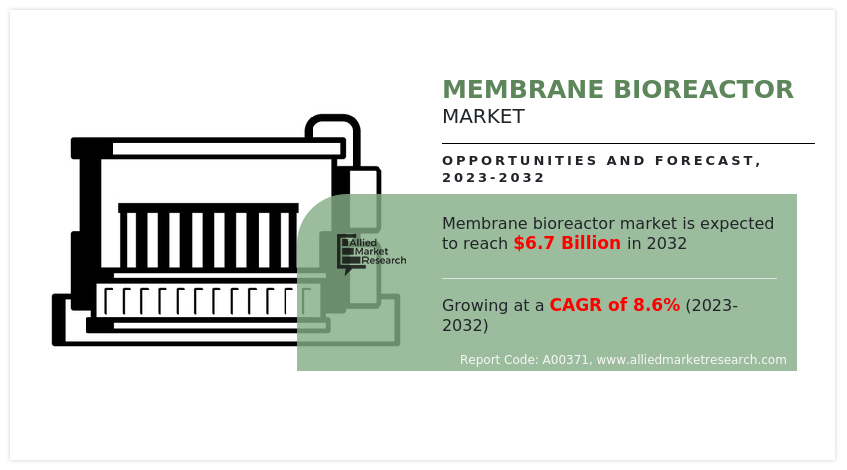
According to a new report published by Allied Market Research, the Membrane Bioreactor Market size was valued at $3 billion in 2022 and is projected to reach $6.7 billion by 2032, growing at a CAGR of 8.6% from 2023 to 2032. Increasing demand for advanced wastewater treatment technologies, growing concerns over water scarcity, and stricter environmental regulations are major factors driving the expansion of the Membrane Bioreactor Market globally.
Understanding Membrane Bioreactor Technology
Membrane Bioreactors (MBRs) are advanced wastewater treatment systems that combine biological treatment processes with membrane filtration technology. These systems are designed to remove organic matter, nutrients, suspended solids, and pathogens from wastewater, producing high-quality treated water suitable for discharge or reuse.
The biological process in MBR systems breaks down organic contaminants, while membrane filtration acts as a physical barrier that separates treated water from microorganisms and solids. This integrated approach improves treatment efficiency and ensures superior water quality compared to traditional wastewater treatment methods.
Download PDF Brochure: https://www.alliedmarketresearch.com/request-sample/470
Because of these advantages, MBR systems are increasingly being adopted across municipal and industrial sectors, contributing to the steady growth of the Membrane Bioreactor Market.
Wide Range of Applications
The Membrane Bioreactor Market has witnessed growing adoption due to the wide range of applications supported by MBR technology. These systems are widely used in municipal wastewater treatment plants to ensure safe and efficient water management.
MBRs effectively remove nitrogen, phosphorus, suspended solids, and harmful pathogens from wastewater. The treated water can either be safely discharged into the environment or reused for non-potable purposes such as irrigation, landscaping, and industrial processes.
In addition to municipal applications, MBR systems are extensively used in industries such as food and beverage processing, chemical manufacturing, pharmaceuticals, and textile production. These industries often generate wastewater with complex compositions, and membrane bioreactor systems are capable of handling such challenging wastewater streams efficiently.
Water Reuse and Sustainability Driving Market Growth
Water scarcity has become a significant global challenge, prompting governments and industries to focus on sustainable water management practices. The ability of MBR systems to produce high-quality treated water suitable for reuse has become a major factor supporting the expansion of the Membrane Bioreactor Market.
MBR-treated water can be further processed to produce reclaimed water that can be used for irrigation, industrial cooling, and even indirect potable water supply. This capability helps reduce dependence on freshwater resources and promotes sustainable water reuse.
Growing environmental awareness and increasing emphasis on sustainability are encouraging the adoption of advanced wastewater treatment technologies. As a result, industries and municipalities are investing more in membrane bioreactor systems to ensure compliance with environmental regulations and reduce their ecological impact.
Advantages of Decentralized Wastewater Treatment
Another important factor driving the Membrane Bioreactor Market is the growing demand for decentralized wastewater treatment solutions. In many remote regions and small communities, centralized wastewater treatment infrastructure is either unavailable or insufficient.
MBR systems offer a compact and efficient solution for such areas. Their relatively small footprint and high treatment efficiency make them suitable for decentralized treatment plants that can operate independently of large municipal systems.
These systems are also ideal for environmentally sensitive locations, including coastal areas, protected ecosystems, and regions with strict water discharge regulations. By producing high-quality effluent, membrane bioreactors help protect natural water bodies and maintain ecological balance.
Technological Advancements Supporting Market Expansion
Technological advancements are playing a crucial role in improving the efficiency and reliability of membrane bioreactor systems. Innovations in membrane materials, filtration processes, and system design are helping reduce operational costs and improve overall system performance.
Advanced membrane technologies are designed to minimize fouling, extend membrane life, and improve filtration efficiency. These developments are making MBR systems more cost-effective and accessible for a wider range of applications.
As research and development activities continue to enhance system performance, the adoption of MBR technology is expected to increase further, contributing to the long-term growth of the Membrane Bioreactor Market.
Market Segmentation Overview
The Membrane Bioreactor Market is segmented based on product type, configuration, end-use industry, and region.
By Product
Based on product type, the market is divided into hollow fiber, flat sheet, and multi-tubular membranes. Among these, the hollow fiber segment dominated the market in 2022.
Hollow fiber membranes provide a large surface area for filtration within a compact structure. This design enables efficient separation of solids and microorganisms from wastewater, improving the performance of bioreactor systems.
By Configuration
The market is categorized into submerged and side stream configurations. The submerged configuration segment accounted for the largest share of the Membrane Bioreactor Market in 2022.
In submerged systems, membrane modules are directly immersed in the mixed liquor of the bioreactor. This design helps reduce membrane fouling, as the continuous flow of water across the membrane surface prevents the accumulation of solids.
Lower fouling levels result in longer operational cycles and reduced maintenance requirements, making submerged configurations highly attractive for wastewater treatment facilities.
By End-Use Industry
Based on end-use industry, the market is segmented into municipal, industrial, and other sectors. The municipal segment accounted for the largest share of the Membrane Bioreactor Market in 2022.
Municipal wastewater treatment plants are facing increasingly strict environmental regulations regarding water discharge quality. Membrane bioreactor systems provide an advanced solution for meeting these standards by effectively removing contaminants such as suspended solids, pathogens, and nutrients.
Meanwhile, the industrial segment is expected to register the fastest growth during the forecast period due to increasing wastewater generation from manufacturing industries.
By Region
Regionally, the Membrane Bioreactor Market is analyzed across North America, Europe, Asia-Pacific, and LAMEA (Latin America, Middle East, and Africa).
The Asia-Pacific region held the largest market share in 2022 and is expected to maintain strong growth during the forecast period. Rapid population growth, urbanization, and increasing demand for clean water are key factors driving the adoption of advanced wastewater treatment technologies in the region.
Countries in Asia-Pacific are investing heavily in water infrastructure to ensure sustainable water resource management and improve environmental protection.
Get a Customized Research Report: https://www.alliedmarketresearch.com/request-for-customization/470
Competitive Landscape
Key companies operating in the Membrane Bioreactor Market include Toray Industries, Koch Separation Solutions, Kubota Corporation, Mitsubishi Chemical Corporation, Evoqua Water Technologies, Veolia, General Electric, WEHRLE-WERK AG, Asahi Kasei Corporation, and Aquatech International.
These companies are focusing on product innovation, technological advancements, and strategic collaborations to strengthen their position in the global market.
Conclusion
The Membrane Bioreactor Market is expected to witness steady growth over the next decade as governments and industries invest in advanced wastewater treatment technologies. Rising water scarcity, increasing environmental regulations, and growing awareness about sustainable water management are key factors driving market expansion. With continuous technological advancements and increasing adoption across multiple sectors, membrane bioreactor systems are set to play a vital role in the future of global water treatment infrastructure.
Other Trending Reports:-
About Us
Allied Market Research (AMR) is a full-service market research and business-consulting wing of Allied Analytics LLP based in Portland, Oregon. Allied Market Research provides global enterprises as well as medium and small businesses with unmatched quality of “Market Research Reports” and “Business Intelligence Solutions.” AMR has a targeted view to provide business insights and consulting to assist its clients to make strategic business decisions and achieve sustainable growth in their respective market domain.
Pawan Kumar, the CEO of Allied Market Research, is leading the organization toward providing high-quality data and insights. We are in professional corporate relations with various companies and this helps us in digging out market data that helps us generate accurate research data tables and confirms utmost accuracy in our market forecasting. Each and every data presented in the reports published by us is extracted through primary interviews with top officials from leading companies of domain concerned. Our secondary data procurement methodology includes deep online and offline research and discussion with knowledgeable professionals and analysts in the industry.




