
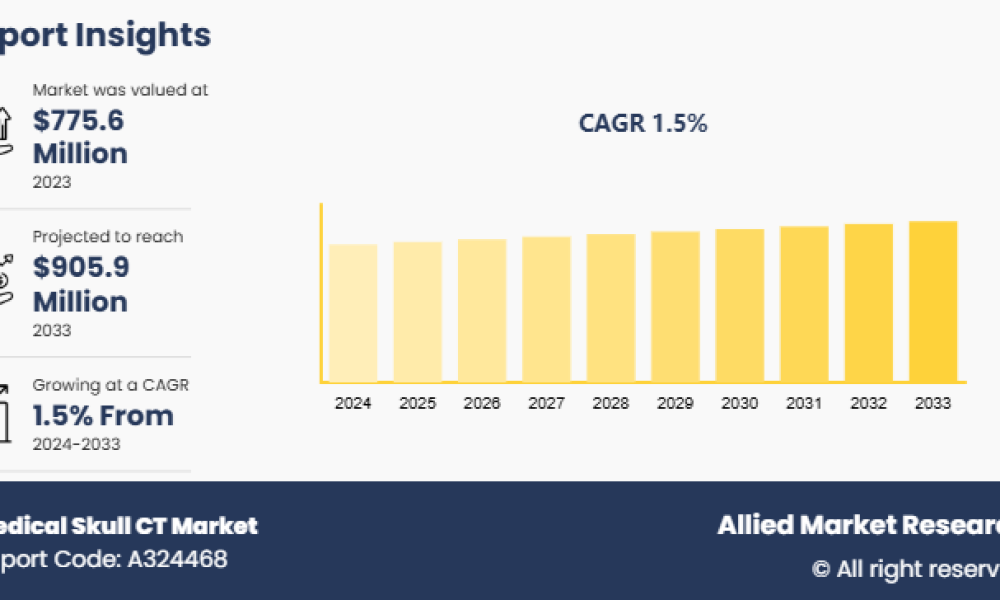
The global medical skull CT market was valued at $775.6 million in 2023 and is projected to reach $905.9 million by 2033, growing at a CAGR of 1.5% from 2024 to 2033. The market growth is propelled by the increasing prevalence of head injuries, neurological disorders, craniofacial abnormalities, and strokes, along with the adoption of advanced imaging technologies that enable faster and more accurate diagnoses.
Market Introduction
A medical skull CT (Computed Tomography) is a diagnostic imaging technique that delivers high-resolution, cross-sectional images of the skull and internal cranial structures. By combining X-ray technology with computer processing, skull CT scans offer detailed visualization of bones, brain tissues, sinuses, and blood vessels. These scans are essential for diagnosing traumatic brain injuries (TBIs), skull fractures, intracranial bleeding, tumors, and infections, while also assisting in surgical planning and biopsies.
With their ability to deliver rapid and precise results, skull CTs are crucial in emergency and trauma care, making them an indispensable tool in modern healthcare.
Get a Sample Copy of this Report: https://www.alliedmarketresearch.com/request-sample/A324468
Key Market Drivers
Rising prevalence of TBIs and strokes: According to the WHO, TBIs are one of the leading causes of disability and death worldwide, fueling demand for advanced diagnostic tools.
Technological advancements: AI-powered CT systems now enhance diagnostic accuracy by identifying small anomalies, enabling early intervention.
Emergency care demand: Growing need for early and accurate diagnosis in trauma cases boosts adoption across hospitals and diagnostic centers.
Healthcare expansion in emerging markets: Countries such as India, Brazil, and across Africa are investing in upgraded diagnostic infrastructure, unlocking growth opportunities.
Key Market Restraints
High cost of CT scanners and ongoing maintenance expenses pose barriers for small and mid-sized facilities.
Radiation exposure risks, particularly for children and repeat patients, continue to limit adoption.
Shortage of skilled professionals in developing regions hinders effective deployment.
Market Opportunities
AI & ML integration: Automated image analysis for faster and more accurate results.
Portable CT scanners: Adoption of compact, mobile systems for use in ambulances and rural healthcare centers.
Emerging markets: Untapped opportunities across Asia-Pacific, Latin America, and Africa.
Market Segmentation
By Type: Single slice CT, Multi slice CT
By Application: Traumatic brain injuries, Stroke diagnosis, Craniofacial abnormalities, Others
By End User: Hospitals, Diagnostic imaging centers, Others
By Region: North America, Europe, Asia-Pacific, LAMEA
Regional Outlook
North America leads the market with the largest share, driven by a high prevalence of TBIs, strokes, and tumors, alongside robust healthcare infrastructure.
The region benefits from early adoption of multi-slice and AI-enabled CT scanners and a growing geriatric population prone to neurological disorders.
Ongoing R&D investments and government support further reinforce North America’s dominance.
Industry Trends
Increasing use of AI-powered anomaly detection and decision support systems.
Rising demand for compact, portable CT devices in emergency and remote settings.
Manufacturers innovating to minimize radiation exposure while preserving image quality.
Patent Landscape (2015–2024)
China recorded the highest patent approvals, driven by supportive government policies and rapid product innovation.
The U.S. holds 10.43% of global patents, while PCT applications account for 4.35%, reflecting continued global innovation.
Competitive Landscape
Leading players include:
GE Healthcare, Siemens Healthineers, Philips Healthcare, Canon Medical Systems, Hitachi Healthcare, Fujifilm Healthcare, Neusoft Medical Systems, Shenzhen Anke High-Tech, United Imaging Healthcare, and Samsung Neurologica.
These companies focus on AI integration, radiation dose reduction, and portable system development to strengthen their market presence.
Key Benefits for Stakeholders
Comprehensive insights into market size, growth drivers, and restraints.
Porter’s five forces analysis to assess industry competitiveness.
Country-level revenue mapping across 20 nations.
Benchmarking and market player positioning for competitive strategy development.
Trusted Sources
World Health Organization (WHO)
Centers for Disease Control and Prevention (CDC)
National Institutes of Health (NIH)
The Lancet
Science Direct
📊 In summary: The global medical skull CT market is set to experience steady but vital growth, driven by the surge in neurological conditions and the integration of AI and portable imaging technologies. With North America leading adoption and emerging markets opening new opportunities, industry players are well-positioned to capitalize on this evolving diagnostic landscape.




