
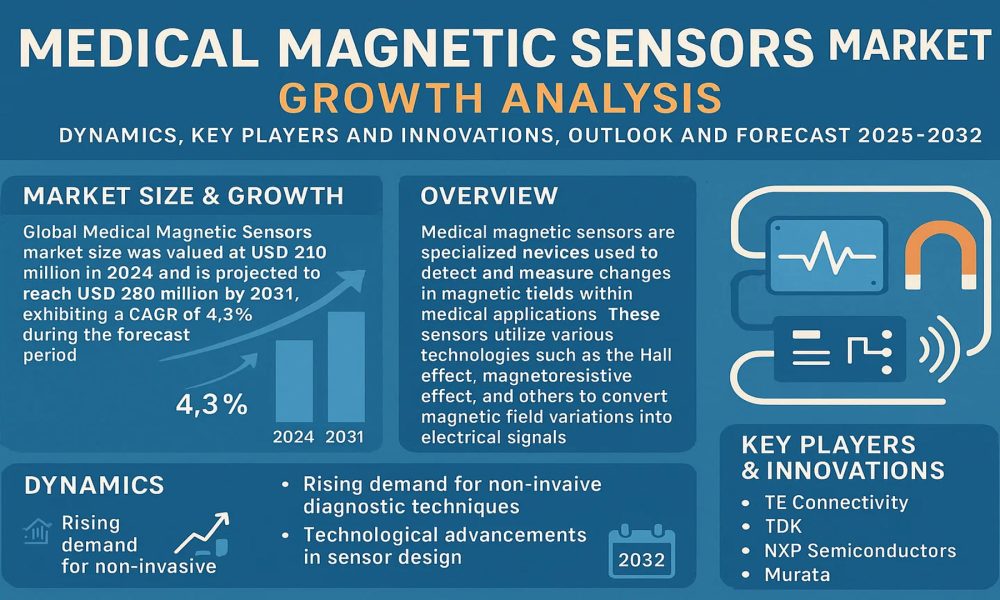
Medical Magnetic Sensors Market size was valued at USD 210 million in 2024 and is projected to reach USD 280 million by 2031, exhibiting a CAGR of 4.3% during the forecast period.
Medical magnetic sensors are specialized devices used to detect and measure changes in magnetic fields within medical applications. These sensors utilize various technologies such as the Hall effect, magnetoresistive effect, and others to convert magnetic field variations into electrical signals. They play a crucial role in monitoring physiological parameters, enabling precise diagnostics and treatment control in medical devices such as pacemakers, MRI systems, and wearable health trackers.
The market is witnessing steady growth, driven by increasing demand for non-invasive medical technologies and the rising adoption of smart healthcare devices. While advancements in sensor miniaturization and accuracy are accelerating innovation, cost sensitivity in emerging markets remains a challenge. Furthermore, key players like AKM Semiconductor, Allegro MicroSystems, and Infineon are expanding their portfolios, strengthening market competitiveness. The Hall Effect Sensor segment, in particular, is expected to dominate the market due to its reliability in critical medical applications.
Access Your Free Sample Report Now- https://www.intelmarketresearch.com/download-free-sample/4792/medical-magnetic-sensors-market
MARKET DYNAMICS
MARKET DRIVERS
Rising Adoption of Minimally Invasive Surgical Techniques Accelerates Market Demand
The global shift toward minimally invasive surgeries (MIS) is creating substantial demand for medical magnetic sensors, which enable precise navigation and positioning during procedures. MIS techniques such as laparoscopy and robotic-assisted surgeries require high-precision magnetic tracking systems, where sensors play a pivotal role in instrument guidance. Over 15 million minimally invasive procedures are performed annually worldwide, with the number growing at approximately 8% each year. This expansion directly correlates with increased adoption of magnetic sensor technologies that facilitate safer, more accurate surgical interventions while reducing patient recovery times.
Expansion of Medical Wearables and Remote Patient Monitoring Spurs Growth
The wearable medical devices market, projected to exceed $185 billion by 2030, is driving innovation in magnetic sensor applications for continuous health monitoring. Advanced biosensors incorporating magnetic detection capabilities enable real-time tracking of physiological parameters like heart rate variability and respiratory patterns. This technology is particularly valuable in chronic disease management, where over 45% of the global population suffers from at least one chronic condition requiring monitoring. The integration of medical-grade magnetic sensors into wearable patches, smart watches, and implantable devices creates reliable data streams for telemedicine platforms while meeting stringent accuracy requirements.
Technological Advancements in Sensor Miniaturization Enhance Medical Applications
Breakthroughs in nanotechnology and microfabrication have enabled the development of sub-millimeter magnetic sensors with unprecedented sensitivity. These advancements allow integration into previously inaccessible medical applications such as catheter-based interventions and ingestible diagnostics. The latest tunnel magnetoresistance (TMR) sensors demonstrate field detection capabilities below 1 nT, making them ideal for detecting subtle biomagnetic signals like neural activity. As research institutions and manufacturers continue pushing the boundaries of miniaturization, these innovations are unlocking new diagnostic and therapeutic possibilities across cardiology, neurology, and gastroenterology applications.
MARKET OPPORTUNITIES
Integration with AI Diagnostics Opens New Frontiers
The convergence of magnetic sensor data with artificial intelligence presents transformative opportunities in predictive healthcare. Advanced algorithms trained on magnetic biomarker patterns can detect early-stage pathologies with 92% accuracy in clinical trials, outperforming conventional diagnostic methods. This synergy is catalyzing partnerships between sensor manufacturers and AI healthcare platforms, with investment in combined solutions growing at 28% annually. The neurological applications sector stands to benefit particularly, where magnetic sensors enable non-invasive brain-computer interfaces.
Emerging Markets Present Untapped Growth Potential
Developing economies with expanding healthcare infrastructures represent the fastest-growing segment for medical magnetic sensor adoption, with projected CAGR exceeding 9% through 2030. Government initiatives in countries such as India and Brazil to modernize surgical facilities and deploy telehealth networks are creating unprecedented demand for compatible sensor technologies. However, success in these markets requires adaptation to local cost structures and operational conditions, presenting both opportunity and challenge for manufacturers.
Segment Analysis:
By Type
Hall Effect Sensors Lead the Market Due to High Accuracy in Medical Device Integration
The market is segmented based on type into:
- Hall Effect Sensor
- Subtypes: Linear, Switch, and others
- Anisotropic Magnetoresistive Sensor
- Giant Magnetoresistive Sensor
- Tunnel Magnetoresistive Sensor
- Others
By Application
Hospital Segment Dominates with Increasing Adoption in Advanced Diagnostics and Patient Monitoring
The market is segmented based on application into:
- Hospital
- Subsegments: Imaging systems, surgical navigation, patient monitoring
- Clinic
- Research laboratories
- Medical device manufacturing
By End User
Medical Equipment Manufacturers Drive Demand Through Innovative Device Integration
The market is segmented based on end user into:
- Medical device manufacturers
- Healthcare providers
- Research institutions
- Diagnostic centers
List of Key Medical Magnetic Sensor Manufacturers
- AKM Semiconductor (Japan)
- Allegro MicroSystems (U.S.)
- Infineon Technologies (Germany)
- Micronas Semiconductor (Switzerland)
- Melexis (Belgium)
- NXP Semiconductors (Netherlands)
- AMS (Austria)
- MEMSIC (U.S.)
- Diodes Incorporated (U.S.)
- Honeywell (U.S.)
- ALPS ALPINE (Japan)
- Yamaha Corporation (Japan)
- STMicroelectronics (Switzerland)
- Wondfo Biotechnology (China)
- Shengbang Microelectronics (China)
MEDICAL MAGNETIC SENSORS MARKET TRENDS
Increasing Adoption in Medical Diagnostics and Imaging Drives Market Growth
The global medical magnetic sensors market is experiencing significant growth due to the rising demand for miniaturized, non-invasive diagnostic tools. Magnetic sensors, particularly those utilizing the Hall Effect and Magnetoresistive technologies, are being widely used in applications like MRI systems, surgical navigation, and implantable medical devices. The market was valued at $210 million in 2024 and is projected to reach $280 million by 2031, growing at a CAGR of 4.3%. The U.S. dominates the market, while China is emerging as a key growth region, driven by increasing investments in healthcare infrastructure.
Other Trends
Expansion of Wearable Medical Devices
The growing demand for wearable health monitoring devices is accelerating the adoption of medical magnetic sensors. These sensors enable precise tracking of physiological parameters such as heart rate and respiratory functions without direct skin contact. Technologies like Tunnel Magnetoresistive (TMR) sensors are increasingly favored due to their high sensitivity and low power consumption, making them ideal for battery-powered wearables. The segment is expected to witness double-digit growth in the coming years, supported by innovations in remote patient monitoring systems.
Integration of AI and IoT in Medical Sensing
Advancements in AI and IoT are transforming medical magnetic sensor applications. AI-driven diagnostic tools now incorporate sensor data for real-time analysis, improving accuracy in disease detection. Meanwhile, IoT-enabled medical devices leverage magnetic sensors for seamless connectivity and data transmission, enhancing remote healthcare delivery. Companies like Infineon and NXP are leading innovation in this space by developing sensor solutions that combine low energy consumption with high reliability, catering to the expanding telemedicine market.
Rising Demand for Minimally Invasive Surgical Tools
Medical magnetic sensors are increasingly being integrated into minimally invasive surgical devices, allowing for precise position tracking and control during procedures. The adoption of Anisotropic Magnetoresistive (AMR) sensors in robotic surgery systems has improved surgical accuracy while reducing recovery times. With hospitals and clinics prioritizing patient safety and operational efficiency, this segment is expected to contribute significantly to market expansion in the next decade.
Access Your Free Sample Report Now- https://www.intelmarketresearch.com/download-free-sample/4792/medical-magnetic-sensors-market
Recent Developments in the Medical Magnetic Sensors Market
- Advancement in Magnetoencephalography (MEG) Systems
- Researchers and medical device manufacturers are increasingly integrating highly sensitive magnetic sensors into MEG systems for real-time brain activity mapping.
- New-generation MEG devices use optically pumped magnetometers (OPMs), which provide higher accuracy, compact size, and reduced shielding requirements compared to traditional SQUID-based systems.
- Integration with Wearable Medical Devices
- Medical magnetic sensors are being embedded into wearable devices for cardiac monitoring, prosthetics, and rehabilitation equipment.
- Companies are focusing on developing ultra-thin and flexible magnetic sensors for continuous monitoring of vital signs, enhancing patient comfort and data accuracy.
- Improved Magnetic Resonance Imaging (MRI) Technology
- Recent innovations involve using magnetic sensors to improve low-field MRI scanners, making them more affordable and accessible in smaller healthcare facilities.
- Compact magnetic sensors are enabling portable MRI systems, widening diagnostic access in rural and remote regions.
- Growing Use in Surgical Navigation and Robotics
- Medical robots and navigation systems now use advanced magnetic sensors to improve precision in minimally invasive surgeries.
- Magnetic tracking systems are helping surgeons with enhanced guidance during neurosurgery, orthopedic, and cardiovascular procedures.
- Collaborations and Partnerships
- Several collaborations between sensor manufacturers and healthcare companies have been announced to accelerate innovations in medical-grade magnetic sensors.
- Startups are partnering with research institutions to explore magneto-biological interactions for new diagnostic applications, including early detection of neurological disorders.
- Regulatory Approvals and Clinical Trials
- Companies have initiated clinical validation trials for next-gen magnetic sensing technologies to gain FDA and CE approvals.
- Recent approvals are supporting the commercialization of medical magnetic sensors in Europe, the U.S., and Asia-Pacific.
About Intel Market Research
Intel Market Research delivers actionable insights in technology and infrastructure markets. Our data-driven analysis leverages:
- Real-time infrastructure monitoring
- Techno-economic feasibility studies
Competitive intelligence across 100+ countries
Trusted by Fortune 500 firms, we empower strategic decisions with precision.
International: +1(332) 2424 294 | Asia: +91 9169164321
Website:https://www.intelmarketresearch.com
Follow us on LinkedIn: https://www.linkedin.com/company/intel-market-research
Market Research Reports | Market Trends | SWOT Analysis | Industrial Survey – Intelmarketresearch
Intel market research provides market research reports and company research reports across worldwide industries. We also offers customized market research solutions




