
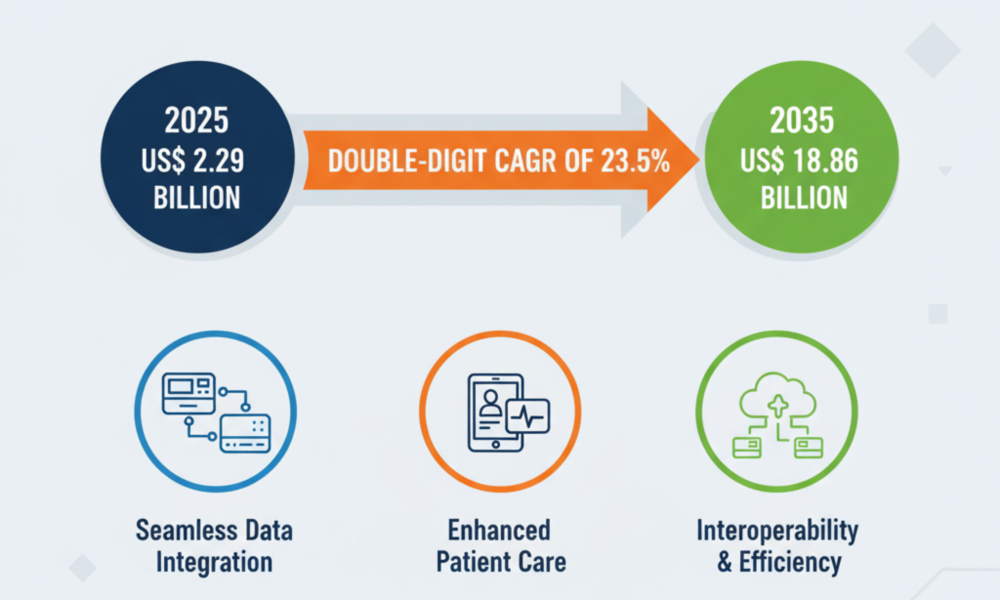
The global medical device connectivity market is poised for significant growth, with a projected valuation of USD 18.86 billion by 2035, up from USD 2.29 billion in 2025. This expansion is fueled by a robust compound annual growth rate (CAGR) of 23.5% from 2025 to 2035. The surge is primarily driven by the increasing demand for telehealth services, the rising adoption of electronic health record (EHR) systems, and advancements in wireless technologies such as Wi-Fi 6, Bluetooth, and 5G. As healthcare providers prioritize real-time data exchange and remote patient monitoring, medical device connectivity solutions are becoming essential for improving patient outcomes, operational efficiency, and seamless integration of IoT-enabled devices. This market evolution is further supported by the need for interconnected systems in hospitals and home care settings, positioning connectivity as a cornerstone of modern healthcare.
Medical Device Connectivity Market Segmentation and Trends:
The medical device connectivity market is segmented by component, connectivity technology, application, end-use vertical, and region, providing a detailed view of its dynamics. By component, segments include solutions (interface devices, medical device connectivity hubs, medical telemetry solutions) and services (consultation, integration & deployment, support & maintenance), with solutions leading due to their role in facilitating device integration. By connectivity technology, the market covers wired and wireless, with wireless connectivity holding a significant share, valued at USD 1.47 billion in 2025 and projected to reach USD 12.35 billion by 2035 at a 23.4% CAGR, driven by mobility and real-time monitoring needs.
By application, segments include vital sign monitoring systems, cardiology devices, ICU systems, oncology systems, home healthcare devices, and others, with vital sign monitoring leading for its critical role in patient care. By end-use vertical, the market encompasses hospitals & clinics, diagnostic centers, healthcare research centers, and others, with hospitals & clinics expected to reach USD 7.34 billion by 2035 at a 22.8% CAGR from USD 881.42 million in 2025, reflecting advanced infrastructure demands.
Full Market Report Available for Delivery. For Purchase or Customization, Please Request Here: https://www.factmr.com/connectus/sample?flag=S&rep_id=10634
Regionally, North America holds 35.8% market share in 2025, while East Asia is projected to grow at 23.8% CAGR. Trends include the adoption of AI-driven analytics for predictive insights, the integration of 5G for enhanced data transmission, and a focus on cybersecurity to protect sensitive health data, aligning with regulatory requirements and patient privacy concerns.
Driving Factors Behind Market Growth:
The medical device connectivity market is propelled by several key drivers. The rising adoption of EHR systems among healthcare providers enables seamless data collection and improves decision-making through real-time transmission between medical devices and EHR platforms. The popularity of IoT-enabled medical devices, offering real-time monitoring and data collection, necessitates connectivity solutions for integration with central healthcare systems.
The growing need for remote monitoring, particularly for home-based devices, reduces hospital visits and ensures timely interventions. Regulatory emphasis on interoperability standards pushes healthcare facilities to adopt connectivity solutions for compatibility and smooth data exchange. Additionally, advancements in wireless technologies like 5G enhance functionality, supporting telehealth and AI-driven solutions, while government investments in healthcare infrastructure further accelerate market growth.
Recent Developments and Key Players:
The medical device connectivity market is competitive, with key players focusing on innovation, partnerships, and expansions to capture share. Recent developments include the World Health Organization’s launch of the Medical Devices Information System (MeDevIS) in January 2025, an open-access platform for medical device access. In March 2022, Cognosos, Inc. introduced LocationAI, a machine learning-driven geolocation engine for asset tracking in healthcare facilities.
Key players include Medtronic, GE Healthcare, IBM Watson Health, Honeywell Life Sciences, Abbott Laboratories, Philips Healthcare, Cerner Corporation, Siemens Healthineers, Qualcomm Life, Boston Scientific, Johnson & Johnson, Roche Diagnostics, and Zebra Technologies. Competitor analysis reveals a emphasis on strategic partnerships and R&D. Companies are investing in secure data protocols, AI analytics, and advanced wireless networking to meet regulatory and market demands.
Regional Insights and Opportunities:
North America leads the medical device connectivity market, driven by advanced healthcare infrastructure, strong regulatory support, and rapid adoption of digital health technologies in the United States. The U.S. market benefits from high demand for IoT-enabled devices, remote monitoring, and AI-driven solutions.
East Asia is experiencing rapid growth at 23.8% CAGR, fueled by investments in healthcare infrastructure and telemedicine expansion, supported by an aging population and rising chronic disease prevalence in China. Europe emphasizes data privacy and interoperability, with growth in Germany and the UK. South Asia & Pacific, Latin America, and the Middle East & Africa offer opportunities through improving digital health access. Partnerships with system integrators and healthcare providers are key to tapping these markets.
Challenges and Future Outlook:
The medical device connectivity market faces challenges, including high implementation costs for integration and maintenance, cybersecurity risks with increased connectivity, and regulatory complexities for data privacy. Interoperability issues between devices and systems also pose hurdles.
However, the future outlook is optimistic, with opportunities in AI-powered analytics and 5G-enabled solutions. As telehealth and remote monitoring expand, the market is well-positioned for sustained growth, transforming healthcare delivery through efficient connectivity by 2035.
Check out More Related Studies Published by Fact.MR:
Medical AR Systems Market: https://www.factmr.com/report/medical-ar-systems-market
Medical Equipment Cooling Market: https://www.factmr.com/report/medical-equipment-cooling-market
Contact:
US Sales Office
11140 Rockville Pike
Suite 400
Rockville, MD 20852
United States
Tel: +1 (628) 251-1583, +353-1-4434-232
Email: [email protected]
About Fact.MR
We are a trusted research partner of 80% of fortune 1000 companies across the globe. We are consistently growing in the field of market research with more than 1000 reports published every year. The dedicated team of 400-plus analysts and consultants is committed to achieving the utmost level of our client’s satisfaction.



