
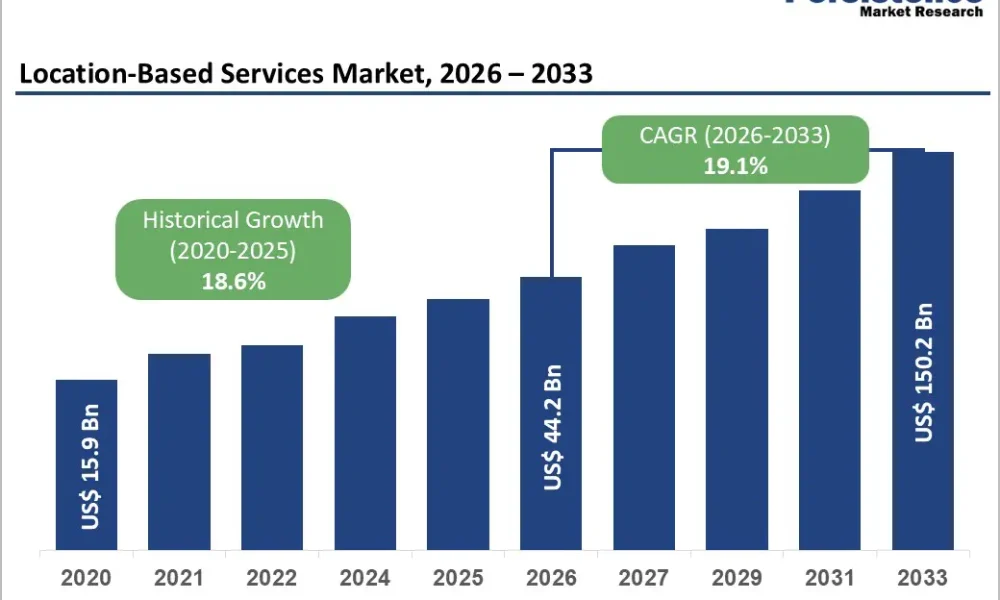
The global Location-Based Services (LBS) market is witnessing rapid expansion as digital technologies increasingly rely on location intelligence to deliver personalized experiences and operational efficiency. The market is projected to grow from US$44.2 billion in 2026 to US$150.2 billion by 2033, expanding at a compound annual growth rate (CAGR) of 19.1% during the forecast period.
Location-based services utilize geographic data from mobile devices, GPS satellites, sensors, and communication networks to provide contextual services based on a user’s location. These services power numerous modern applications such as navigation systems, ride-hailing platforms, location-based advertising, asset tracking, and emergency response solutions.
Technological advancements such as Global Positioning System (GPS) accuracy improvements, fifth-generation (5G) connectivity, Internet of Things (IoT) networks, and cloud computing are significantly transforming the LBS ecosystem. Businesses across sectors including transportation, retail, healthcare, logistics, and smart city infrastructure are increasingly integrating LBS capabilities into their digital strategies.
As companies strive to enhance customer engagement and operational efficiency, location intelligence has become a strategic asset. However, the industry must also address challenges related to privacy, data security, and infrastructure costs to sustain long-term growth.
Market Overview
Location-based services enable organizations to collect, analyze, and utilize geographic data to offer context-aware services to users. With billions of smartphones and connected devices generating continuous location data, LBS platforms have become essential for modern digital ecosystems.
The rising adoption of smartphones, wearable devices, and connected vehicles is significantly increasing the volume of location-based data available for analytics. Organizations use this information to improve services such as navigation, delivery management, customer engagement, and resource optimization.
Several industries are benefiting from LBS integration. For instance, retail companies use geo-marketing to deliver personalized promotions based on a user’s proximity to stores. Logistics firms rely on real-time tracking to optimize routes and reduce fuel consumption. Healthcare organizations employ location tracking to manage medical assets and improve emergency response times.
Additionally, the rollout of 5G networks is expected to dramatically enhance LBS capabilities by enabling ultra-low latency and high-speed connectivity. These advancements will support more accurate positioning and real-time analytics, expanding the potential applications of location-based technologies.
Key Industry Highlights
Several important trends are shaping the future of the location-based services market:
- North America is expected to dominate the market, accounting for approximately 40% of global revenue in 2026 due to advanced technological infrastructure and high smartphone penetration.
- Asia Pacific is projected to be the fastest-growing regional market, driven by rising smartphone adoption, rapid urbanization, and the expansion of e-commerce and logistics sectors.
- Navigation and tracking services will lead the application segment, capturing around 40% of market share in 2026 due to increasing demand for route optimization and fleet management.
- Geo-marketing and location-based advertising are forecast to grow at the fastest pace as companies leverage location intelligence to deliver personalized marketing campaigns.
A notable example of industry innovation occurred in July 2025, when Stellantis partnered with 4screen to integrate real-time location-based services into vehicles from brands such as FIAT, Jeep, and Ram. The integration allows drivers to discover nearby restaurants, charging stations, and dealerships through the vehicle infotainment system.
Market Drivers
Proliferation of Smartphones and Connected Devices
The widespread adoption of smartphones and connected devices is one of the most significant factors driving the location-based services market.
Modern smartphones come equipped with technologies such as GPS receivers, Bluetooth sensors, Wi-Fi connectivity, and accelerometers that allow precise location tracking. These features enable businesses to collect detailed geographic data that can be used to deliver personalized services and targeted marketing campaigns.
Consumers increasingly rely on location-enabled applications for everyday activities including navigation, ride-hailing, restaurant discovery, and online shopping. This continuous interaction with location-based applications generates valuable insights that organizations can leverage to enhance customer engagement.
The integration of LBS with Internet of Things (IoT) ecosystems further expands its applications. Smart devices such as connected vehicles, wearable health monitors, and logistics sensors constantly transmit location data, enabling predictive analytics and automated decision-making.
As billions of connected devices join global networks, organizations are investing in scalable infrastructure capable of processing vast volumes of location data. This growing ecosystem will continue to accelerate demand for advanced LBS platforms.
Market Restraints
Privacy and Data Security Concerns
Despite strong growth prospects, privacy and data security concerns remain a major challenge for the location-based services market.
Location data is highly sensitive because it can reveal personal information such as daily routines, travel patterns, workplace locations, and consumer preferences. If improperly managed, this information can be exploited for unauthorized surveillance or targeted advertising without user consent.
Growing public awareness of data privacy issues has made consumers more cautious about sharing their location information with digital platforms. As a result, companies must adopt transparent policies and obtain explicit consent before collecting or processing location data.
Regulatory frameworks such as the General Data Protection Regulation (GDPR) in Europe have introduced strict compliance requirements for organizations handling personal data. Companies that fail to adhere to these regulations risk financial penalties and reputational damage.
To address these concerns, organizations are implementing privacy-by-design strategies, including encryption, anonymization, and secure data storage systems. By prioritizing data protection, companies can build trust among users and ensure sustainable growth in the LBS market.
Market Opportunities
Expansion of Indoor Positioning Technologies
Indoor positioning systems (IPS) represent one of the most promising opportunities for the location-based services market.
Traditional GPS systems are highly effective for outdoor navigation but struggle to maintain accuracy in indoor environments due to signal obstruction. Indoor positioning technologies address this limitation by using alternative methods such as Wi-Fi signals, Bluetooth beacons, and RFID tags to determine precise locations within buildings.
These technologies enable a wide range of applications across sectors including retail, healthcare, airports, shopping malls, and warehouses. For example, retailers can guide customers through stores using indoor navigation apps, while hospitals can track medical equipment and staff in real time.
In September 2025, OpenSpace introduced AI Autolocation, a spatial artificial intelligence system capable of delivering accurate indoor positioning using smartphone sensors and 360-degree site maps without the need for additional beacons.
As smart buildings and connected infrastructure become more prevalent, indoor positioning systems will play an increasingly important role in enhancing operational efficiency and customer experiences.
Elevate your business strategy with comprehensive market data. Request a sample report now: https://www.persistencemarketresearch.com/samples/24478
Technology Insights
GPS Remains the Dominant Technology
Global Positioning System (GPS) technology is expected to remain the largest segment in the location-based services market, accounting for approximately 45% of total revenue in 2026.
GPS technology provides accurate, real-time location data for a wide range of applications including navigation systems, fleet management platforms, and location-based advertising services. Its widespread integration into smartphones, vehicles, and wearable devices ensures continued dominance in the LBS ecosystem.
For example, TRAC Intermodal launched GeoFleet in August 2025, a GPS-based fleet tracking system that uses geofencing technology to optimize shipping operations and enable usage-based billing.
5G-Enabled LBS is the Fastest-Growing Segment
The rollout of 5G networks is expected to significantly enhance the capabilities of location-based services. Compared to previous generations of mobile connectivity, 5G provides higher bandwidth, lower latency, and improved reliability.
These improvements allow organizations to deliver more accurate real-time location tracking and enable advanced applications such as autonomous vehicles, smart city management, and industrial automation.
For instance, Airtel Business partnered with Swift Navigation in September 2025 to launch an AI-powered cloud-based location service capable of delivering centimeter-level accuracy for emergency response and industrial operations.
Application Insights
Navigation and Tracking Lead the Market
Navigation and tracking services are expected to dominate the location-based services market with approximately 40% share in 2026.
Applications such as GPS navigation systems, ride-hailing platforms, and logistics tracking solutions rely heavily on accurate location data to optimize routes and improve operational efficiency. Companies such as ride-sharing platforms and delivery services depend on LBS to coordinate drivers, manage fleets, and deliver goods efficiently.
Real-time tracking also improves safety and transparency in transportation and logistics industries by allowing organizations to monitor vehicle locations and shipment statuses continuously.
Geo-Marketing and Advertising Grow Rapidly
Geo-marketing and location-based advertising are expected to experience the fastest growth through 2033. Businesses increasingly use geographic data to deliver targeted promotions and personalized advertising campaigns.
Location-based marketing enables companies to send promotions to customers when they are near a store, event, or service location. This highly targeted approach improves engagement rates and increases conversion opportunities.
For example, in November 2025, Prime Video introduced interactive location-based advertisements that allow brands to customize television commercials with local details such as pricing and dealership locations.
End-User Insights
Transportation and Logistics Lead Market Demand
The transportation and logistics industry is expected to account for approximately 30% of LBS market revenue in 2026.
Companies in this sector rely on location-based technologies to monitor fleet movements, optimize delivery routes, and track shipments in real time. These capabilities improve operational efficiency while reducing fuel costs and delivery times.
Location intelligence also enhances supply chain visibility, enabling businesses to manage inventory more effectively and respond quickly to disruptions.
Healthcare Emerges as a High-Growth Segment
The healthcare sector is projected to be the fastest-growing end-user segment during the forecast period.
Hospitals and healthcare providers increasingly use location-based services for patient tracking, emergency response coordination, and asset management. For example, medical staff can quickly locate essential equipment or track patient movements within hospital facilities.
As telemedicine and remote healthcare services expand, LBS technologies will play a critical role in enabling real-time monitoring and improving healthcare delivery.
Regional Insights
North America Leads the Market
North America is expected to dominate the global location-based services market, capturing around 40% of market share in 2026.
The region benefits from strong technological infrastructure, high smartphone penetration, and significant investments in digital innovation. Companies in sectors such as retail, transportation, and healthcare widely integrate LBS platforms to enhance customer engagement and operational efficiency.
Smart city initiatives across major metropolitan areas are also driving the adoption of location intelligence technologies.
Europe Maintains Strong Market Presence
Europe remains a significant market for location-based services due to widespread digital adoption and advanced infrastructure.
Countries such as the United Kingdom, Germany, and France actively deploy LBS technologies in transportation systems, logistics networks, and retail marketing strategies. Additionally, regulatory frameworks such as GDPR encourage responsible data usage while fostering innovation.
Asia Pacific Shows the Fastest Growth
Asia Pacific is forecast to experience the highest growth rate in the LBS market between 2026 and 2033.
Rapid urbanization, increasing smartphone adoption, and expanding e-commerce ecosystems in countries such as China and India are driving demand for location-based services. Governments across the region are also investing heavily in smart city initiatives that rely on location intelligence for traffic management, public safety, and logistics optimization.
Competitive Landscape
The location-based services market is moderately consolidated, with several technology companies dominating the industry.
Major global players include:
- Apple
- HERE Technologies
- TomTom
- Qualcomm
- Foursquare
- Uber Technologies
- Garmin
- Sygic
- Telenav
Large technology companies maintain market leadership through integrated ecosystems that combine mapping services, navigation platforms, and data analytics capabilities. These firms continue to invest heavily in research and development to improve positioning accuracy and expand their service offerings.
Specialized companies focus on niche segments such as mapping technology, fleet management solutions, and customized location analytics platforms.
Conclusion
The global location-based services market is entering a phase of accelerated growth fueled by technological advancements and the increasing importance of location intelligence in modern digital ecosystems.
With the market expected to expand from US$44.2 billion in 2026 to US$150.2 billion by 2033, organizations across industries are investing in LBS platforms to enhance operational efficiency, deliver personalized customer experiences, and unlock new revenue opportunities.
While privacy concerns and infrastructure costs present challenges, continuous innovation in 5G connectivity, IoT networks, and indoor positioning technologies will further expand the potential applications of location-based services.
As businesses increasingly rely on real-time location data to guide decision-making, LBS technologies will become a fundamental component of the global digital economy in the years ahead.
Related Reports:




