
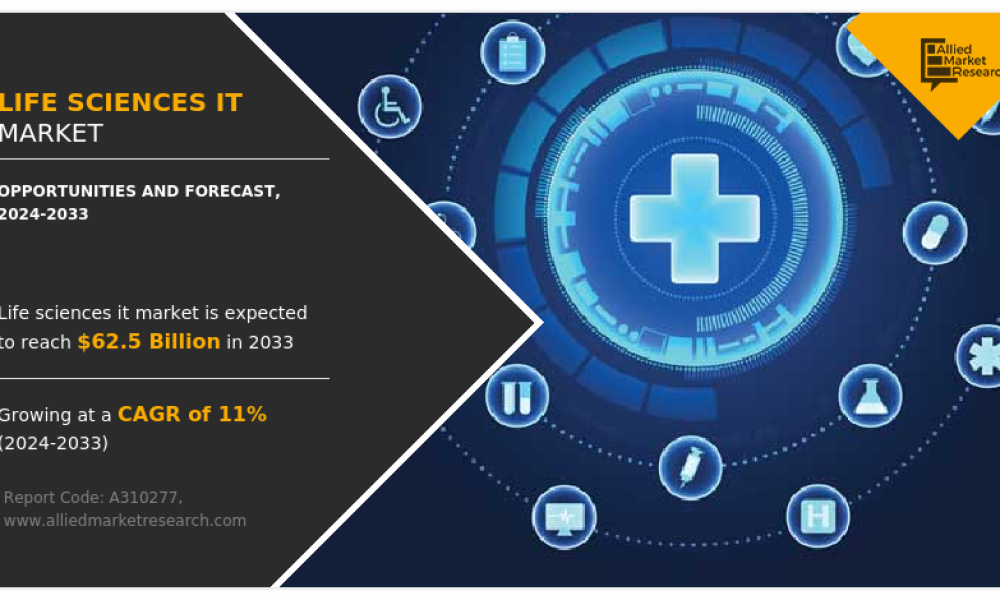
The global life sciences IT market is poised for significant expansion, with its valuation projected to surge from $21.3 billion in 2023 to $62.5 billion by 2033, growing at a compound annual growth rate (CAGR) of 11%. This rapid growth is primarily fueled by the increasing adoption of life science analytics software, the rising prevalence of chronic diseases, and the expanding need for advanced diagnostic technologies.
Why Life Sciences IT Matters
Life sciences IT plays a crucial role in transforming modern healthcare and research by streamlining data collection, analysis, and visualization. It enables healthcare providers and researchers to derive insights from complex biological and clinical data—driving innovations in drug discovery, genomics, clinical trials, and personalized medicine.
Key functionalities include:
Management of massive biomedical data
Integration of AI and ML for better analytics
Enhanced compliance and quality control
Facilitated collaboration among research teams
Key Market Drivers
1. Advanced Analytical Tools in High Demand
With over 80% of healthcare data being unstructured, there’s a growing need for IT systems that can process and analyze this information effectively. Life sciences IT tools empower professionals to make data-driven decisions that improve patient care and optimize operations.
AI and ML algorithms improve predictive analytics
Data visualization tools enhance decision-making
Personalized care becomes more accessible
2. Accelerated Drug Discovery and Development
The integration of AI in life sciences IT solutions has revolutionized how pharmaceutical companies identify drug candidates, simulate biological interactions, and reduce time-to-market.
AI-based screening improves accuracy of target identification
Real-time data analytics support rapid decision-making
ML models predict drug safety and efficacy
3. Laboratory Automation on the Rise
The shift toward decentralized and automated laboratories has driven demand for IT platforms that can handle large, varied datasets while maintaining synchronization between remote teams and equipment.
Cloud-based platforms allow real-time collaboration
Data management systems support flexible workflows
Automation increases productivity and accuracy
Challenges in the Market
Despite robust growth prospects, the market faces notable restraints:
Data security concerns pose a significant risk, especially with sensitive patient and genomic information.
Integration challenges between legacy systems and new technologies can slow down adoption.
Emerging Opportunities
The continued integration of AI and machine learning presents vast opportunities, especially in:
Predictive modeling for clinical outcomes
Virtual clinical trials
Advanced diagnostics and early disease detection
Segment Analysis: A Closer Look
By Solution
Bioinformatics led the market in 2022, driven by the increasing demand for genomic data analysis tools.
Enterprise resource planning (ERP) tools are gaining traction among smaller firms, pushing growth in the “others” segment.
By Type
Services segment is anticipated to grow the fastest, due to their cost-effectiveness and accessibility for small and medium-sized enterprises (SMEs).
By End User
Pharmaceutical and biotechnology companies dominate the market thanks to their heavy investment in R&D and digital infrastructure.
By Region
North America held the largest share in 2022 due to advanced healthcare infrastructure and key market players.
Asia-Pacific is projected to witness the highest growth rate, supported by favorable government policies, growing biotech hubs, and rising healthcare digitization.
Market at a Glance: Key Takeaways
Market Size (2023): $21.3 Billion
Projected Size (2033): $62.5 Billion
CAGR (2024–2033): 11%
Growth Drivers
Rising adoption of life sciences IT in pharma R&D
Surge in chronic diseases demanding accurate diagnostics
Increased deployment of AI and ML in health analytics
Challenges
Data security and privacy concerns
Integration with legacy healthcare systems
Leading Players
Thermo Fisher Scientific Inc.
Illumina, Inc.
Qiagen N.V.
IBM Corp
Oracle Corporation
DNAnexus Inc.
Agilent Technologies
Clario Inc.
Revvity, Inc.
Genedata AG
The global life sciences IT market is undergoing a transformative phase, driven by the confluence of digital health, biotechnology, and AI. As healthcare ecosystems become increasingly complex and data-driven, the need for integrated, scalable, and intelligent IT solutions will only intensify. With rising investments, supportive policies, and rapid technological advancements, the sector is set to emerge as a cornerstone of future healthcare innovate.




