
The legal cannabis market has transitioned from a fringe, highly regulated niche into one of the most dynamic global consumer and healthcare industries. Legalization for medical and recreational use across multiple jurisdictions has fundamentally reshaped how cannabis is produced, distributed, prescribed, and consumed. What was once an informal or illicit economy is now increasingly characterized by licensed cultivation, pharmaceutical-grade manufacturing, retail transparency, and regulatory oversight. Governments are recognizing cannabis not only as a public health consideration but also as a significant source of tax revenue, job creation, and export potential, which has accelerated reforms in both developed and emerging economies.
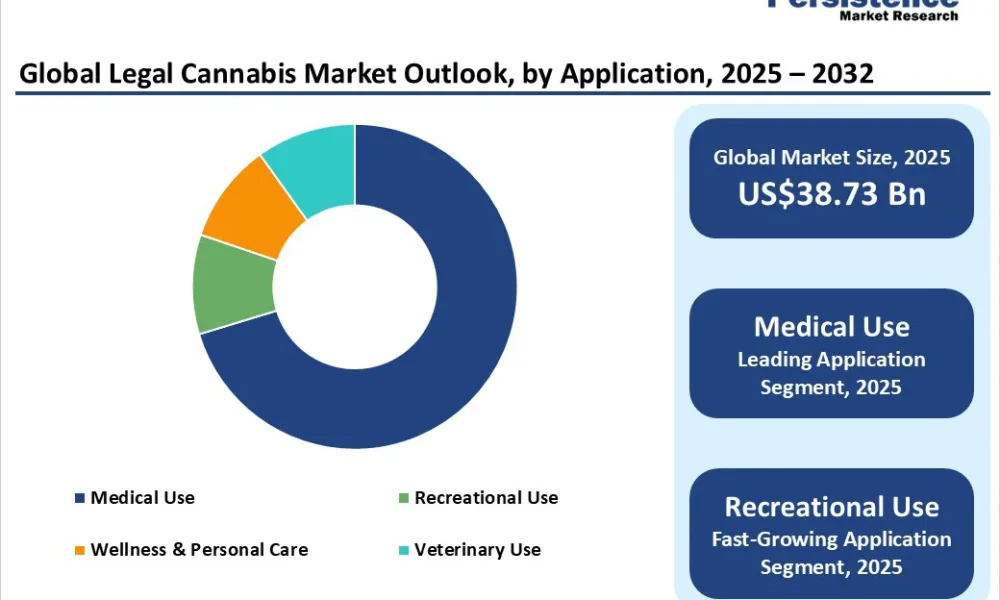
From a market perspective, the industry is entering a scale-up phase defined by consolidation, innovation, and cross-border expansion. According to current estimates, the global legal cannabis market is valued at US$38.73 billion in 2025 and is projected to reach US$141.22 billion by 2032, growing at a robust CAGR of 20.3% during the forecast period. Growth is primarily driven by expanding legalization for both medical and adult-use cannabis, rising acceptance of cannabis-based therapies for chronic pain and neurological conditions, and a steady shift in consumer perception toward plant-based and alternative wellness solutions. Dried flower remains the leading product segment due to familiarity and cost advantages, while medical use dominates applications with approximately 71% of total revenue. Geographically, North America leads the market with nearly 68% share, supported by mature regulatory frameworks, high consumer adoption, and advanced retail and cultivation infrastructure.
Download Your Free Sample & Explore Key Insights: https://www.persistencemarketresearch.com/samples/35660
Key Highlights from the Report
• The global legal cannabis market is projected to grow from US$38.73 billion in 2025 to US$141.22 billion by 2032 at a CAGR of 20.3%.
• North America accounts for the largest market share due to established legalization and high consumer penetration.
• Medical cannabis remains the leading application segment, contributing around 71% of total market revenue.
• Dried cannabis flower dominates product demand, holding approximately 51% of the global market share.
• Europe is the fastest-growing region, driven by Germany’s legalization reforms and expanding medical programs.
• Companies are increasingly investing in advanced formulations, international expansion, and pharmaceutical-grade production.
Market Segmentation Analysis
The legal cannabis market is segmented based on product type, application, distribution channel, and end-user, each playing a distinct role in shaping demand patterns and competitive strategies. By product type, the market includes dried flower, cannabis oils and tinctures, concentrates, edibles, beverages, and topical or wellness products. Dried flower continues to dominate due to its long-standing consumer acceptance, relatively simple production processes, and established retail channels. However, oils, concentrates, and edibles are witnessing faster growth as consumers increasingly prefer discreet consumption, precise dosing, and smoke-free alternatives.
From an application standpoint, the market is primarily divided into medical, recreational, and wellness uses. Medical cannabis holds the largest share as many countries initially legalized cannabis strictly for therapeutic purposes, creating structured patient access programs. These programs often involve physician prescriptions, regulated dosages, and pharmaceutical-grade standards, which increase both trust and average revenue per user. Recreational cannabis, while smaller in share, is expanding rapidly as adult-use legalization gains momentum across North America and Europe. Wellness applications, including skincare, supplements, and functional beverages, represent an emerging category that bridges the gap between medical and recreational use, appealing to health-conscious consumers seeking mild, plant-based benefits.
Regional Insights and Market Trends
Regional dynamics play a crucial role in defining the pace and structure of the legal cannabis market. North America remains the most mature and dominant region, accounting for nearly 68% of the global market in 2025. The United States drives growth through state-level legalization, with a growing number of states permitting medical and recreational use. Innovation in product formats such as THC-infused beverages, high-potency concentrates, and pharmaceutical-grade extracts has further strengthened the region’s leadership. Policy measures, such as California’s temporary reduction in cannabis excise taxes and New York’s rapid expansion of licensed dispensaries, illustrate how governments are actively refining regulations to support licensed operators and curb illicit sales.
Europe represents the fastest-growing regional market, largely driven by regulatory reforms and rising patient adoption. Germany has emerged as a central hub following the legalization of recreational cannabis in April 2024 and the rapid expansion of its medical cannabis program. Imports have surged as domestic cultivation struggles to meet demand, positioning Europe as a key destination for international suppliers. The United Kingdom, while maintaining a prohibition on recreational use, continues to experience steady growth in its private medical cannabis market, supported by specialized clinics and rising patient awareness. Across the region, regulatory complexity remains a challenge, but the long-term growth outlook remains strong due to population size and increasing political acceptance.
Asia Pacific is still in an early stage of market development, characterized by cautious regulatory approaches. Countries such as Australia have established structured medical cannabis frameworks, leading to a sharp rise in prescriptions and domestic cultivation licenses. Australia is also positioning itself as an exporter, leveraging its agricultural expertise and reputation for high-quality standards. In contrast, Thailand has recently tightened controls by reclassifying cannabis buds as a controlled herb, limiting access strictly to medical prescriptions. These developments highlight the region’s balancing act between economic opportunity and regulatory oversight, suggesting gradual but uneven growth across Asia Pacific.
Get Custom Insights Designed for Your Business: https://www.persistencemarketresearch.com/request-customization/35660
Market Drivers
Market growth is strongly supported by the increasing emphasis on precision therapeutics and advanced technology within the legal cannabis industry. Companies are moving beyond generic cannabis products toward targeted formulations with specific THC-to-CBD ratios, terpene profiles, and minor cannabinoid blends designed for distinct medical conditions. This shift aligns with growing physician demand for consistent, reliable alternatives to conventional pharmaceuticals, particularly for chronic pain, epilepsy, neurological disorders, and mental health conditions. Regulatory authorities are also encouraging higher standards of safety and efficacy, which further supports the adoption of pharmaceutical-grade cannabis products.
Technological advancements in cultivation and manufacturing are another critical driver. Modern techniques such as vertical farming, hydroponics, selective breeding, and controlled-environment agriculture are improving yield, quality, and cost efficiency. Advanced extraction, testing, and quality assurance technologies ensure compliance with strict regulations related to potency, contaminants, and labeling. Additionally, digital solutions such as seed-to-sale tracking systems, blockchain-enabled traceability, and AI-driven demand forecasting are strengthening transparency and regulatory compliance, particularly in mature markets like North America and Europe.
Market Restraints
Despite its strong growth outlook, the legal cannabis market faces notable restraints related to regulatory complexity and financial exclusion. Regulations vary significantly across countries and even within regions, forcing companies to adapt to multiple compliance frameworks. Differences in product standards, labeling requirements, and seed-to-sale tracking systems increase operational costs and administrative burdens, particularly for smaller cultivators and processors. Packaging regulations, including child-resistant designs and extensive health warnings, further add to production costs and slow time-to-market for new products.
Financial barriers remain another major constraint. Many cannabis businesses continue to face limited access to traditional banking, credit, and insurance services due to the industry’s classification as high-risk. This exclusion results in heavy reliance on cash transactions, which increases security risks and complicates tax reporting and auditing. High transaction fees and limited digital payment options also discourage consumer spending and hinder retail growth. For smaller operators, restricted access to capital limits their ability to scale operations, invest in innovation, or compete with larger, well-funded players.
Market Opportunities
Emerging technologies and niche applications are unlocking new growth opportunities within the legal cannabis market. One of the most promising areas is the development of advanced delivery systems, including nanoemulsions and nanocapsules, which significantly improve cannabinoid bioavailability and consistency. These technologies enable innovative product formats such as dissolvable strips, sprays, and fast-acting soft gels that appeal to both medical patients and wellness consumers seeking predictable effects. As clinical research continues to validate these approaches, companies investing in precision delivery systems are likely to gain a competitive edge.
Additional opportunities are emerging in pet therapeutics and biosynthetic cannabinoids. Hemp-derived CBD products for pets are gaining popularity as owners seek natural solutions for pain, anxiety, and inflammation, creating a less saturated niche compared to human medical cannabis. At the same time, biosynthetic production of rare cannabinoids such as CBG and CBN using engineered microbes offers a scalable and cost-efficient alternative to traditional cultivation. These innovations address supply constraints and open new avenues for product differentiation, particularly in pharmaceutical and wellness segments.
Checkout Now & Download Complete Market Report: https://www.persistencemarketresearch.com/checkout/35660
Company Insights
The competitive landscape of the legal cannabis market is defined by a mix of established multinationals, regional leaders, and innovative start-ups. Major players leverage vertically integrated operations, extensive cultivation capacity, and strong retail networks to maintain market share, while smaller firms focus on niche products and localized markets.
• Canopy Growth Corporation
• Tilray Brands
• Aurora Cannabis
• Curaleaf Holdings
• Green Thumb Industries
• Trulieve Cannabis Corp.
• Cresco Labs
• Verano Holdings
• Glass House Brands
• Eaze
• Budr Cannabis
• Vireo Growth
• MedMen Enterprises
• Aphria Inc.
• Cronos Group
• HEXO Corp
• OrganiGram Holdings
• Supreme Cannabis Company
• iAnthus Capital Holdings
• The Green Organic Dutchman
Recent market developments highlight the industry’s ongoing evolution. In August 2025, SoNo 1420 launched a THC-infused beverage in Connecticut, reflecting the growing convergence between cannabis and functional beverages as alternatives to alcohol. In June 2025, Vireo Growth Inc. completed its acquisition of Proper Brands in Missouri, strengthening its production capabilities and expanding its footprint in key U.S. medical cannabis markets.
Market Segmentation
By Product Type
- Dried Flower
- Cannabis Oils & Concentrates
- Edibles & Beverages
- Topicals & Transdermals
- Pharmaceutical-Grade Products
By Application
- Medical Use
- Recreational Use
- Wellness & Personal Care
- Veterinary Use
By Compound Type
- THC-Dominant Products
- CBD-Dominant Products
- Balanced THC:CBD Blends
- Minor Cannabinoids
By Distribution Channel
- Dispensaries & Cannabis Retail Stores
- Pharmacies & Clinics
- Online Platforms & Delivery Services
- Specialty & Wellness Stores
By Region
- North America
- Europe
- East Asia
- South Asia & Oceania
- Latin America
- Middle East & Africa
Conclusion
The legal cannabis market is entering a transformative phase marked by rapid expansion, regulatory refinement, and increasing product sophistication. Strong growth projections reflect not only wider legalization but also deeper integration of cannabis into healthcare, wellness, and lifestyle consumption. While regulatory complexity and financial barriers continue to pose challenges, advancements in technology, precision therapeutics, and innovative delivery systems are steadily reshaping industry standards. With North America maintaining leadership, Europe accelerating through reform-driven growth, and Asia Pacific cautiously opening new pathways, the global legal cannabis market is positioned for sustained long-term development. Companies that balance compliance, innovation, and strategic expansion will be best placed to capitalize on the evolving opportunities within this high-growth industry.




