
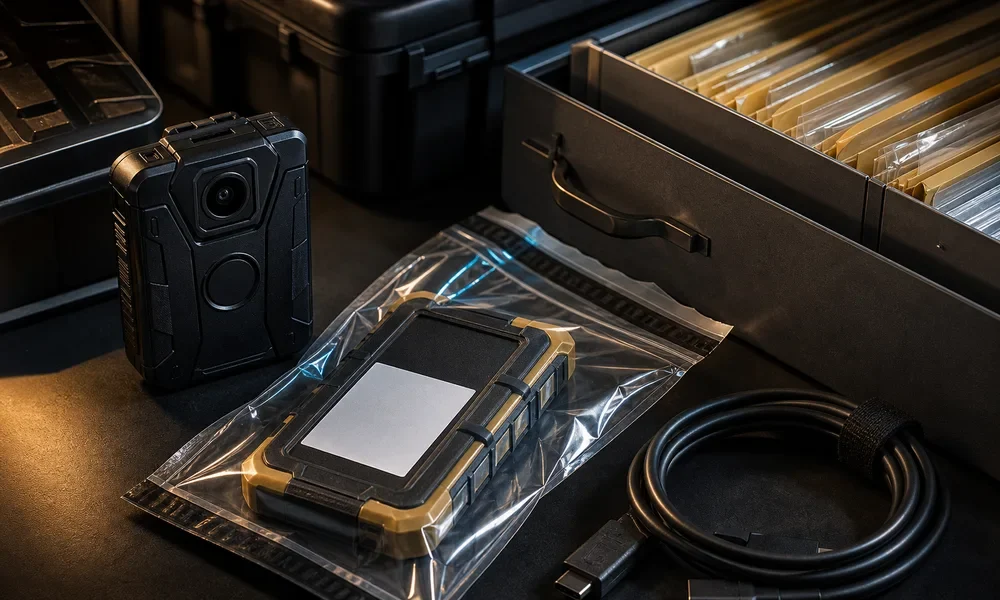
The modern evidence room has no single door. A body-worn camera records at the edge. A patrol vehicle uploads when connectivity returns. A drone produces large media files. A forensic workstation creates an image. A cloud application stores related records, while an on-premises case system remains the authoritative source.
This spread is more than an inconvenience for storage teams. It means digital evidence must cross systems without losing the characteristics that allow investigators, attorneys, and courts to understand what it is and how it was handled.
The National Institute of Standards and Technology identifies preservation challenges specific to digital objects and law-enforcement-generated evidence, distinct from those of traditional physical items. In our view, for state, local and federal agencies, preservation therefore depends on distributed-systems engineering as well as policy.
Collection Is Only the First Integrity Event
Teams often focus on the hash recorded when they acquire evidence. A matching cryptographic hash supports byte-level integrity; it does not establish who collected the material, whether collection was authorized, or whether the record is authentic in every other respect. Custody records and acquisition procedures remain necessary, and the chain continues after collection. A file may be queued on a device, transferred through a docking station, written to local storage, replicated to a secondary facility, and restored during an investigation.
At each transition, the agency needs to know which object moved, from where, under which policy, and with what result. A transfer process should verify completeness and surface mismatches. It should never silently turn an interrupted operation into an apparently successful file.
Metadata needs equal care. Capture time, source identifiers, permissions, and case relationships may be stored inside the file, alongside it, or in a separate application. Moving content without the metadata required by the evidence-management process can preserve bytes while damaging meaning.
The architecture should identify the authoritative record for each kind of metadata. A replication tool should not be expected to replace an evidence-management platform, but its behavior must not break the relationship between the evidence object and that platform.
Intermittent Networks Must Be Treated as Normal
Field connectivity is not a smaller version of data-center connectivity. Links disappear, bandwidth changes,ges and devices may remain offline for hours. Systems designed around permanent reachability can create backlogs that operators notice only when someone requests missing evidence.
Test with realistic conditions. Interrupt a large upload, reconnect through a slower link, and confirm whether the transfer resumes safely or restarts. Fill a destination volume. Power-cycle a sending endpoint. Observe how duplicate filenames and changed files are handled.
Queue visibility matters. Supervisors should be able to distinguish evidence that has not yet left the field from evidence received and verified centrally. Alerts should identify growing delay without exposing sensitive content to staff who do not need it.
A cross-platform replication product such as EnduraData EDpCloud may be considered for moving files among heterogeneous endpoints and sites. The decisive question is whether the configured route can meet the agency’s evidence-handling requirements under real network conditions—not whether it produces a fast transfer in an ideal demonstration.
Separate Preservation Copies From Working Copies
Investigators, analysts and prosecutors may need convenient access to evidence, but convenience should not blur the status of the preserved original. The system design should distinguish an authoritative preservation copy from derivatives used for review, redaction, transcription, or analytics.
Replication can improve availability, but it can also propagate unwanted changes if write permissions and directionality are poorly controlled. Agencies should decide which locations may originate changes, which receive read-only copies, and how conflicts are resolved. Bidirectional movement may suit some operational records but is inappropriate for preserved evidence.
Backup adds another layer. A synchronized secondary copy is not automatically a versioned recovery source. Define how earlier states are retained, how legal holds interact with normal lifecycle rules, and how restoration is validated. Test a recovery using non-case data before relying on the procedure.
Access should follow role and purpose. A technician may need to repair a failed route without opening evidence. A security analyst may need event data without case contents. An investigator may need a working copy without permission to alter the preserved original.
Build an Evidence Packet for the Evidence System
The data-movement architecture itself needs documentation. Maintain a diagram of endpoints, relays, credentials, encryption boundaries, queues, logs, and storage tiers. Record software versions and configuration changes. Assign ownership for reviewing failures and reconciling exceptions.
For a pilot, create a synthetic case containing a representative mix of video, images, documents, and small metadata files. Capture initial hashes. Move the set through every intended route, including a simulated outage. Compare results, inspect events, and restore one item from backup. Then ask a staff member who did not design the system to reconstruct the sequence.
That last step tests whether the evidence is understandable, not merely intact. A technically accurate log that requires a product developer to interpret it may be of limited operational use. Procedures and records should allow trained agency personnel to explain what happened.
Procurement teams should write these scenarios into acceptance criteria. They should also require vendors to state limitations: unsupported platforms, maximum tested object counts, metadata behavior, temporary storage and dependencies supplied by other systems.
Digital evidence will continue to expand in volume and variety. Agencies cannot solve that challenge simply by buying more capacity. They need movement that is observable, recoverable, and governed from collection through long-term preservation.
The chain of custody is often described as a series of human handoffs. Increasingly, it is also a series of system events. Treating those events as part of a distributed system gives agencies a more realistic way to preserve integrity—especially when the evidence room now extends to every device, vehicle, office, and cloud that touches the case.