
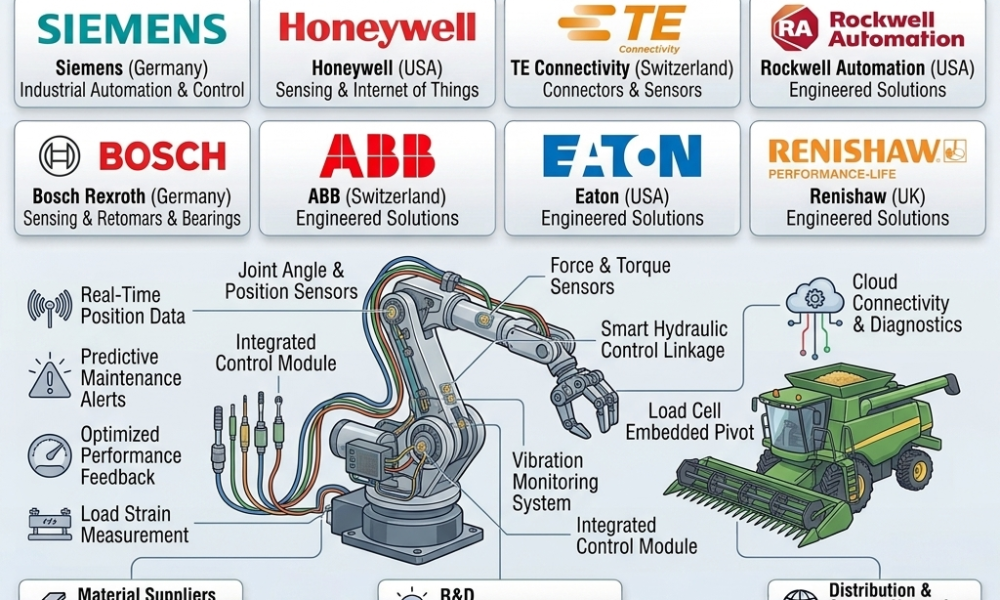
The global sensorized linkage assemblies market is expected to reach USD 720.6 million in 2026 and is projected to expand to USD 1,938.1 million by 2036, registering a CAGR of 10.4% during the forecast period. Vehicle manufacturers and Tier-1 suppliers are increasingly integrating sensing into mechanical linkage assemblies to provide reliable movement feedback for chassis, suspension, steering, transmission, pedal, and other electronically controlled vehicle functions.
The shift from conventional mechanical linkages toward signal-bearing assemblies is being reinforced by the growth of electric and software-defined vehicle architectures. The International Energy Agency reported in May 2026 that global electric car sales exceeded 20 million units in 2025, creating a large installed base of vehicles with higher levels of electronic control and sensing.
Global vehicle production also provides a broad platform for sensorized linkage deployment. OICA reported in April 2026 that worldwide vehicle production reached 96.4 million units in 2025. As automakers introduce new vehicle programs and localize component production, suppliers with capabilities spanning mechanical fit, sensor integration, connector design, calibration, and validation can address a wider range of platform requirements.
What Are the Key Segments in the Sensorized Linkage Assemblies Market?
- Suspension Linkage Assemblies – 36.5%: Suspension linkage assemblies are projected to account for 36.5% of 2026 revenue by linkage type, supported by increasing requirements for motion feedback in active ride and electronically controlled suspension applications.
- Position Sensors – 46.0%: Position sensors are expected to represent 46.0% of 2026 revenue by sensor type. Their ability to provide compact and accurate movement feedback supports integration into chassis, steering, suspension, and actuation systems.
- Passenger Cars – 58.0%: Passenger cars are anticipated to capture 58.0% of 2026 revenue by vehicle type. High vehicle production volumes and increasing electronic content are supporting sensorized linkage adoption across passenger vehicle platforms.
- OEM – 71.0%: OEM sales are forecast to account for 71.0% of 2026 revenue. Factory integration requires calibration approval, validated interfaces, connector reliability, and vehicle-level testing.
- Chassis Control Applications: Chassis control represents an important application area as automakers use sensor feedback to monitor movement and support electronically managed suspension, steering, and vehicle-dynamics functions.
Get detailed market forecasts, competitive benchmarking, and pricing trends:
https://www.futuremarketinsights.com/reports/sample/rep-gb-33677
Which Countries Are Showing the Strongest Growth in Sensorized Linkage Assemblies?
China is projected to be the fastest-growing country, registering an 11.8% CAGR through 2036. Rapid new-energy vehicle production and shorter vehicle platform development cycles are supporting demand for compact, integrated sensing solutions. The country’s large automotive manufacturing ecosystem also provides opportunities for suppliers capable of supporting localized production.
India is expected to expand at an 11.2% CAGR through 2036. Increasing domestic vehicle production and greater localization of automotive electronics and components are supporting the integration of sensorized linkage assemblies into new vehicle programs.
The United States is forecast to grow at a 10.8% CAGR through 2036. Advanced vehicle validation programs, electrification, and increasing electronic content are contributing to demand for motion-feedback assemblies that can operate reliably in demanding chassis environments.
How Is Regional Demand Shaping the Sensorized Linkage Assemblies Market?
Asia remains an important center of market expansion as China and India increase vehicle production, electrification, and component localization. New-energy vehicle platforms require increasing levels of electronic monitoring and control, creating opportunities for assemblies that combine mechanical movement with reliable position or force feedback.
North America and Europe continue to emphasize validation, durability, and field performance. Suppliers serving these markets must demonstrate stable sensor outputs under heat, vibration, moisture, and mechanical loading while providing connector and calibration support throughout the vehicle program.
The broader automotive sensors ecosystem is also supporting demand as manufacturers move sensing capabilities closer to moving components and control points. This integration can reduce signal uncertainty while providing vehicle controllers with more direct information about component position.
What Is Changing the Competitive Landscape?
Competition increasingly focuses on sensor capability, connector reliability, sealing, calibration stability, and system-level vehicle integration. Key participants include Bosch, ZF, Continental, TE Connectivity, Sensata Technologies, Denso, Nexteer Automotive, FORVIA HELLA, Amphenol, and Methode Electronics.
ZF said in July 2025 that its Smart Chassis Sensor measures wheel height and captures acceleration in three dimensions. Such sensor integration illustrates the broader movement toward chassis components that provide both physical movement and electronic feedback.
Sensorized linkage suppliers are also responding to increasing software content within vehicle architectures. Rather than supplying a purely mechanical linkage, manufacturers are increasingly expected to support signal integrity, diagnostic functionality, calibration, and communication with electronic control systems.
The development of X-by-Wire architectures further increases the importance of reliable motion sensing. As mechanical and electronic control functions become more closely integrated, suppliers with mechanical engineering, sensing, connector, and validation capabilities can address more complex platform requirements.
What Does the Analyst Say About the Sensorized Linkage Assemblies Market?
“Sensorized linkage assemblies are evolving into critical feedback components that support software-defined vehicles, advanced chassis control, and intelligent actuation systems. OEMs increasingly evaluate suppliers based on sealing quality, sensor calibration stability, connector design, and long-term validation performance. Reliable movement reporting under heat, vibration, and harsh operating conditions is becoming a key purchasing criterion. Suppliers combining mechanical linkage expertise with automotive-grade sensing technologies are expected to strengthen their position in future chassis and actuation programs.”
— Nikhil Kaitwade, Principal Consultant at Future Market Insights
What Is Driving Demand for Sensorized Linkage Assemblies?
Software-defined Vehicle Architectures
Vehicle software increasingly controls suspension, steering, braking, powertrain, and other dynamic functions. These systems require dependable information about component position and movement, increasing the value of linkage assemblies that combine mechanical functionality with sensing.
EV and Hybrid Platform Development
Electric vehicles are increasing the electronic content of vehicle architectures. With global electric car sales exceeding 20 million in 2025, automakers are developing platforms that integrate more sensors and electronic control within compact chassis packages.
Closed-loop Chassis Control
Chassis systems increasingly use real-time feedback to adjust vehicle behavior. Sensorized suspension and steering linkages can provide position information directly from moving components, supporting closed-loop control strategies.
Safety and Diagnostic Requirements
Electronically controlled safety and chassis functions require reliable feedback and diagnostic signals. Sensorized components can provide controllers with direct information about movement, helping support monitoring and fault-detection strategies.
Drive Your Business Growth Strategy: Checkout the Report for Key Insights!
https://www.futuremarketinsights.com/checkout/33677
What Are the Key Market Restraints?
Sensorized linkage assemblies generally require more complex validation than conventional mechanical components. Suppliers must demonstrate sensor accuracy, calibration stability, sealing, connector durability, electromagnetic compatibility, and mechanical performance across the vehicle’s operating environment.
Cost can also be a consideration. Adding sensors, wiring interfaces, electronics, and calibration requirements increases component complexity compared with conventional linkage assemblies. Suppliers must therefore demonstrate sufficient system value to justify the additional integration requirements.
What Opportunities Exist for Sensorized Linkage Assembly Manufacturers?
The increasing use of electronically controlled chassis systems creates opportunities for suppliers that can combine mechanical linkage engineering with automotive-grade sensing. Integrated assemblies can reduce the number of separate components and provide vehicle controllers with more direct movement information.
Suppliers can also expand through specialized applications in suspension, steering, transmission, pedal, and actuation systems. Offering validated sensor modules, sealed connectors, calibration support, and diagnostic capabilities can strengthen participation in OEM platform programs.
Localization represents another opportunity, particularly in China and India, where expanding vehicle production and component manufacturing are creating additional platform requirements.
How Is the Sensorized Linkage Assemblies Market Segmented?
The sensorized linkage assemblies market is segmented by linkage type, sensor type, vehicle type, application, sales channel, and region.
By Linkage Type: Shift Linkage Assemblies, Suspension Linkage Assemblies, Throttle or Pedal Linkages, Steering Linkage Assemblies.
By Sensor Type: Position Sensors, Load or Force Sensors, Angle Sensors, Multi-sensor Modules.
By Vehicle Type: Passenger Cars, EVs or Hybrids, Commercial Vehicles, Off-highway Vehicles.
By Application: Chassis Control, Transmission or Shifter, Steering, Pedal or Actuation.
By Sales Channel: OEM, Tier Supplier Integrated Routes.
By Region: North America, Latin America, Europe, East Asia, South Asia and Pacific, Middle East and Africa.
Why Do Suspension Linkage Assemblies Lead the Linkage Type Segment?
Suspension linkage assemblies are projected to account for 36.5% of 2026 revenue. Increasing electronic control of vehicle dynamics and suspension systems creates demand for linkage components capable of delivering reliable mechanical movement alongside position feedback.
Why Do Position Sensors Account for the Largest Sensor Type Share?
Position sensors are expected to represent 46.0% of 2026 revenue. Accurate movement measurement is important for electronically controlled chassis and actuation systems, where vehicle controllers need dependable information about linkage position.
Why Do Passenger Cars Dominate Vehicle-Type Demand?
Passenger cars are projected to account for 58.0% of 2026 revenue. Their high production volumes and increasing electronic content provide a substantial platform for sensorized chassis, steering, suspension, and actuation components.
Why Does OEM Integration Remain Important?
OEM channels are forecast to capture 71.0% of 2026 revenue. Sensorized assemblies must be validated as part of the complete vehicle system, making factory-level calibration, software compatibility, mechanical integration, and durability testing important during platform development.
What Are the Drivers, Restraints and Opportunities in the Sensorized Linkage Assemblies Market?
The market is increasingly shaped by software-defined vehicle architectures, closed-loop chassis control, and the integration of mechanical movement with electronic feedback.
- Driver: Increasing electronic control and sensing requirements across EV and conventional vehicle platforms.
- Restraint: Higher component complexity, validation requirements, and integration costs.
- Opportunity: Integrated sensorized assemblies for suspension, steering, shifter, pedal, and advanced actuation applications.
What Is the Sensorized Linkage Assemblies Market Demand Outlook?
The market is projected to increase from USD 720.6 million in 2026 to USD 1,938.1 million by 2036, reflecting a 10.4% CAGR. Growth is being supported by vehicle electrification, software-defined architectures, and increasing demand for closed-loop motion control.
OEM sourcing decisions are moving beyond mechanical durability alone. Sensor calibration stability, connector design, sealing, signal reliability, and validation access are becoming important considerations when selecting suppliers for next-generation vehicle programs.
Chassis Motion Feedback and Calibration Analysis
Sensorized linkage assemblies can place motion feedback directly near the mechanical joint being monitored. This approach can provide vehicle controllers with more direct position information for chassis, suspension, steering, and actuation functions.
However, sensor performance must remain stable under vibration, temperature variation, contamination, and repeated mechanical movement. This makes sealing, calibration, connector design, and vehicle-level validation central to product development.
Sensor Integration and Software-defined Vehicle Analysis
The expansion of software-defined vehicle architectures is increasing the interaction between mechanical components and electronic control systems. Linkages that once transferred physical movement can now also provide information to vehicle controllers.
This creates opportunities for suppliers that can integrate sensing, signal conditioning, mechanical durability, and communication interfaces into a validated assembly. Such capabilities can support broader participation across chassis control, steering, transmission, pedal, and actuation programs.
Which Countries Are Growing Fastest in the Sensorized Linkage Assemblies Market?
China is projected to grow at 11.8% CAGR, followed by India at 11.2% and the United States at 10.8% through 2036. The market’s regional outlook is supported by EV production, vehicle platform localization, increasing electronic content, and growing requirements for reliable motion feedback.
About Future Market Insights
Future Market Insights (FMI) is a leading provider of market research and consulting services, offering syndicated and customized research across industries including automotive, mobility, and advanced manufacturing. FMI provides market intelligence, competitive assessments, forecasts, and strategic insights to support business decision-making.



