
The global shifter cable assemblies market is expected to reach USD 1.5 billion in 2026 and is projected to expand to USD 2.3 billion by 2036, registering a CAGR of 4.6% during the forecast period. Demand is being supported by continued vehicle production, increasing requirements for reliable transmission control, and replacement activity across aging vehicle fleets.
The industry provides a mechanical link between the cabin selector and transmission, making cable routing, lever feel, end-fitting strength, and environmental durability important considerations for vehicle manufacturers and repair channels. OICA reported in April 2026 that global vehicle production reached 96.4 million units in 2025, creating a broad base of new vehicle programs and future service-part requirements for cable suppliers.
Replacement demand is also gaining importance as vehicles remain in service for longer periods. S&P Global Mobility reported in May 2025 that the average age of vehicles in the USA reached 12.8 years, increasing the relevance of wear-related replacement for cables, bushings, and shift-linkage components. Suppliers with broad catalog coverage and installation-focused designs can address requirements across mixed vehicle fleets.
What Are the Key Segments in the Shifter Cable Assemblies Market?
- Push-pull Cables – 47.0%: Push-pull cables are projected to account for 47.0% of 2026 revenue by cable type. Their bidirectional motion transfer and compact packaging make them suitable for transmission layouts requiring dependable selector movement.
- Automatic Transmission – 54.0%: Automatic transmission applications are expected to represent 54.0% of 2026 revenue. Increasing use of automatic transmissions across passenger vehicles and hybrid platforms is supporting demand for compatible cable assemblies.
- Passenger Cars – 68.5%: Passenger cars are anticipated to capture 68.5% of 2026 revenue by vehicle type, reflecting their large production volumes and continued requirements for consistent gear-selection performance.
- OEM Supply: OEM programs remain an important demand channel because cable assemblies must be validated for vehicle-specific routing, shift feel, adjustment, durability, and transmission integration before production launch.
- Aftermarket Replacement: The aftermarket provides continued demand as aging vehicles require replacement cables and related linkage components to restore accurate gear selection and maintain vehicle usability.
Get detailed market forecasts, competitive benchmarking, and pricing trends:
https://www.futuremarketinsights.com/reports/sample/rep-gb-33682
Which Countries Are Showing the Strongest Growth in Shifter Cable Assemblies?
India is projected to be the fastest-growing country in the shifter cable assemblies market, expanding at a 5.6% CAGR through 2036. Increasing vehicle production, expanding domestic component manufacturing, and growing demand for replacement parts are supporting the country’s market development. The combination of OEM production and a broad vehicle service ecosystem creates opportunities for suppliers offering application-specific cable assemblies.
China is expected to grow at a 5.2% CAGR through 2036. Large-scale vehicle manufacturing and continued expansion of electrified vehicle production are influencing transmission component requirements. Suppliers are increasingly required to support different vehicle platforms with application-specific cable routing and end-fitting configurations.
Germany is forecast to register a 4.3% CAGR, supported by continued automotive engineering activity, hybrid vehicle development, and transmission technology investment. Durability testing, precision assembly, and integration requirements remain important factors for suppliers serving European vehicle programs.
How Is Regional Demand Shaping the Shifter Cable Assemblies Market?
Asia continues to provide an important production base for shifter cable assemblies as vehicle manufacturing and component sourcing expand. India and China combine large vehicle manufacturing ecosystems with growing domestic supplier capabilities, supporting opportunities for both OEM programs and replacement markets.
European demand is supported by established automotive manufacturing and engineering capabilities. Hybrid vehicle development and continued transmission-system investment maintain requirements for reliable mechanical control components, while mature vehicle fleets contribute to replacement demand.
North America remains relevant because of its large installed vehicle base and increasing vehicle age. Long vehicle operating cycles create opportunities for aftermarket suppliers offering broad application coverage, durable end fittings, and installation-ready assemblies.
What Is Changing the Competitive Landscape?
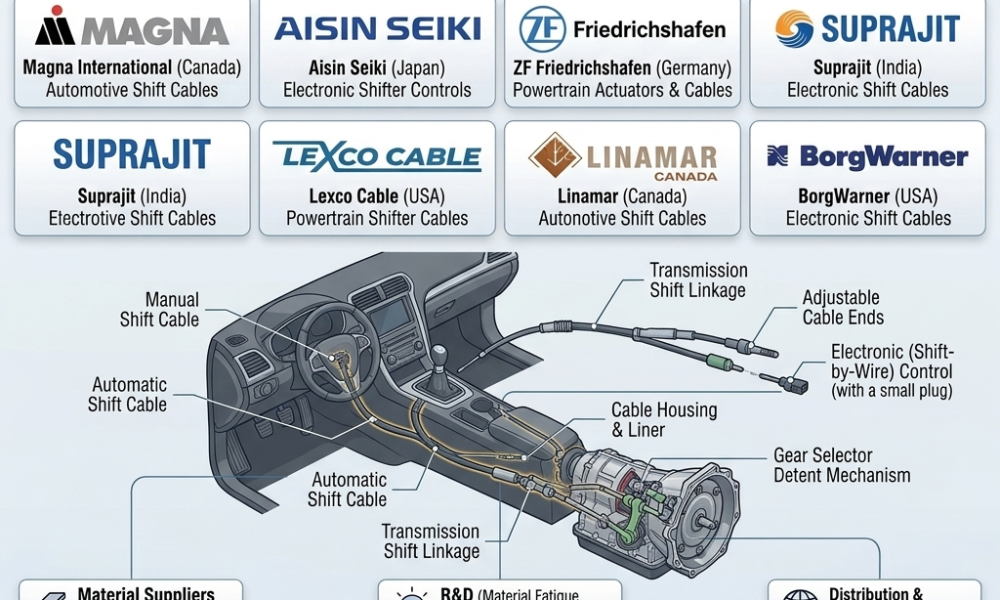
Competition increasingly centers on cable durability, routing performance, end-fitting reliability, adjustment mechanisms, and application coverage. Key companies include Kongsberg Automotive, Suprajit Engineering, HI-LEX, Orscheln Products, and Cablecraft Motion Controls.
Suppliers are expanding product coverage to address the increasing diversity of vehicle platforms. Standard Motor Products reported in April 2026 that it released more than 500 new part numbers during Q1 2026, covering late-model import and domestic vehicles. Such catalog expansion is important for distributors seeking to reduce sourcing gaps across mixed vehicle fleets.
OEM qualification also remains an important competitive factor. Cable assemblies must maintain consistent movement and shift feel across repeated operating cycles while withstanding vibration, temperature changes, moisture, and mechanical loads.
For aftermarket suppliers, catalog accuracy and installation efficiency are becoming equally important. Clear vehicle application data, correct cable-end configurations, and replacement designs that minimize adjustment requirements can help reduce installation time for repair professionals.
What Does the Analyst Say About the Shifter Cable Assemblies Market?
“Automotive shifter cable assemblies are evolving from mechanical linkage components into durability-focused transmission control solutions that support vehicle performance and long-term reliability. OEMs increasingly evaluate cable assemblies based on routing efficiency, shift feel consistency, vibration resistance, and environmental durability. Suppliers providing validated end fittings, simplified adjustment features, and regional engineering support are expected to strengthen long-term customer relationships. Companies capable of combining robust cable design with OEM validation and aftermarket service support are likely to establish stronger competitive positions.”
— Nikhil Kaitwade, Principal Consultant at Future Market Insights
What Is Driving Demand for Shifter Cable Assemblies?
Continued Vehicle Production
Global vehicle production provides a direct foundation for new shifter cable assembly demand. With OICA reporting 96.4 million vehicles produced globally in 2025, suppliers continue to address requirements from new vehicle programs while developing service-part coverage for vehicles already in operation.
Aging Vehicle Fleets
Longer vehicle lifecycles are supporting replacement demand. As cables and associated linkage components experience repeated movement and environmental exposure, repair shops require replacement assemblies that can restore accurate selector operation without extensive installation work.
Automatic Transmission Adoption
Automatic transmission applications represent 54.0% of the 2026 market by transmission type. Their broad use in passenger cars creates sustained demand for cable systems designed around specific transmission layouts, selector mechanisms, and vehicle packaging requirements.
OEM Validation and Durability Requirements
OEMs increasingly evaluate assemblies according to shift feel, cable routing, end-fitting strength, vibration resistance, and environmental durability. These requirements encourage suppliers to strengthen testing and vehicle-specific engineering capabilities.
What Are the Key Market Restraints?
Shifter cable assemblies must meet vehicle-specific packaging and routing requirements, which can increase engineering complexity. Small differences in transmission location, selector geometry, cable length, and mounting points can require application-specific designs.
The increasing adoption of electronically controlled transmission systems can also limit the addressable role of conventional mechanical cables in certain vehicle architectures. Suppliers therefore need to maintain broad application coverage while adapting products to changing transmission configurations.
What Opportunities Exist for Shifter Cable Assembly Manufacturers?
The aftermarket represents a significant opportunity as vehicle fleets age. Suppliers can expand addressable demand through broader catalog coverage, direct-fit replacement products, improved connector and end-fitting accuracy, and distribution networks that support faster parts availability.
OEM opportunities also exist through engineering collaboration during vehicle development. Suppliers capable of supporting cable routing studies, durability validation, shift-feel optimization, and vehicle-specific packaging can participate earlier in platform development.
Commercial and off-highway applications provide another avenue for expansion, particularly where cable systems must withstand higher vibration, contamination, temperature variation, and repeated operating cycles.
Drive Your Business Growth Strategy: Checkout the Report for Key Insights!
https://www.futuremarketinsights.com/checkout/33682
How Is the Shifter Cable Assemblies Market Segmented?
The shifter cable assemblies market is segmented by cable type, transmission type, vehicle type, sales channel, cable end type, and region.
By Cable Type: Push-pull Cables, Selector Cables, Shift Cables, Parking Brake and Other Assemblies.
By Transmission Type: Manual Transmission, Automatic Transmission, DCT or AMT, Commercial Vehicle Transmission.
By Vehicle Type: Passenger Cars, Light Commercial Vehicles, Commercial Vehicles, Off-highway Vehicles.
By Sales Channel: OEM, Aftermarket.
By Cable End Type: Ball Joint Ends, Clevis Ends, Eyelet Ends, Custom Ends.
By Region: North America, Latin America, Europe, East Asia, South Asia and Pacific, Middle East and Africa.
Why Do Push-pull Cables Lead the Cable Type Segment?
Push-pull cables are projected to account for 47.0% of 2026 revenue. Their ability to transfer selector movement in both directions through a flexible mechanical connection makes them suitable for compact transmission layouts and vehicle-specific routing requirements.
Why Does Automatic Transmission Account for the Largest Transmission Segment?
Automatic transmission applications are expected to represent 54.0% of 2026 revenue. The segment benefits from widespread automatic transmission use in passenger vehicles and continued application across hybrid vehicle platforms.
Why Do Passenger Cars Dominate Vehicle-Type Demand?
Passenger cars are projected to capture 68.5% of 2026 revenue. High global passenger vehicle production and the large installed base of vehicles requiring service and replacement components support sustained demand.
How Is Aftermarket Demand Developing?
The aftermarket is supported by vehicle aging and wear-related replacement. Repair buyers increasingly seek direct-fit components with accurate application information, reliable end fittings, and designs that reduce adjustment and installation time.
What Are the Drivers, Restraints and Opportunities in the Shifter Cable Assemblies Market?
The shifter cable assemblies market is increasingly shaped by vehicle production, transmission diversity, fleet aging, and demand for application-specific replacement components.
- Driver: Continued vehicle production and automatic transmission adoption.
- Restraint: Increasing electronic transmission control and vehicle-specific packaging requirements.
- Opportunity: Expanded aftermarket catalog coverage and OEM engineering partnerships.
What Is the Shifter Cable Assemblies Market Demand Outlook?
The market is projected to increase from USD 1.5 billion in 2026 to USD 2.3 billion by 2036, reflecting a 4.6% CAGR. Demand is expected to remain connected to both new vehicle production and replacement requirements from aging fleets.
For OEMs, the focus remains on predictable shift feel, cable routing, durability, and end-fitting strength. For aftermarket buyers, catalog breadth and installation efficiency become increasingly important as vehicle populations become more diverse.
Shift Feel and End-Fitting Durability Analysis
Selector feel is closely connected to cable friction, routing geometry, adjustment accuracy, and end-fitting design. Small deviations can affect the driver’s perception of shift quality and may create installation or warranty concerns.
Manufacturers therefore need to validate assemblies across repeated shift cycles and operating conditions. Durable end fittings and consistent cable movement can reduce replacement issues and support long-term transmission-control reliability.
Aftermarket Coverage and Catalog Expansion Analysis
The increasing average age of vehicles creates an opportunity for suppliers that can support a wide range of applications. Repair businesses frequently work across mixed fleets, making accurate catalog information important for selecting the correct cable length, end configuration, and mounting arrangement.
Expansion of part-number coverage can therefore improve distributor availability and reduce sourcing gaps. Standard Motor Products’ introduction of more than 500 new part numbers in Q1 2026 illustrates the importance of continuing application coverage as newer vehicles enter the service market.
Which Countries Are Growing Fastest in the Shifter Cable Assemblies Market?
India is projected to grow at 5.6% CAGR, followed by China at 5.2% and Germany at 4.3% through 2036. The broader market outlook is supported by vehicle production, transmission-system development, aging vehicle fleets, and continued requirements for replacement cable assemblies.
About Future Market Insights
Future Market Insights (FMI) is a leading provider of market research and consulting services, offering syndicated and customized research across industries including automotive, mobility, and advanced manufacturing. FMI provides market intelligence, competitive assessments, forecasts, and strategic insights to support business decision-making.



