
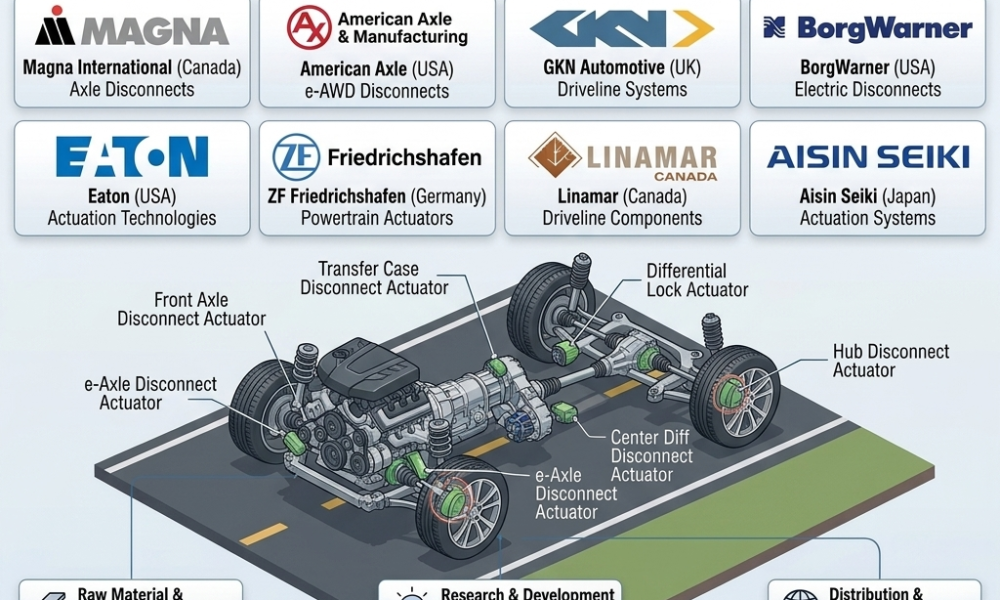
The global driveline disconnect actuators market is expected to reach USD 940.6 million in 2026 and is projected to expand to USD 2,186.2 million by 2036, registering a CAGR of 8.8% during the forecast period. Automakers are increasingly integrating disconnect actuation into AWD, hybrid, and electric vehicle architectures to reduce unnecessary driveline drag while maintaining traction capability when required.
The market is shifting from basic mechanical motion control toward electronically managed driveline separation. The U.S. Environmental Protection Agency reported that average new-vehicle fuel economy reached a record 27.2 mpg for model year 2024, reinforcing attention on technologies that can reduce mechanical losses in heavier vehicle packages. Meanwhile, the International Energy Agency reported that electric car sales exceeded 20 million units in 2025, accounting for approximately one-quarter of global new-car sales.
What Are the Key Segments in the Driveline Disconnect Actuators Market?
- Electric Disconnect Actuators – 46.0%: Electric disconnect actuators are projected to account for 46.0% of 2026 revenue by actuator type, supported by faster response, software integration, diagnostic feedback, and packaging flexibility across electrified drivetrains.
- Axle-integrated Modules – 48.0%: Axle-integrated modules represent 48.0% of 2026 revenue by integration type as compact e-axle architectures increasingly combine actuation and drivetrain functions within integrated assemblies.
- OEM – 83.0%: OEM sourcing is expected to account for 83.0% of 2026 revenue. Platform-specific calibration, validation, packaging, and controller integration make factory-level sourcing particularly important for disconnect actuator programs.
- AWD Disconnect – 39.5%: AWD disconnect applications represent 39.5% of 2026 demand by driveline type. These systems allow secondary driveline components to be separated during low-load conditions while preserving all-wheel-drive capability when traction is required.
- SUVs / Crossovers – 42.0%: SUVs and crossovers are expected to account for 42.0% of 2026 vehicle-type demand, supported by widespread AWD availability and increasing focus on efficiency in heavier vehicle platforms.
Get detailed market forecasts, competitive benchmarking, and pricing trends:
https://www.futuremarketinsights.com/reports/sample/rep-gb-33665
Which Countries Are Showing the Strongest Growth in Driveline Disconnect Actuators?
China is projected to be the fastest-growing profiled market, registering a 10.2% CAGR through 2036. Large-scale new-energy vehicle production, domestic e-drive manufacturing, and increasing integration of electric driveline technologies are supporting demand. IEA data cited by FMI indicates that Chinese electric car sales exceeded a 50% monthly sales share in 11 of 12 months during 2025.
India is forecast to expand at a 9.6% CAGR, supported by local EV assembly, electric SUV launches, and increasing domestic drivetrain manufacturing. FMI also cites stronger electric vehicle activity, including growth in Mahindra electric car sales following the introduction of new electric models.
South Korea is expected to grow at a 9.3% CAGR, reflecting its export-oriented EV manufacturing base and continued validation of advanced drivetrain technologies across vehicle platforms.
Germany is projected to register an 8.7% CAGR, while the United States is expected to grow at 8.4%. Both markets combine established AWD vehicle production with increasing adoption of electrified drivetrain architectures.
The United Kingdom is forecast to grow at 8.1%, followed by France at 8.0% and Japan at 7.3%.
How Is Regional Demand Shaping the Driveline Disconnect Actuators Market?
Asia remains central to market expansion as EV production, e-drive technologies, and drivetrain manufacturing continue to develop. China combines large-scale new-energy vehicle production with a growing domestic supplier base, creating opportunities for actuator manufacturers capable of supporting high-volume OEM platforms.
South Asia is also becoming important as India expands EV assembly and electric SUV production. Meanwhile, established markets in Europe, North America, and Japan are creating demand through AWD applications, hybrid platforms, vehicle efficiency programs, and replacement requirements for increasingly complex electric axle systems.
What Is Changing the Competitive Landscape?
Competition is increasingly focused on actuator control, drivetrain integration, eDrive packaging, and OEM engineering support. Major participants include BorgWarner, Magna, GKN Automotive, Valeo, Schaeffler, Dana, ZF, and American Axle & Manufacturing.
Magna is strengthening its electric driveline manufacturing presence in China. The company announced a new eDrive manufacturing facility in 2025, expanding its ability to support electric vehicle programs in the region.
BorgWarner secured its first 48V electric cross differential program with a Chinese OEM in February 2026. The program expands its torque-management capabilities for electric vehicles.
GKN Automotive became part of Dauch Corporation in February 2026. The combined organization supports electric, hybrid, and internal-combustion vehicle applications across multiple markets.
Valeo and Schaeffler are strengthening actuator and e-axle offerings, while Dana, ZF, and American Axle & Manufacturing compete through axle, driveline, repair, and service-channel capabilities.
What Does the Analyst Say About the Driveline Disconnect Actuators Market?
“Driveline disconnect actuators are evolving into critical platform-control components that improve drivetrain efficiency, vehicle range, and intelligent AWD performance across next-generation vehicles. Vehicle manufacturers increasingly evaluate disconnect actuators based on engagement quality, controller compatibility, and seamless integration with advanced drivetrain management systems. Electric actuation technologies continue to strengthen their market position by providing precise control, real-time status feedback, and improved efficiency for EV and hybrid AWD platforms. Suppliers combining clutch engineering expertise, software calibration capabilities, and complete drivetrain validation services are expected to strengthen their long-term competitive advantage.”
— Nikhil Kaitwade, Principal Consultant at Future Market Insights
What Is Driving Demand for Driveline Disconnect Actuators?
AWD Efficiency and Driveline Drag Reduction
Automakers are increasingly using disconnect systems to separate secondary driveline components when all-wheel-drive capability is not required. Reducing parasitic losses during light-load or steady-cruising conditions can support broader vehicle efficiency objectives.
Electrification and Dual-Motor Architectures
EV and hybrid platforms are creating additional applications for controlled axle separation. Electric disconnect actuators can support precise engagement commands, electronic diagnostics, and integration with vehicle control systems while allowing AWD functionality to remain available when required.
SUV and Crossover Demand
SUVs and crossovers remain important applications because AWD systems are frequently offered on higher-value vehicle variants. Increasing vehicle mass and customer expectations for traction create demand for disconnect systems that balance driveline performance with efficiency.
Software-Controlled Actuation
Modern driveline architectures increasingly require actuators to communicate operating status to vehicle controllers. Repeatable engagement timing, diagnostic feedback, and compatibility with drivetrain management software are therefore becoming important considerations during OEM validation.
What Are the Key Market Restraints?
Validation requirements can increase development costs for smaller suppliers. Disconnect actuators must meet demanding requirements for shift timing, sealing, NVH behavior, durability, position feedback, and controller compatibility.
Packaging complexity is another consideration as electric axles combine motors, reduction gears, differentials, clutches, and control hardware in increasingly compact assemblies. Suppliers must demonstrate that actuator integration does not compromise serviceability or system reliability.
What Opportunities Exist for Driveline Disconnect Actuator Manufacturers?
The aftermarket and service segment provides an additional opportunity as electric axle repair becomes more established. Repair kits, trained technicians, diagnostic support, and replacement actuator availability can help extend supplier participation beyond initial OEM vehicle production.
Suppliers can also expand opportunities by combining actuator hardware with software calibration, position sensing, clutch engineering, and complete driveline validation. These capabilities can reduce integration burden for vehicle manufacturers developing AWD and electrified platforms.
How Is the Driveline Disconnect Actuators Market Segmented?
The driveline disconnect actuators market is segmented by actuator type, driveline type, vehicle type, sales channel, integration, and region.
By Actuator Type: Electric Disconnect Actuators, Vacuum Actuators, Hydraulic Actuators, Electromechanical Modules.
By Driveline Type: AWD Disconnect, 4WD Disconnect, EV Axle Disconnect, Hybrid Driveline Disconnect.
By Vehicle Type: SUVs / Crossovers, Pickup Trucks, EVs / Hybrids, Commercial Vehicles.
By Sales Channel: OEM, Aftermarket / Service.
By Integration: Standalone Actuator, Axle-integrated Module, Transfer Case Integrated.
Drive Your Business Growth Strategy: Checkout the Report for Key Insights!
https://www.futuremarketinsights.com/checkout/33665
Why Do Electric Disconnect Actuators Lead the Actuator-Type Segment?
Electric disconnect actuators are projected to account for 46.0% of 2026 revenue. Their compatibility with electronic vehicle controllers, faster command response, diagnostic feedback, and reduced reliance on conventional vacuum systems support adoption across BEV, hybrid, and AWD applications. Valeo’s disconnect actuator technology includes applications for BEV AWD and P4 hybrid systems.
What Supports AWD Disconnect Demand?
AWD disconnect systems are projected to represent 39.5% of 2026 driveline-type demand. The technology enables vehicles to disengage secondary driveline components during operating conditions where additional traction is unnecessary, helping manufacturers address efficiency targets without eliminating AWD capability.
Why Does OEM Sourcing Dominate?
OEM sales are anticipated to account for 83.0% of 2026 revenue because actuator performance is closely tied to vehicle-level calibration, drivetrain packaging, traction-control software, and validation requirements. This makes early supplier involvement important during vehicle platform development.
How Is Axle-integrated Module Adoption Developing?
Axle-integrated modules are projected to represent 48.0% of 2026 integration demand. Compact e-axle designs increasingly place disconnect functions within the axle or final-drive assembly, helping manufacturers manage packaging while reducing the number of separately mounted components.
What Are the Drivers, Restraints and Opportunities in the Driveline Disconnect Actuators Market?
Market demand is increasingly tied to drivetrain efficiency, electrified axle architecture, and platform-level actuator validation.
- Driver: AWD drag reduction and demand for efficient vehicle architectures.
- Restraint: High validation requirements involving NVH, sealing, shift timing, and controller integration.
- Opportunity: Growing aftermarket demand for electric axle repair, replacement components, and service support.
What Is the Driveline Disconnect Actuators Market Demand Outlook?
The market is expected to expand from USD 940.6 million in 2026 to USD 2,186.2 million by 2036, reflecting an 8.8% CAGR. Growth is being shaped by the convergence of AWD efficiency programs, EV and hybrid drivetrain development, and increasingly software-controlled vehicle architectures.
OEMs are likely to continue evaluating disconnect actuator suppliers according to more than component-level specifications. Engagement quality, diagnostic feedback, NVH performance, sealing, controller compatibility, and vehicle-level validation are becoming important elements of sourcing decisions.
AWD Efficiency and Driveline Separation Analysis
AWD disconnect systems provide manufacturers with a mechanism to retain traction capability while reducing the mechanical losses associated with continuously driven secondary axles. This creates a direct link between actuator performance and vehicle efficiency targets.
For suppliers, actuator response must remain consistent across temperature, load, vibration, and repeated engagement cycles. These requirements increase the importance of integrated testing across the actuator, clutch, axle, and vehicle-control system.
EV Axle Integration and Service Readiness Analysis
Electrification is broadening the role of disconnect actuators beyond conventional AWD systems. EV and hybrid platforms require precise coordination between electric motors, axle systems, clutches, and vehicle controllers.
As these vehicles enter the aftermarket, repairability and technician capability become increasingly important. ZF’s electric axle repair-kit activity illustrates how service ecosystems are developing around electrified driveline components.
Which Countries Are Growing Fastest in the Driveline Disconnect Actuators Market?
China is projected to lead country growth at 10.2% CAGR, followed by India at 9.6%, South Korea at 9.3%, Germany at 8.7%, the United States at 8.4%, the United Kingdom at 8.1%, France at 8.0%, and Japan at 7.3% through 2036.
About Future Market Insights
Future Market Insights (FMI) is a leading provider of market research and consulting services, offering syndicated and customized research across industries including automotive, mobility, and advanced manufacturing. FMI delivers market intelligence designed to support strategic decision-making through data-driven analysis, forecasts, competitive assessments, and industry insights.



