
The global transmission linkage bushings market is expected to reach USD 620.6 million in 2026 and is projected to expand to USD 1,001.3 million by 2036, registering a CAGR of 4.9% during the forecast period. Demand is being supported by the need for cost-effective drivetrain repairs, durable linkage interfaces, and replacement components that restore shift quality without requiring complete cable assembly replacement.
The market is closely connected to global vehicle production and the growing repair pool created by aging vehicle fleets. The International Organization of Motor Vehicle Manufacturers reported in April 2026 that global vehicle production reached 96.4 million units in 2025. This production base continues to support OEM sourcing while creating a larger installed vehicle population requiring future service and replacement components.
Transmission linkage bushings provide a relatively low-cost method of addressing looseness, wear, and degraded shift feel. OEM procurement teams, aftermarket distributors, independent repair networks, and fleet maintenance operations increasingly evaluate these components based on fit accuracy, material life, installation efficiency, and their ability to reduce repeat service visits.
What Are the Key Segments in the Transmission Linkage Bushings Market?
- Rubber Bushings – 57.6%: Rubber bushings are projected to account for 57.6% of 2026 revenue by material type. Their vibration-isolation properties, flexibility, and durability support their use in transmission linkage and selector interfaces.
- Automatic Transmission – 52.4%: Automatic transmission applications are expected to represent 52.4% of 2026 revenue. Broad use of automatic transmission systems across passenger vehicles supports continued demand for selector and cable-end bushing replacements.
- Passenger Cars – 68.2%: Passenger cars are anticipated to capture 68.2% of 2026 revenue by vehicle type. The large installed passenger vehicle population creates a recurring pool of service requirements as linkage bushings experience wear.
- Aftermarket: Replacement activity represents an important commercial opportunity as repair workshops seek lower-ticket alternatives to complete cable or linkage assembly replacement.
- Shift Linkage Applications: Shift linkage, selector linkage, and cable-end or pivot-joint applications form the principal application areas for transmission linkage bushings, with fitment accuracy influencing shift feel and component retention.
Get detailed market forecasts, competitive benchmarking, and pricing trends:
https://www.futuremarketinsights.com/reports/sample/rep-gb-33683
Which Countries Are Showing the Strongest Growth in Transmission Linkage Bushings?
India is projected to be the fastest-growing country in the transmission linkage bushings market, registering a 5.8% CAGR through 2036. Increasing vehicle production and demand for affordable repair solutions are supporting market expansion. A broad independent repair ecosystem also creates opportunities for suppliers offering application-specific replacement bushings.
China is expected to expand at a 5.4% CAGR through 2036. High automotive production volumes and a strong domestic component manufacturing base support both OEM and replacement demand. Suppliers serving the Chinese market need to address diverse vehicle applications while maintaining consistent material and fitment specifications.
The United States is forecast to grow at a 4.6% CAGR through 2036. Strong aftermarket distribution, repair-kit adoption, and transmission-related service activity are supporting demand. Catalog breadth and workshop availability remain important factors for suppliers addressing the country’s mature vehicle fleet.
Japan and South Korea also remain relevant production-oriented markets, while Western European markets provide opportunities through established automotive service networks and demand for application-specific replacement components.
How Is Regional Demand Shaping the Transmission Linkage Bushings Market?
Asia remains an important center of demand as vehicle production, component manufacturing, and automotive repair activity continue to develop. India combines expanding vehicle production with strong demand for cost-conscious repair solutions, while China’s large manufacturing base supports both OEM sourcing and replacement-component opportunities.
North America and Europe provide substantial aftermarket opportunities because of established vehicle populations and mature repair networks. In these markets, suppliers can differentiate through catalog depth, accurate vehicle application information, packaging designed for workshop use, and reliable distribution.
The broader transmission components market provides additional context for drivetrain service demand as vehicle manufacturers and repair businesses manage increasingly diverse transmission architectures.
What Is Changing the Competitive Landscape?
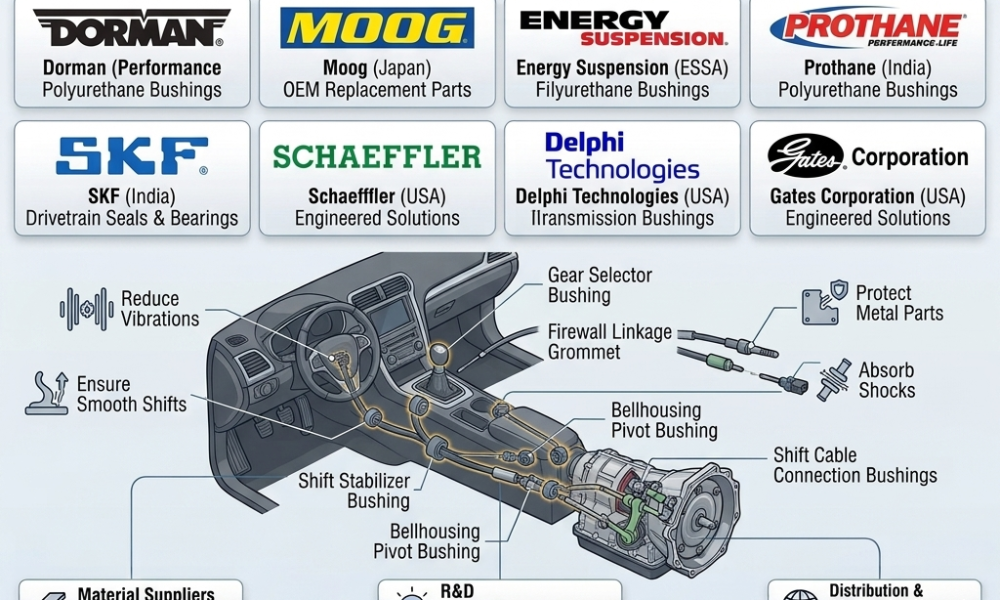
Competition increasingly focuses on material quality, fitment accuracy, application coverage, polymer expertise, and aftermarket catalog depth. Dorman Products and Freudenberg, alongside other aftermarket suppliers, compete through molded-component expertise, broad application coverage, and workshop-oriented replacement solutions.
Material engineering remains an important competitive factor because bushings must withstand repeated movement, vibration, temperature changes, and environmental exposure. Suppliers must balance flexibility with resistance to deformation and wear.
Catalog accuracy is also becoming increasingly important. A bushing that matches the correct cable end, selector linkage, pivot point, and vehicle application can reduce installation errors and avoid unnecessary replacement of larger assemblies.
For aftermarket distributors, product availability across a wide range of vehicle applications can strengthen channel performance. Repair businesses increasingly prefer parts that can be identified quickly and installed without extensive modification.
What Does the Analyst Say About the Transmission Linkage Bushings Market?
“Transmission linkage bushings are evolving from inexpensive molded components into critical service parts that improve shift performance, repair efficiency, and long-term drivetrain reliability. Buyers increasingly evaluate replacement bushings based on fitment accuracy, material durability, shift feel restoration, and long-term wear resistance. Suppliers offering validated materials, comprehensive vehicle coverage, and workshop-friendly packaging are expected to strengthen long-term customer relationships. Companies capable of combining advanced polymer technology with accurate cataloging and dependable aftermarket support are likely to establish stronger competitive positions.”
— Nikhil Kaitwade, Principal Consultant at Future Market Insights
What Is Driving Demand for Transmission Linkage Bushings?
Aging Vehicle Fleets and Wear-related Repairs
As vehicles remain in service for longer periods, small linkage components can become important sources of looseness and degraded selector feel. Replacing worn bushings can provide a lower-cost repair route than replacing a complete cable or linkage assembly.
Cost-conscious Aftermarket Repairs
Repair shops and vehicle owners increasingly seek component-level solutions when a worn bushing is the primary cause of a shift-quality issue. This creates demand for replacement products that restore function while limiting repair-ticket costs.
Automatic Transmission Applications
Automatic transmission systems represent 52.4% of 2026 market revenue by transmission type. The extensive installed base of automatic vehicles creates recurring requirements for selector-linkage and cable-end components.
Exact Fitment and Catalog Coverage
Vehicle-specific dimensions, mounting arrangements, cable ends, and linkage geometries make application accuracy important. Suppliers with comprehensive catalogs can help distributors and workshops identify suitable replacements across mixed vehicle fleets.
What Are the Key Market Restraints?
The increasing electrification of vehicles may gradually alter the addressable market for conventional transmission linkage components. Some EV architectures use different drivetrain control arrangements and may require fewer traditional mechanical selector interfaces.
Material degradation can also vary with operating temperature, contamination, vibration, and repeated mechanical loading. Suppliers therefore need to validate polymer formulations and component geometry across different vehicle applications.
What Opportunities Exist for Transmission Linkage Bushing Manufacturers?
The aftermarket provides a significant opportunity for manufacturers capable of offering vehicle-specific repair solutions. Component-level bushing replacements can address service needs where complete assembly replacement would be unnecessarily expensive.
Suppliers can also expand opportunities through improved cataloging, installation instructions, repair kits, and packaging that helps workshops identify the correct application quickly.
Polymer engineering provides another opportunity. Advanced rubber, polyurethane, nylon, engineering plastics, and metal-reinforced designs can be developed for different durability and performance requirements across passenger, commercial, and off-highway vehicles.
How Is the Transmission Linkage Bushings Market Segmented?
The transmission linkage bushings market is segmented by material, transmission type, vehicle type, sales channel, application, and region.
By Material: Rubber Bushings, Polyurethane Bushings, Nylon / Engineering Plastic, Metal-reinforced Bushings.
By Transmission Type: Manual Transmission, Automatic Transmission, DCT / AMT, Commercial Vehicle Transmission.
By Vehicle Type: Passenger Cars, Light Commercial Vehicles, Heavy Commercial Vehicles, Off-highway / Other Vehicles.
By Sales Channel: OEM, Aftermarket.
By Application: Shift Linkage, Selector Linkage, Cable End / Pivot Joint.
By Region: North America, Europe, East Asia, South Asia and Pacific, and other regional markets.
Drive Your Business Growth Strategy: Checkout the Report for Key Insights!
https://www.futuremarketinsights.com/checkout/33683
Why Do Rubber Bushings Lead the Material Segment?
Rubber bushings are projected to account for 57.6% of 2026 revenue. Their combination of flexibility, vibration isolation, and resistance to repeated mechanical movement makes them suitable for linkage interfaces where controlled movement and noise reduction are required.
Why Does Automatic Transmission Account for the Largest Transmission Segment?
Automatic transmission applications are expected to represent 52.4% of 2026 revenue. The large installed base of automatic passenger vehicles and continued use of selector cable mechanisms support demand for replacement bushings.
Why Do Passenger Cars Dominate Vehicle-Type Demand?
Passenger cars are projected to account for 68.2% of 2026 revenue. High vehicle volumes and the extensive installed fleet create recurring replacement opportunities as linkage components age.
How Is Aftermarket Demand Developing?
Aftermarket demand is increasingly connected to repair economics. When a worn bushing causes selector looseness or degraded shift feel, replacing the individual component can provide a lower-cost alternative to complete cable assembly replacement.
What Are the Drivers, Restraints and Opportunities in the Transmission Linkage Bushings Market?
The market is increasingly shaped by aging vehicle fleets, component-level repair economics, material durability, and demand for accurate aftermarket fitment.
- Driver: Growing replacement demand from aging vehicle fleets and automatic transmission applications.
- Restraint: Electrification can reduce demand for some conventional mechanical transmission interfaces.
- Opportunity: Vehicle-specific bushing catalogs, advanced polymer formulations, and workshop-focused replacement kits.
What Is the Transmission Linkage Bushings Market Demand Outlook?
The market is projected to increase from USD 620.6 million in 2026 to USD 1,001.3 million by 2036, reflecting a 4.9% CAGR. Demand will continue to be influenced by vehicle production, fleet age, transmission architecture, and the economics of component-level repairs.
For OEM buyers, material durability and consistent linkage performance remain central requirements. For aftermarket distributors and workshops, accurate fitment and product availability become increasingly important as vehicle populations become more diverse.
Shift Feel and Component Wear Analysis
Transmission linkage bushings influence the amount of play between selector mechanisms, cable ends, and linkage interfaces. Wear can contribute to looseness and changes in perceived shift quality.
This makes material selection and dimensional consistency important during component development. Suppliers must account for repeated movement, vibration, temperature exposure, and environmental conditions when validating bushing designs.
Aftermarket Repair Economics and Catalog Coverage Analysis
Component-level replacement can offer workshops a lower-cost repair route when only the bushing has deteriorated. This creates a distinct aftermarket opportunity for suppliers capable of identifying common failure points and providing vehicle-specific replacement solutions.
Catalog coverage becomes particularly important because transmission linkage configurations vary across vehicle platforms. Accurate application data can reduce incorrect part selection and help repair businesses complete jobs with fewer repeat visits.
Which Countries Are Growing Fastest in the Transmission Linkage Bushings Market?
India is projected to grow at 5.8% CAGR, followed by China at 5.4% and the United States at 4.6% through 2036. Regional demand is supported by vehicle production, aging fleets, aftermarket repair activity, and the continued need for cost-effective transmission linkage service solutions.
About Future Market Insights
Future Market Insights (FMI) is a leading provider of market research and consulting services, offering syndicated and customized research across industries including automotive, mobility, and advanced manufacturing. FMI provides market intelligence, competitive assessments, forecasts, and strategic insights to support business decision-making.



