
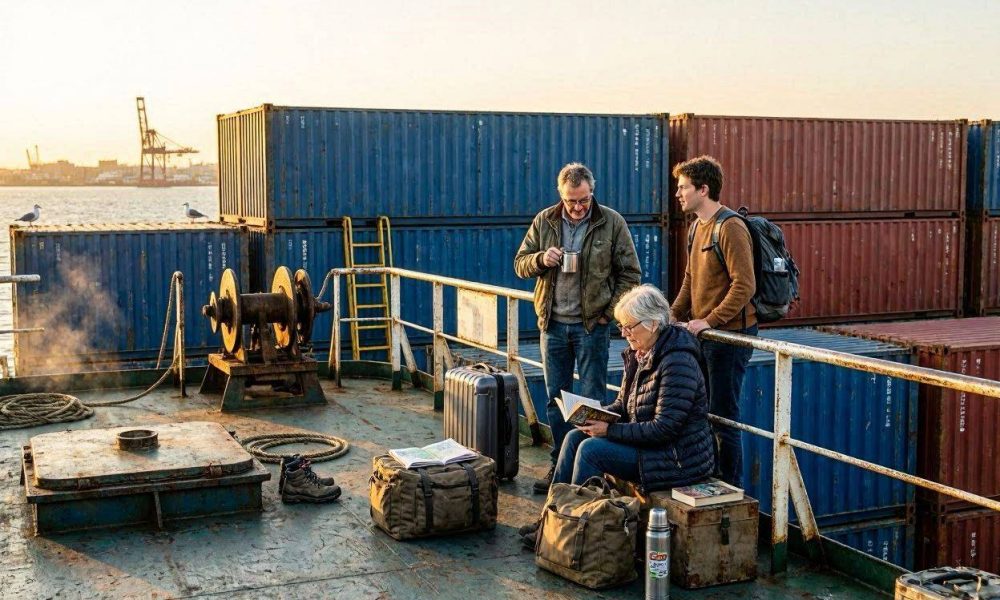
As sustainability becomes a top priority, eco-conscious adventurers are looking at container ships as a low-emissions alternative to flying across the oceans.
WASHINGTON, DC, May 30, 2026, The idea sounds almost too elegant for the climate-conscious traveler: skip the jet, avoid the airport, board a working cargo ship, and cross the ocean at the same slow pace as the goods that quietly power modern life.
The green appeal begins with an uncomfortable truth about flying.
Long-haul air travel remains one of the most carbon-intensive choices an individual traveler can make, especially when the journey crosses oceans and replaces days of slow movement with hours of high-altitude fuel burn.
For travelers trying to reduce their footprint without giving up international travel entirely, the cargo ship has emerged as a strange symbol of ethical patience, offering distance without the familiar environmental guilt associated with transatlantic or transpacific flights.
The appeal is especially strong among slow-travel advocates, climate-aware remote workers, and burned-out professionals who want a journey that feels less extractive, less rushed, and less dependent on the aviation economy.
Yet the environmental answer is not simple: cargo ships are efficient at moving freight per ton, but they are still enormous fossil-fuel machines operating within a global industry under pressure to decarbonize.
The real question is not whether ships are cleaner than planes in every case, but whether a passenger occupying an existing cabin on an already scheduled cargo route creates a lower additional footprint than booking a seat on a flight.
Cargo shipping is efficient, but not impact-free.
Container ships move extraordinary volumes of goods with far lower emissions per ton-mile than air freight, which is why ocean freight remains the backbone of global trade despite growing concern over maritime pollution.
That efficiency can make cargo ships seem like an obvious greener choice for passengers, but freight efficiency does not automatically translate into a clean passenger journey because ships burn heavy fuels, operate for long distances, and contribute meaningfully to global emissions.
A recent Reuters report on shipping decarbonization noted that the shipping sector accounts for nearly 3 percent of global greenhouse gas emissions, which makes it both essential to trade and impossible to ignore in climate policy.
The industry is investing in alternative fuels, efficiency technologies, and carbon-reduction strategies, yet progress remains uneven because ships are expensive, fuel infrastructure is limited, and global regulation depends on international agreement.
For eco-conscious travelers, this means cargo travel may be greener than flying in some circumstances, but it should not be romanticized as carbon-free, pure, or automatically sustainable.
The marginal-emissions argument is the heart of the debate.
Supporters of freighter travel often argue that the ship is sailing anyway, meaning an additional passenger in an available cabin may add very little marginal emissions compared with a dedicated passenger flight.
That argument has some intuitive strength because a container ship does not change course, add a voyage, or meaningfully increase fuel consumption because one traveler occupies a spare cabin already built into the vessel.
However, the calculation becomes less clear if passenger demand grows enough to influence ship design, hospitality services, port logistics, agency operations, or the need for additional passenger capacity that would not otherwise exist.
The greenest version of cargo travel is therefore highly specific: a small number of passengers using existing cabins on existing cargo routes without creating additional sailings, detours, or tourism infrastructure.
Once cargo travel becomes a consumer product rather than an incidental passenger option, the environmental case becomes more complicated and must be measured rather than assumed.
Compared with flying, time becomes the traveler’s biggest climate contribution.
A flight compresses an ocean crossing into hours, while a cargo ship may take one or two weeks, depending on route, ports, weather, delays, and vessel operations.
That time difference is precisely why the emissions comparison is not only technical but also philosophical: choosing the ship means accepting distance rather than defeating it with fuel-intensive speed.
For climate-aware travelers, the slower journey can reduce the impulse to take frequent short trips, encouraging fewer international moves, longer stays, and a deeper relationship with the destination.
The environmental benefit may therefore come less from the ship alone and more from the behavioral change it encourages, because someone willing to spend two weeks crossing an ocean is unlikely to treat distant cities as disposable weekend escapes.
Slow travel becomes greener when it reduces the total number of trips, lengthens stays, and replaces high-frequency air travel with fewer, more deliberate journeys.
Transportation emissions are forcing travelers to rethink old habits.
Climate-conscious travel is growing as more people recognize that transportation choices are central to personal and national emissions patterns.
The U.S. Environmental Protection Agency states in its transportation emissions guidance that transportation is the largest contributor to U.S. greenhouse gas emissions, which keeps travel behavior under scrutiny as governments and consumers look for lower-carbon alternatives.
That does not mean every person must stop traveling, but it does mean travelers are increasingly asked to think beyond ticket price, convenience, and reward points.
A journey now carries an ethical dimension, especially when the traveler has enough privilege, flexibility, and income to choose slower or lower-impact alternatives.
Cargo ship travel has entered that conversation because it challenges the assumption that crossing an ocean must be fast, routine, and disconnected from the environmental cost of speed.
The hidden emissions may happen before and after the voyage.
A cargo ship crossing may look greener than a flight on paper, but the full journey includes getting to the departure port, staying near terminals, reaching the arrival city, and managing any extra accommodation required because schedules are uncertain.
Ports are often far from tourist centers, and travelers may need taxis, trains, hotels, replacement flights, or backup plans when maritime schedules shift around cargo operations.
Emissions can reduce the advantage of the voyage, especially if the traveler must fly to reach the ship or fly again after disembarking.
The cleanest version of the journey is therefore one where the traveler can reach the port by rail or low-emission ground transport, board an already scheduled vessel, and remain at the destination long enough to justify the slow crossing.
A freighter is not a magic solution if the traveler builds a high-emission itinerary around it.
Cargo ship travel is not the same as cruise travel.
The environmental case for cargo travel should not be confused with cruise tourism, which often involves large passenger vessels designed around hospitality, entertainment, high energy use, and port-intensive itineraries.
A container ship passenger is joining a working freight route, while a cruise passenger is joining a vessel whose entire business model exists to provide a leisure experience.
That distinction matters because cruise ships may carry thousands of passengers, operate hotel-like systems, and generate emissions tied directly to tourism demand.
Cargo ship travel is usually smaller, quieter, and incidental to freight movement, which is why its marginal footprint may be lower when cabins are limited, and voyages occur regardless of passenger bookings.
Still, both forms of sea travel depend on maritime fuel, port infrastructure, and global shipping systems that remain under climate pressure.
The industry’s fuel transition will determine the long-term answer.
The environmental promise of cargo travel will improve only if the shipping industry itself becomes cleaner through lower-carbon fuels, efficiency upgrades, wind assistance, routing technology, port electrification, and stricter emissions standards.
Alternative fuels such as methanol, ammonia, and hydrogen-derived fuels are being explored, but each faces challenges around cost, safety, availability, production emissions, and ship retrofitting.
For travelers, this means the same route could become greener over time if the vessel uses cleaner fuel or operates under stricter emissions rules, while another route may remain heavily dependent on fossil fuels.
The passenger’s footprint, therefore, depends not only on choosing sea over air but on the ship, the fuel, the route, the occupancy, the port logistics, and the broader decarbonization path of maritime trade.
The simple answer, “ship good, plane bad,” is emotionally satisfying but technically incomplete.
Sustainability also depends on how often people move.
A traveler who replaces one annual transatlantic flight with a slow cargo crossing and stays abroad for several months may reduce emissions more meaningfully than a traveler who takes a one-time freighter trip but continues flying frequently throughout the year.
The climate issue is not only about the mode of transport but also about the rhythm of life that the mode encourages.
Slow travel works best when it changes habits, making fewer journeys feel more valuable and turning distance into something respected rather than constantly overcome.
That behavioral shift is why cargo travel appeals to people who are rethinking not only aviation, but the entire consumer logic of fast tourism.
The greener traveler is not simply the person who boards a ship, but the person who learns to move less often, stay longer, and treat each journey as consequential.
The practical barriers keep freighter travel in a niche.
Cargo ship passenger travel is not widely available, and travelers who imagine booking a cabin like a cruise may be surprised by limited routes, medical requirements, age restrictions, port rules, and changing schedules.
Some operators have reduced or suspended passenger options in recent years, and availability can depend on safety rules, crew policies, insurance requirements, and geopolitical conditions.
The traveler must also accept that a working vessel does not exist to entertain passengers, meaning meals, cabins, internet, social life, and daily routine may be sparse compared with mainstream tourism expectations.
That limitation is part of the environmental appeal because scarcity prevents cargo travel from becoming mass tourism, but it also means the option is available mainly to people with time, flexibility, and tolerance for uncertainty.
For most travelers, trains, ferries, longer stays, and fewer flights may be more practical sustainability tools than an ocean freighter.
Slow travel often leads to deeper questions about relocation.
Many people first consider cargo travel because they want a greener way to cross oceans, but the deeper impulse is often a desire to live differently, consume less speed and build a more deliberate relationship with place.
That can lead travelers to explore longer stays, seasonal relocation, second residences, or lawful international bases that reduce the need for repeated long-haul flights.
For those considering a more permanent overseas life, professional planning for residency and citizenship solutions can become relevant when the objective shifts from a single greener journey to a structured global lifestyle.
That transition matters because sustainability is easier when mobility is planned around legal residence, stable banking, health coverage, and fewer emergency movements.
A person who belongs somewhere for longer can often travel less, waste less, and avoid the high-carbon churn that comes from treating every destination as temporary.
The greener choice may also be the quieter choice.
Many travelers drawn to freighters are not only thinking about carbon, but also seeking silence, separation from screens, and a slower experience of the world.
The voyage becomes a climate decision, but also a psychological one, because the ship strips travel down to time, weather, distance, and the industrial reality of global movement.
For burned-out professionals, that quiet can feel like a form of repair, especially after years of airports, notifications, video calls, and itineraries built around maximum efficiency.
The environmental and emotional appeals, therefore, reinforce each other because a slower traveler often consumes fewer experiences, takes fewer flights, and becomes more aware of the systems that make movement possible.
A cargo ship crossing may reduce emissions in some cases, but it also reduces the illusion that distance can be ignored.
Privacy, sustainability, and mobility are starting to overlap.
Some travelers seeking slower, lower-impact travel also want privacy, discretion, and a less-exposed lifestyle, especially as work, finances, and social identity become increasingly visible online.
For individuals who want secure mobility without evasion, professional anonymous living planning can sit within a lawful framework when the goal is safety, discretion, and compliant residence rather than hidden movement or undocumented work.
That distinction matters because sustainable travel should not become a cover for avoiding tax, immigration rules, employment obligations or financial transparency.
The cleanest global lifestyle is not only lower-carbon, but also legally stable, properly documented, and built around realistic long-term responsibilities.
As slow travel matures, the people who benefit most will be those who combine environmental awareness with lawful planning, financial discipline, and a willingness to stay put when staying put is the greener choice.
The bottom line is that cargo travel can be greener, but only under the right conditions.
Catching a lift on a cargo ship may be a lower-emissions way to cross an ocean when the passenger joins an existing route, avoids extra flights around the voyage, and uses the journey to reduce overall travel frequency.
It is not automatically green because shipping remains a major global source of emissions, and the true footprint depends on the route, fuel, ship efficiency, port logistics, and whether the passenger creates additional demand.
For eco-conscious adventurers, the freighter’s real value may be that it forces a different relationship with distance, replacing speed with patience and turning transit into part of the ethical decision.
The most sustainable lesson is not that everyone should board container ships, but that travelers should move less often, stay longer, and stop treating the atmosphere as the invisible cost of convenience.
For the public record, cargo ship travel is not a perfect climate solution, but it is a powerful symbol of a new travel ethic that asks whether the greener journey begins when people finally stop rushing across the planet.




