
Definition
An Integrated Smart POS System is an advanced electronic solution that merges payment processing capabilities with comprehensive business management functionalities. Unlike traditional point-of-sale (POS) terminals, these systems are equipped to manage inventory tracking, sales analytics, customer relationship management (CRM), and employee management – all from a single platform.
Modern Smart POS systems leverage cloud computing, AI-driven analytics, and omnichannel retail functionalities, acting as centralized hubs that streamline both front-end and back-end operations in retail, hospitality, food service, and other commercial sectors.
Key features of Integrated Smart POS Systems include:
- Omnichannel Retail Integration: Supports sales and inventory synchronization across online and physical stores.
- AI-Driven Analytics: Offers real-time insights, predictive inventory management, and personalized customer recommendations.
- Contactless Payments: Includes NFC, EMV chip readers, QR code scanning, and mobile wallet support.
- Customizable Interfaces: Multi-screen setups, handheld devices, and kiosks cater to various operational needs.
- Cloud-Based Management: Enables centralized data access, remote monitoring, and seamless software updates.
Industries adopting Integrated Smart POS Systems benefit from enhanced operational efficiency, improved customer experience, and reduced human error, making these systems vital in the ongoing digital transformation of retail and service sectors.
Market Size
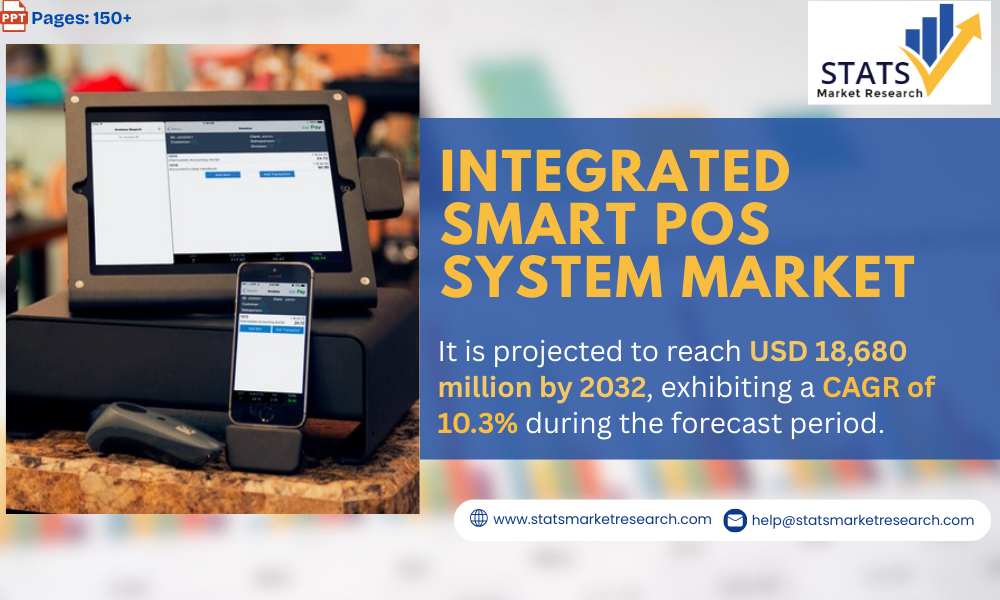
Global Integrated Smart POS System market was valued at USD 9,562 million in 2024 and is projected to reach USD 18,680 million by 2032, exhibiting a CAGR of 10.3% during the forecast period.
Download FREE Sample of this Report @ https://www.statsmarketresearch.com/download-free-sample/8061181/global-integrated-smart-pos-system-forecast-market
Key Market Drivers for Growth Include:
- Retail Digital Transformation:
- Modern retailers increasingly demand integrated solutions for payment, inventory, and analytics.
- Supermarkets, quick-service restaurants (QSRs), and convenience stores have adopted Smart POS systems to reduce transaction times by 30-45 seconds per customer, significantly improving throughput during peak hours.
- Surge in Contactless Payments:
- Contactless transactions have grown 3.5 times faster than traditional payment methods since 2020.
- NFC-enabled POS systems are becoming mandatory for modern retailers, particularly in Asia-Pacific, where mobile payment penetration in countries like China exceeds 80% of smartphone users.
- Cloud-Based Solutions:
- Cloud POS platforms reduce upfront costs by 40-60%, making systems accessible for SMEs.
- Subscription-based models further enhance affordability and scalability for smaller operators.
- AI and Omnichannel Integration:
- AI-powered analytics boost upselling and cross-selling opportunities, increasing average transaction values by 12-18%.
- Unified commerce platforms enable retailers to synchronize physical and digital sales channels, enhancing revenue and customer engagement.
Regional Highlights:
- North America: Dominates adoption with mature retail and technology infrastructure.
- Asia-Pacific: Fastest-growing market due to rapid urbanization, expanding retail sectors, and high mobile payment adoption.
- Europe and Latin America: Steady growth driven by modernization of retail operations and emerging omnichannel trends.
Market Dynamics (Drivers, Restraints, Opportunities, and Challenges)
Drivers
- Rising Retail Digitalization
- Increasing demand for unified platforms that integrate payments, inventory, and analytics.
- Operational efficiency gains, particularly in high-volume retail environments.
- Contactless Payment Adoption
- NFC, QR, and mobile wallet compatibility are becoming standard requirements.
- Supports consumer preferences for faster and safer payment methods.
- Cloud-Based Flexibility
- Reduced upfront costs and subscription-based models allow small retailers to adopt advanced POS systems.
- AI and Predictive Analytics
- Real-time sales insights, dynamic pricing, and inventory forecasting enhance revenue opportunities.
Restraints
- Integration Challenges with Legacy Systems
- 42% of POS modernizations face difficulties integrating with ERP or accounting platforms.
- Middleware solutions or backend overhauls increase costs.
- Data Security Concerns
- Cybersecurity threats are rising 23% annually in retail.
- Compliance with PCI DSS 4.0 adds $15,000-$50,000 per location for larger retailers.
- Workforce Training Gaps
- Average staff training requires 12-18 hours.
- High turnover in sectors like food service complicates implementation.
Opportunities
- AI-Powered Revenue Streams
- Predictive analytics and machine learning enable upselling, dynamic pricing, and personalized promotions.
- Supermarkets and convenience stores report significant increases in average transaction values.
- Omnichannel Retail Integration
- POS systems act as central hubs connecting online and offline channels.
- Bundled offerings with e-commerce solutions command 25-30% premium pricing.
- Cashierless Checkout Solutions
- Pilot programs indicate 40-60% labor cost reductions.
- Early adopters are positioned to capture significant market share as technology matures.
Challenges
- Hardware Fragmentation and Interoperability
- Proprietary architectures from major vendors create vendor lock-in scenarios with switching costs 300-400% higher than initial deployment.
- Average POS replacement cycles reduced to 3-5 years due to technological obsolescence.
- Infrastructure Limitations in Emerging Markets
- Power reliability and internet connectivity issues complicate deployments.
Regional Analysis
- North America: Largest market share due to strong retail digitalization, cloud adoption, and contactless payment penetration.
- Europe: Steady growth in QSRs and supermarkets, with cloud-based POS adoption increasing operational efficiency.
- Asia-Pacific: Fastest-growing region driven by urbanization, high smartphone penetration, and mobile payments.
- Latin America: Emerging growth in supermarkets, convenience stores, and hospitality sectors.
- Middle East & Africa: Gradual adoption focused on urban retail environments and government initiatives to modernize payment systems.
Get the Complete Report & TOC @ https://www.statsmarketresearch.com/global-integrated-smart-pos-system-forecast-market-8061181
Competitor Analysis
The Integrated Smart POS System market is highly competitive, featuring global tech giants and regional innovators:
- Toshiba Corporation (Japan): Leading with robust POS ecosystems and retail partnerships.
- NCR Corporation (U.S.): Market leader in cloud POS solutions and omnichannel integration.
- Diebold Nixdorf (U.S.): AI-driven inventory management solutions for multinational retailers.
- HP Inc. (U.S.): Android-based POS terminals focused on the food service sector.
- POSIFLEX (Taiwan) & Shiji Information Technology (China): Aggressive pricing and localized solutions for emerging markets.
Innovation and differentiation are key drivers, with major players investing in biometric authentication, predictive analytics, and modular hardware designs to maintain market leadership.
Global Integrated Smart POS System: Market Segmentation Analysis
This report provides a deep insight into the global Integrated Smart POS System market, covering all its essential aspects. This ranges from a macro overview of the market to micro details of the market size, competitive landscape, development trend, niche market, key market drivers and challenges, SWOT analysis, value chain analysis, etc.
The analysis helps the reader to shape the competition within the industries and strategies for the competitive environment to enhance the potential profit. Furthermore, it provides a simple framework for evaluating and assessing the position of the business organization. The report structure also focuses on the competitive landscape of the Global Integrated Smart POS System market. This report introduces in detail the market share, market performance, product situation, operation situation, etc., of the main players, which helps the readers in the industry to identify the main competitors and deeply understand the competition pattern of the market.
In a word, this report is a must-read for industry players, investors, researchers, consultants, business strategists, and all those who have any kind of stake or are planning to foray into the Integrated Smart POS System market in any manner.
Market Segmentation (by Application)
- Supermarket
- Food Service
- Convenience Store
- Retail
- Hospitality
- Others
Market Segmentation (by Type)
- Single Screen
- Subtypes: Compact, Standard, and others
- Dual Screen
- Mobile POS
- Subtypes: Tablet-based, Handheld, and others
- Self-Service Kiosk
- Others
Key Company
- Toshiba Corporation (Japan)
- NCR Corporation (U.S.)
- Diebold Nixdorf (U.S.)
- HP Inc. (U.S.)
- POSIFLEX (Taiwan)
- Fujitsu (Japan)
- NEC Corporation (Japan)
- Shiji Information Technology (China)
- Shanghai Sunmi Technology (China)
- Elo Touch Solutions (U.S.)
- Fujian Centerm Information (China)
- PAX Global Technology (China)
- Ingenico Group (France)
- VeriFone (U.S.)
Geographic Segmentation
- North America: U.S., Canada
- Europe: Germany, France, UK, Italy
- Asia-Pacific: China, India, Japan, South Korea
- Latin America: Brazil, Mexico, Argentina
- Middle East & Africa: UAE, Saudi Arabia, South Africa
FAQ
What is the current market size of the Integrated Smart POS System market?
The global market was valued at USD 9,562 million in 2024 and is projected to reach USD 18,680 million by 2032, growing at a CAGR of 10.3%.
Which are the key companies operating in the Integrated Smart POS System market?
Key players include:
- Toshiba Corporation (Japan)
- NCR Corporation (U.S.)
- Diebold Nixdorf (U.S.)
- HP Inc. (U.S.)
- POSIFLEX (Taiwan)
What are the key growth drivers in the Integrated Smart POS System market?
- Digitalization of retail operations
- Surge in contactless payment adoption
- Cloud-based POS solutions with AI-driven analytics
Which regions dominate the Integrated Smart POS System market?
- North America holds the largest share due to mature retail infrastructure.
- Asia-Pacific shows the highest growth potential due to rapid urbanization and mobile payment adoption.
What are the emerging trends in the Integrated Smart POS System market?
- AI-powered predictive analytics for sales and inventory
- Omnichannel and unified commerce integration
- Cashierless checkout and self-service kiosks
- Biometric authentication and modular hardware systems
About Us
☎️ International: +1 (332) 2424 294
📄 Website: www.statsmarketresearch.com
Join us on LinkedIn:- https://www.linkedin.com/company/statsmarketresearch




