
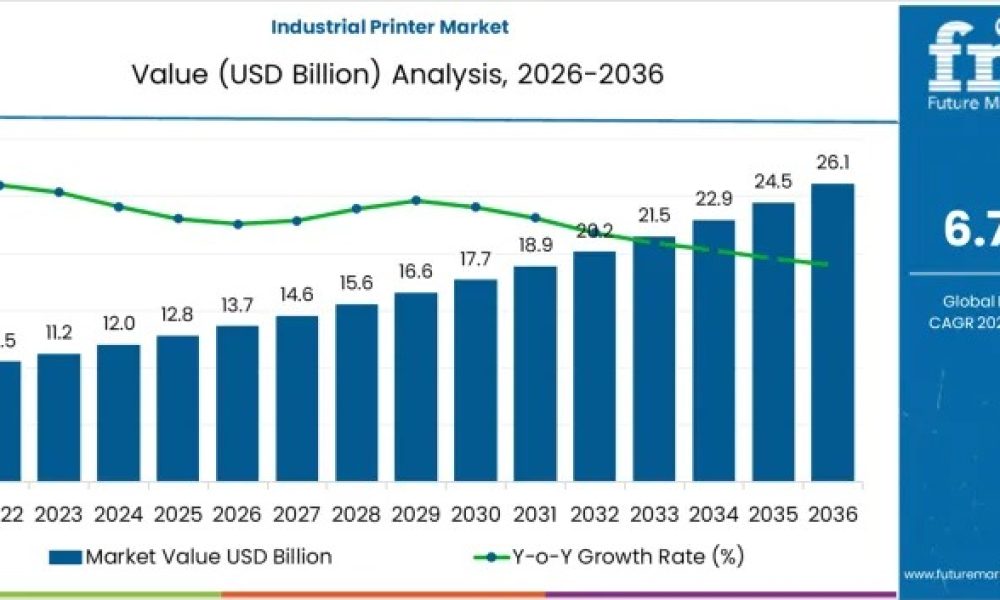
The industrial printer market is entering a decade of sustained structural growth as manufacturers across the globe strengthen their focus on automation, traceability, and regulatory compliance. Valued at USD 13.7 billion in 2026, the market is forecasted to reach USD 26.3 billion by 2036, expanding at a CAGR of 6.7%. Unlike consumer printing, industrial printing is not discretionary. It is deeply embedded within production systems where uninterrupted operation, permanent marking, and data accuracy are mandatory for shipment approval and compliance. Industrial printers are increasingly viewed as mission-critical infrastructure rather than optional capital equipment. Their value creation is anchored in installed base expansion and recurring consumable demand, making this market structurally resilient and operationally essential across manufacturing supply chains.
Industry Meaning
Industrial printers are specialized systems designed for high-volume, high-durability printing across manufacturing environments. They are primarily used for coding, marking, labeling, and serialization on substrates such as packaging materials, metals, plastics, glass, and textiles.
Unlike commercial printers, industrial printers operate under continuous duty cycles, often in harsh conditions involving dust, heat, vibration, and moisture. Their role extends beyond aesthetics; they ensure compliance with regulatory requirements, enable traceability, support inventory systems, and integrate directly with manufacturing execution systems (MES). From food packaging and pharmaceutical labeling to automotive parts marking and electronics identification, industrial printers form the digital interface between physical products and data systems.
Strategic Outlook
Strategically, the industrial printer market is aligned with long-term industrial megatrends: smart factories, traceable supply chains, and compliance-driven production. Growth is not fueled by replacement cycles but by capacity expansion and operational complexity.
Manufacturers increasingly deploy printers where production variability is high and regulatory exposure is significant. Serialization laws, product safety regulations, and global export documentation are reinforcing printer adoption as a structural requirement rather than a discretionary upgrade.
Inkjet printing dominates global demand due to its non-contact flexibility, speed, and compatibility with variable data, making it ideal for modern packaging and logistics environments. Meanwhile, regional demand concentrates in China, India, the USA, Germany, and Japan, where manufacturing density and compliance intensity are highest.
Market Evolution
Historically, industrial printing focused on basic batch coding and date marking. Over time, the market has evolved into a sophisticated ecosystem supporting:
- Track-and-trace systems
- Multilingual compliance labels
- Anti-counterfeiting measures
- Automated data exchange
The shift from static to dynamic data printing has transformed printers into data-driven production assets. Today’s systems integrate seamlessly with enterprise software, enabling real-time printing of barcodes, QR codes, serial numbers, and product identifiers.
The evolution reflects how manufacturing itself has changed from linear mass production to highly customized, regulated, and digitally monitored operations.
Request For Sample Report | Customize Report |purchase Full Report – Sample link
Growth Opportunities
Several structural opportunities are driving long-term market expansion:
- Contract manufacturing growth – Outsourced production increases reliance on standardized coding systems.
- Pharmaceutical expansion – Batch coding, expiry marking, and serialization are mandatory.
- Logistics automation – Barcode and shipping label printing in warehouses and fulfillment centers.
- Customization and short runs – Variable data printing supports product personalization.
- Anti-counterfeiting initiatives – Permanent and tamper-resistant marking systems.
- Smart factories – Integration with Industry 4.0 workflows and IoT systems.
Emerging manufacturers are also entering the market with cloud-connected printers, modular designs, and AI-assisted maintenance platforms, expanding competitive diversity.
Demand Patterns
By application, packaging and labeling dominate with 52% share, reflecting how regulatory compliance and branding have become inseparable from production. Industrial manufacturing, electronics, pharmaceuticals, and automotive sectors follow, each with specialized marking needs.
Country-level demand highlights:
- China (8.1% CAGR) – Electronics, consumer goods, export compliance.
- India (7.9% CAGR) – Pharmaceuticals, food packaging, regulatory formalization.
- USA (7.4% CAGR) – Serialization laws, reshoring, automation.
- Germany (6.6% CAGR) – Precision manufacturing, Industry 4.0.
- Japan (6.2% CAGR) – Electronics, quality assurance, replacement demand.
Demand intensity correlates directly with production density, compliance exposure, and automation penetration.
Technology Trends
Technology is redefining competitive advantage in industrial printing. Key trends include:
- High-speed inkjet systems with improved resolution and lower maintenance.
- Laser marking for permanent, solvent-free coding.
- Thermal transfer printing for high-contrast labels.
- Smart connectivity with MES and ERP systems.
- Predictive maintenance using sensor data.
- Eco-friendly inks and low-emission technologies.
- Compact modular printers for decentralized facilities.
Manufacturers are also focusing on printhead longevity, consumable efficiency, and environmental stability, as these factors directly influence total cost of ownership.
Competitive Landscape
The industrial printer market is moderately consolidated, with global leaders dominating through scale, service networks, and technology depth.
HP Inc. leads the market with a broad portfolio of industrial inkjet systems used in packaging, large-format printing, and logistics applications. Its strength lies in global service infrastructure and integration with digital workflows.
Seiko Epson (Epson) is a major player in industrial inkjet and label printing platforms, known for precision engineering and high-speed performance.
Canon offers industrial printing solutions across commercial and specialty segments, focusing on automation-ready platforms and digital integration.
Brother International supports demand with durable industrial label printers widely deployed in manufacturing and logistics environments.
Xerox contributes industrial digital presses and workflow software that enhance automation and variable data printing.
Alongside these leaders, emerging manufacturers are developing cloud-native systems, AI-powered diagnostics, and subscription-based consumable models, challenging traditional ownership economics.
Competition increasingly centers on uptime reliability, service quality, integration flexibility, and lifecycle cost, rather than hardware pricing alone.
Executive-Level Insights
- Market Size (2026): USD 13.7 billion
- Market Forecast (2036): USD 26.3 billion
- Growth Rate: 6.7% CAGR
- Leading Technology: Inkjet printing (46%)
- Top Application: Packaging & labeling (52%)
- Fastest Growth Regions: China, India, USA
- Core Drivers: Traceability, compliance, automation
- Strategic Differentiators: Uptime, service, consumables efficiency
Conclusion
The industrial printer market is no longer defined by hardware alone. It is now a data-driven, compliance-centric infrastructure layer embedded within global manufacturing systems. From pharmaceuticals and food packaging to automotive components and e-commerce logistics, industrial printers enable the digital traceability that modern supply chains require.
Between 2026 and 2036, growth will be shaped by automation intensity, regulatory persistence, and smart factory adoption. Companies that invest in connectivity, predictive maintenance, and service ecosystems will define the next generation of industrial printing leadership. In a world where every product must be identifiable, traceable, and compliant, industrial printers are not just tools they are the silent enablers of industrial trust and operational continuity.
Why FMI: https://www.futuremarketinsights.com/why-fmi
About Future Market Insights (FMI)
Future Market Insights, Inc. (FMI) is an ESOMAR-certified, ISO 9001:2015 market research and consulting organization, trusted by Fortune 500 clients and global enterprises. With operations in the U.S., UK, India, and Dubai, FMI provides data-backed insights and strategic intelligence across 30+ industries and 1,200 markets worldwide.
Contact Us:
Future Market Insights Inc.
Christiana Corporate, 200 Continental Drive,
Suite 401, Newark, Delaware – 19713, USA
T: +1-347-918-3531
For Sales Enquiries: [email protected]



