
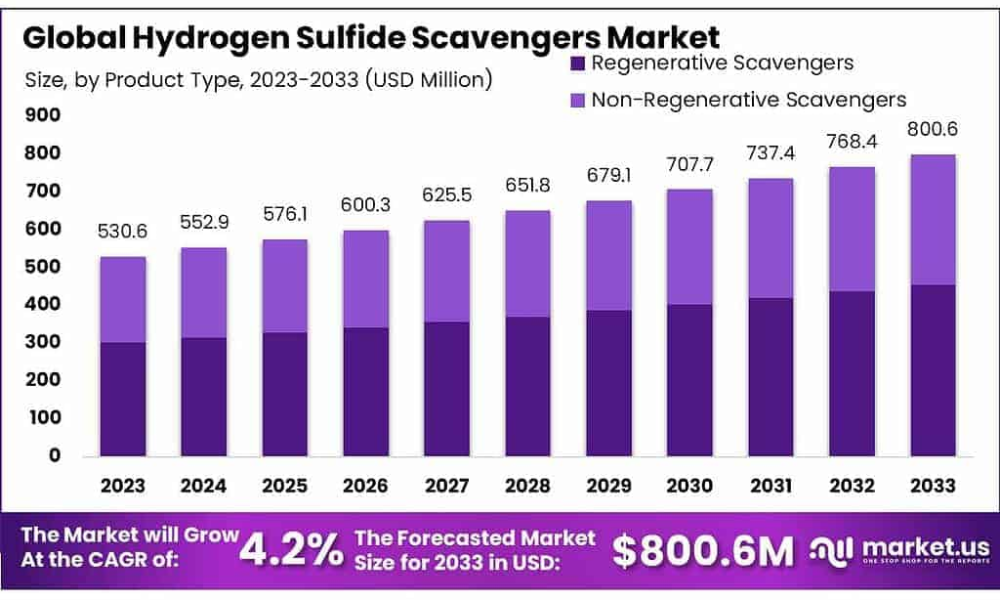
New York, NY – July 08, 2025 – The Global Hydrogen Sulfide Scavengers Market is growing steadily, driven by increasing demand from industries like oil & gas, water treatment, and chemicals. In 2023, the market was valued at USD 530.6 million and is projected to reach USD 800.6 million by 2033, expanding at a CAGR of 4.2% from 2024 to 2033.
This growth is fueled by stricter environmental regulations, rising energy needs, and the need to remove toxic hydrogen sulfide (H₂S) from industrial processes. The oil & gas sector remains the largest consumer due to H₂S contamination in crude oil and natural gas, while water treatment applications are gaining traction due to rising concerns over clean water supply. Market popularity is rising as companies adopt efficient and cost-effective scavengers like triazine-based and non-triazine alternatives.
Opportunities lie in developing eco-friendly and high-performance scavengers, especially in emerging regions like Asia-Pacific and the Middle East, where industrial expansion is rapid. Additionally, advancements in scavenger technologies and increasing shale gas exploration are expected to further drive market expansion. With growing environmental awareness and industrial demand, the hydrogen sulfide scavengers market is set for significant opportunities in the coming decade.
Important Revelation
- Market Growth: Projected to reach USD 800.6 Million by 2033, the Hydrogen Sulfide Scavengers Market exhibits a robust 4.2% CAGR from 2023.
- Regenerative Dominance: Regenerative Scavengers, holding a significant 54% market share, are favored for reusability, generating less waste in continuous operations.
- Formulation Preference: Liquid Scavengers, leading in 2023, are versatile and efficient, especially in the Oil & Gas, Petrochemicals, and Water Treatment industries.
- Applications Across Industries: Oil and Gas, with over 43.5% market share, utilizes scavengers in exploration, transportation, refining, and processing for safety and compliance.
- Market Drivers: Stringent regulations, increased exploration activities, and environmental concerns drive demand for effective hydrogen sulfide removal solutions.
- Restraints: Implementation costs, technological challenges, and safety risks limit scavenger adoption, hindering market expansion to some extent.
- Innovation Opportunities: Advancements in scavenging technologies offer opportunities for more potent and versatile solutions, catering to diverse industrial requirements.
- Regional Dominance: Asia Pacific, with over 36.10% revenue share in 2023, focuses on innovative infrastructure solutions, while Europe anticipates growth through energy-efficient systems.
➤ Download Exclusive Sample Of This Premium Report (Including Full TOC, Table & Figures): https://market.us/report/hydrogen-sulfide-scavengers-market/request-sample/
Report Segmentation
By Product Type
- Regenerative hydrogen sulfide scavengers market dominated the market in 2023, securing a commanding 54% share. Their widespread adoption is primarily due to their reusability, which enables multiple usage cycles after regeneration. This feature not only reduces waste but also offers long-term cost benefits, making it particularly suitable for industries with continuous or long-term hydrogen sulfide treatment needs. These include sectors engaged in ongoing production processes where operational efficiency and sustainability are paramount.
- In contrast, non-regenerative scavengers, while effective in removing hydrogen sulfide, are designed for single-use applications. Once utilized, they cannot be regenerated and must be discarded. This limits their suitability for prolonged operations but makes them ideal for short-term or one-off applications where immediate H2S removal is required. Their lower sustainability and cost-efficiency in the long run, however, make them a less preferred option in industries focused on long-term environmental goals.
By Formulation
- Liquid scavengers held the largest market share in 2023 due to their broad applicability and efficiency across industries such as oil & gas, petrochemicals, and water treatment. Their ease of use and reliable performance make them the preferred formulation for a wide range of H2S mitigation processes.
- Solid scavengers also captured a significant portion of the market. Offered in pellets or granules, these are valued for their long shelf life and stable performance, making them ideal for extended-release applications or where long-term action is needed, such as in industrial maintenance. Powder scavengers, known for their fast-reacting properties, are favored in sectors like mining where rapid and immediate H2S removal is critical.
By Application
- The oil and gas industry emerged as the leading application segment in 2023, accounting for over 43.5% of the hydrogen sulfide scavenger market. Within this sector, upstream operations such as drilling and extraction extensively utilize scavengers to ensure safe handling of H2S at the wellhead. In midstream activities, including transport and storage, scavengers help protect infrastructure from corrosion and ensure regulatory compliance. Downstream operations rely on these chemicals during refining and processing to purify hydrocarbons and eliminate sulfur content, ensuring both safety and product quality.
- The petrochemical industry is another significant end user, where scavengers are applied to remove H2S from feedstocks and intermediates, ensuring product integrity and safety standards. In the pulp and paper sector, these compounds are integral to bleaching operations, reducing emissions and maintaining output quality. Mining operations also depend heavily on the hydrogen sulfide scavengers market, especially during ore processing and refining stages. Their usage helps reduce toxic emissions, safeguarding worker health and supporting environmental compliance.
Market Key Segmentation
Product Type
- Regenerative Scavengers
- Non-Regenerative Scavengers
By Formulation
- Liquid Scavengers
- Solid Scavengers
- Powder Scavengers
Application
- Oil & Gas Industry
- Upstream (Exploration & Production)
- Midstream (Transportation & Storage)
- Downstream (Refining & Processing)
- Petrochemical Industry
- Paper & Pulp Industry
- Mining Industry
- Water Treatment Industry
- Others
Regional Analysis
In 2023, the Asia Pacific (APAC) region accounted for the largest share of the hydrogen sulfide scavengers market, capturing over 36.1% of total revenue. This dominance is projected to continue throughout the forecast period, driven by the region’s extensive infrastructure development and growing demand for innovative industrial solutions. Comprising more than 40 countries, many of which are recognized by the United Nations as developing or underdeveloped, the region presents substantial growth opportunities across multiple industries.
The demand for the hydrogen sulfide scavengers market in APAC is particularly strong in the construction of modern residential and commercial infrastructure. Rapid urbanization, especially in emerging economies such as India, is fostering the adoption of cost-effective and efficient scavenging technologies. Rising disposable incomes, lifestyle improvements, and an emphasis on advanced environmental control solutions are key factors supporting this trend.
In Europe, the hydrogen sulfide scavengers market is projected to expand at a notable Compound Annual Growth Rate (CAGR) during the forecast period. The region is witnessing a steady rise in the deployment of energy-efficient scavenging technologies and integrated control systems. Demand is being propelled by modern applications that prioritize safety and environmental compliance, particularly in residential settings, hospitality venues, cultural institutions, and commercial establishments.
Factors Affecting the Growth of the Hydrogen Sulfide Scavengers Market
- Growing Oil and Gas Industry Demand: The rising global demand for energy fuels oil and gas exploration, particularly in sour gas reservoirs with high H2S content. The hydrogen sulfide scavengers market is essential to remove toxic H2S gas, ensuring safety and equipment integrity, and driving market growth as production expands.
- Stringent Environmental Regulations: Governments worldwide enforce strict rules to control H2S emissions due to their toxic and corrosive nature. Industries like oil, gas, and wastewater treatment must use scavengers to comply, boosting demand for effective, eco-friendly solutions to meet regulatory standards.
- Technological Advancements in Scavengers: Ongoing research improves scavenger efficiency, cost-effectiveness, and environmental impact. Innovations like triazine-based and regenerative scavengers enhance H2S removal, attracting industries seeking advanced solutions and thus expanding the market with new, sustainable products.
- Rising Wastewater Treatment Needs: Increased industrial activity and stricter wastewater standards drive demand for H2S scavengers in treatment plants. They control odors and corrosion caused by H2S, ensuring compliance with regulations and supporting market growth in this sector.
- High Costs of Scavenger Solutions: The development and implementation of advanced H2S scavengers can be expensive, limiting adoption in price-sensitive regions. High operational costs for compliance and disposal of by-products may restrain market growth for smaller industries.
Competitive Landscape
- Suez SA
- Danaher Corporation
- Dorf-Ketal Chemicals India Private Limited
- Schlumberger Limited
- Halliburton Company
- Ecolab Inc.
- Arkema S.A.
Get in Touch with Us:
Market.us (Powered By Prudour Pvt. Ltd.)
Address: 420 Lexington Avenue, Suite 300, New York City, NY 10170, United States
Send Email: [email protected]
Refer To More Related Reports:



