

Overview
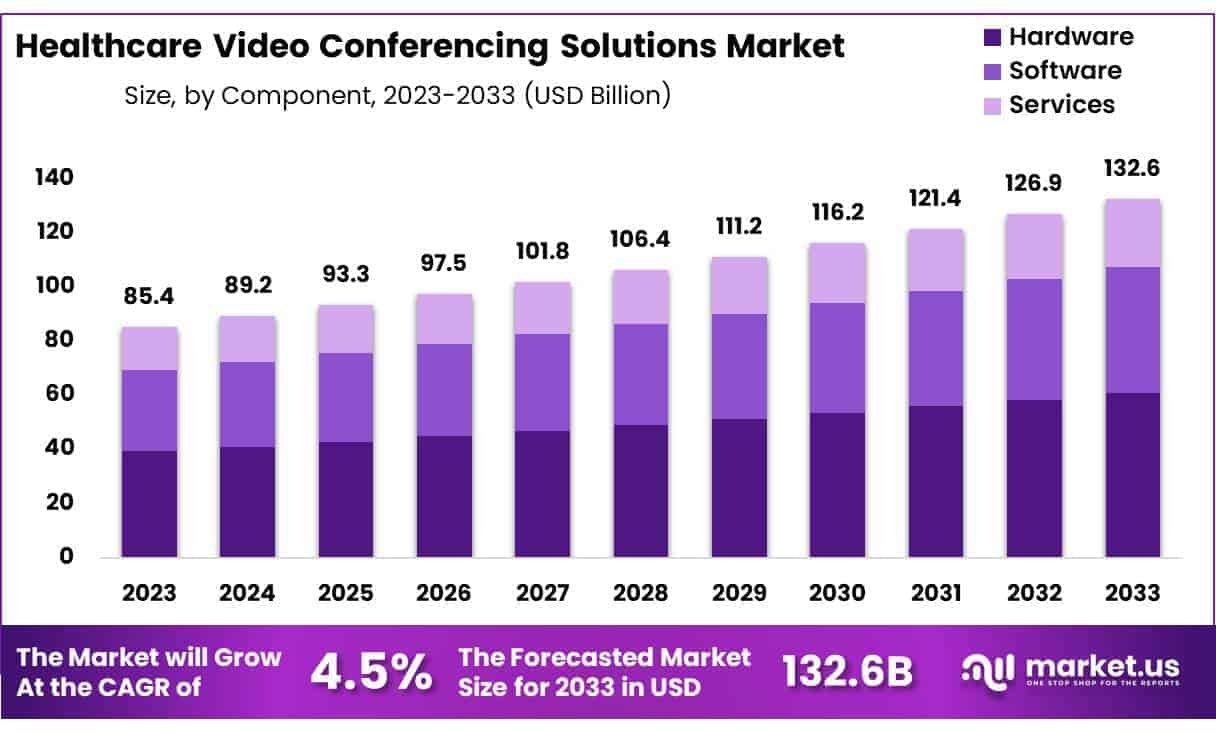
The Global Healthcare Video Conferencing Solutions Market size is expected to be worth around US$ 132.6 Billion by 2033 from US$ 85.4 Billion in 2023, growing at a CAGR of 4.5% during the forecast period from 2024 to 2033.
The global Healthcare Video Conferencing Solutions Market is witnessing robust growth, driven by the rising demand for remote patient care, increasing healthcare digitalization, and the growing adoption of telehealth services. These solutions enable real-time communication between patients and healthcare providers, enhancing clinical collaboration, reducing travel-related delays, and expanding access to specialized medical care, particularly in rural and underserved regions.
The market is being propelled by advancements in cloud technology, AI integration, and the proliferation of high-speed internet connectivity. Hospitals, clinics, and home healthcare providers are increasingly implementing video conferencing tools to conduct virtual consultations, follow-up appointments, and multi-disciplinary team discussions. These platforms also support remote diagnostics, mental health counseling, and chronic disease management.
According to industry analysis, the Healthcare Video Conferencing Solutions market is expected to grow significantly over the forecast period due to regulatory support for telemedicine, cost-efficiency in virtual care delivery, and patient preference for remote services. North America holds a dominant market share owing to advanced infrastructure, favorable reimbursement policies, and rising telehealth utilization. However, Asia-Pacific is projected to exhibit the fastest growth, attributed to expanding healthcare access and rising digital health investments.
Key players are focusing on product innovation, HIPAA-compliant platforms, and strategic partnerships to enhance service capabilities and maintain competitive advantage in this evolving healthcare landscape.
Click here to get a Sample report copy @ https://market.us/report/healthcare-video-conferencing-solutions-market/free-sample/
Key Takeaways
- Market Size: The Healthcare Video Conferencing Solutions Market is projected to reach approximately USD 132.6 billion by 2033, rising from USD 85.4 billion in 2023.
- Market Growth: The market is anticipated to expand at a compound annual growth rate (CAGR) of 4.5% during the forecast period from 2024 to 2033.
- Technology Analysis: On-premise video conferencing solutions dominated the market in 2023, accounting for a substantial 56% share due to their enhanced control and security features.
- Component Analysis: Hardware components held the leading position in 2023, contributing 46% to the total market share, supported by increased investments in telehealth infrastructure.
- Regional Analysis: North America led the global market in 2023, securing over 36.0% of total revenue, driven by advanced digital health ecosystems and favorable reimbursement policies.
- Security Concerns: Data protection remains a critical challenge, with healthcare providers required to implement stringent cybersecurity protocols to safeguard patient information and ensure compliance with regulations such as HIPAA.
- Expansion Opportunities: The market presents strong growth prospects in emerging economies, where improving healthcare infrastructure and increasing demand for accessible medical services are expected to accelerate adoption.
Segmentation Analysis
- Technology Analysis: The healthcare video conferencing market is segmented into on-premise and cloud-based systems. On-premise solutions dominate with a 56% share in 2023, favored for enhanced data control and customization. However, cloud-based systems are gaining traction due to their cost-efficiency, ease of deployment, and scalability. As cloud security improves, their adoption is expected to accelerate. This shift highlights evolving technological preferences in healthcare, driven by a balance between security needs and operational flexibility.
- Component Analysis: The market is categorized into hardware, software, and services. Hardware leads with a 46% market share in 2023, due to the necessity of physical infrastructure like cameras and microphones in healthcare setups. Software supports system functionality by enabling scheduling and integration into clinical workflows. Service components, including installation and maintenance, ensure seamless operation. Together, these segments reflect a well-distributed investment landscape essential for reliable and scalable healthcare video conferencing deployments.
Market Segments
By Technology
- On-premise
- Cloud-based
Component
- Hardware
- Software
- Services
To Purchase this Premium Report @ https://market.us/purchase-report/?report_id=128486
Regional Analysis
North America held a dominant position in the healthcare video conferencing solutions market in 2023, accounting for over 36.0% of the total revenue share. This leadership is driven by widespread adoption of telehealth technologies across healthcare institutions, alongside a strong presence of leading market players, particularly in the United States. The demand for reliable, high-quality virtual communication between providers and patients continues to support regional market expansion.
Meanwhile, the Asia Pacific region is projected to witness the fastest growth during the forecast period. Factors contributing to this surge include rapid advancements in mobile broadband technologies such as WiMAX and HSDPA, especially in nations like Japan and India. Increasing awareness of the benefits of video conferencing in enhancing healthcare accessibility and efficiency is expected to further drive adoption across emerging markets in the region.
Key Players Analysis
The report provides an in-depth assessment of key players in the Healthcare Video Conferencing Solutions Market, with a strong focus on their competitive positioning and corporate profiles. Each company is evaluated based on product and service portfolios, financial performance, strategic initiatives, market share, and geographic reach.
A detailed SWOT analysis is presented for the top three to five companies, identifying their core strengths, existing challenges, emerging opportunities, and competitive threats. This section also highlights strategic developments, including recent partnerships, mergers and acquisitions, and the launch of new solutions aimed at strengthening market presence.
The competitive landscape further features a ranking of the top five players, outlining their regional influence and sector-specific performance based on current market dynamics and the proprietary Ace matrix framework. To meet diverse client requirements, the report also offers customization options for the company profiles covered, ensuring tailored insights aligned with specific business objectives.
Market Key Players
- Adobe
- Pexip AS
- Zoom Video Communications, Inc.
- Intrado Corporation
- Vidyo, Inc.
- Plantronics, Inc.
- Logitech
- Huawei Technologies Co., Ltd.
- Cisco
- Avaya Inc.
Market Dynamics
- Market Driver: The primary driver of the Healthcare Video Conferencing Solutions Market is the growing demand for remote healthcare services. Rising adoption of telemedicine, driven by the need to improve patient access, reduce hospital visits, and minimize healthcare costs, is fueling market growth. Healthcare providers are increasingly integrating video conferencing solutions to enhance real-time communication, ensure continuity of care, and streamline clinical workflows, particularly in rural and underserved regions where in-person consultations are limited.
- Market Trend: A notable trend shaping the market is the integration of artificial intelligence (AI) and machine learning into video conferencing platforms. These technologies are enhancing diagnostic capabilities, automating patient triage, and improving virtual consultation outcomes. Additionally, the increasing use of cloud-based video conferencing solutions is enabling scalable and cost-effective deployment, especially for small to mid-sized healthcare facilities. As digital transformation accelerates, intelligent features like real-time analytics and automated transcription are becoming standard across healthcare video platforms.
- Market Opportunity: Significant market opportunities exist in emerging economies where healthcare infrastructure is evolving, and digital health adoption is accelerating. Countries in Asia Pacific, Latin America, and Africa are witnessing increased investments in broadband connectivity and mobile health technologies. With growing awareness of the benefits of virtual care and rising patient volumes, healthcare systems in these regions present untapped potential for video conferencing solution providers aiming to expand their global footprint and improve care delivery outcomes.
Conclusion
The Healthcare Video Conferencing Solutions Market is poised for steady expansion, driven by the increasing demand for remote care, technological advancements, and digital transformation in healthcare systems. With a projected market value of USD 132.6 billion by 2033 and a CAGR of 4.5%, the sector reflects strong growth potential.
On-premise systems currently lead, though cloud-based solutions are rapidly gaining ground. North America dominates the market, while Asia Pacific presents significant future opportunities. Continued innovation, strategic partnerships, and rising telehealth adoption will shape the competitive landscape and fuel long-term market development across global regions.
View More Reports:
Electrophysiology Market Set for 15.2% CAGR Through 2034
Radiology Information Systems Market To Reach USD 3.6 Billion By 2034
Generative AI in Pharmaceutical Market to Reach US$ 40.88 Billion by 2034



